Luggage in Japan: Coin Lockers, Takkyubin and Oversized Baggage Rules
Japanese trains were not built for suitcases, so Japan moves the suitcase separately. How luggage forwarding works, what the 160cm rule means, and what to do when every locker at the station is full.
 Signpost Japan
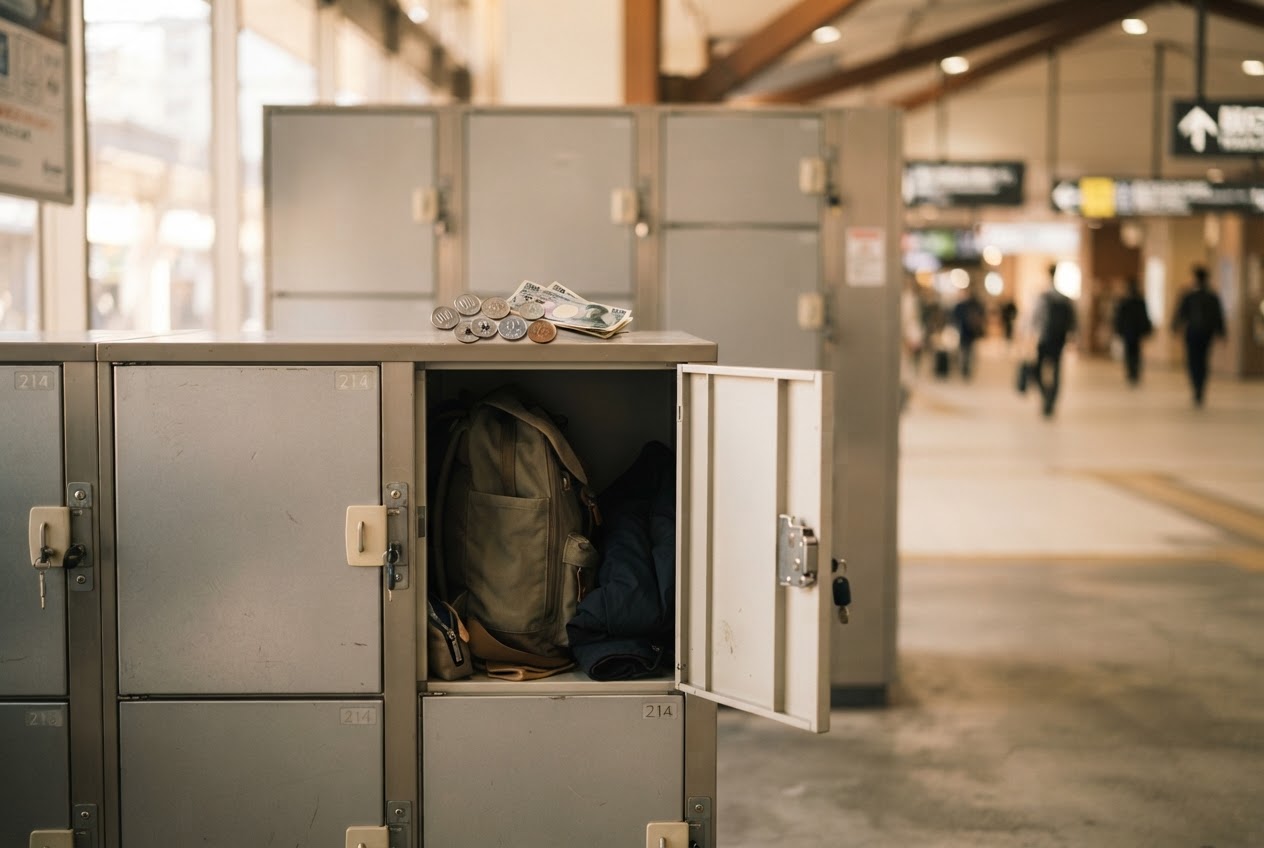
Nothing marks out a first-time visitor like dragging a large suitcase through a Tokyo ticket gate at 8:30 in the morning. Japanese trains have almost no luggage space by design, and the country solved the problem a different way: it sends your bag ahead of you.
Once you understand that, travelling in Japan gets substantially easier.
At a glance
- Forwarding
- Hotel to hotel, usually overnight, about 2,000 JPY per case
- Lockers
- 400–800 JPY a day depending on size. Full by 9am at popular stations.
- Shinkansen rule
- Bags over 160cm total need a free oversized baggage reservation
- Where to ask
- Any hotel front desk, any convenience store, airport arrival halls
- The habit to copy
- Travel between cities with a day bag, not a suitcase
Takkyubin: the thing to actually do
Takkyubin (宅急便) is next-day door-to-door delivery, and it is one of the great conveniences of Japanese life. Yamato Transport — the black cat logo — is the biggest operator, with Sagawa and the Japan Post service alongside.
For a traveller, it works like this: hand your suitcase to your hotel’s front desk before about 11am, fill in a form with the next hotel’s address, pay around 2,000 JPY, and the case is waiting for you when you arrive tomorrow.
Ask at the front desk the night before
Say “takkyubin”. Every hotel in Japan handles this, including small business hotels and most ryokan. They will give you a form.
Fill in the destination hotel, and the arrival date
Ask your next hotel to accept a delivery in your name — they always will. Write your name exactly as on the booking, and the date you arrive.
Hand it over before the morning cut-off
Usually around 11am for next-day delivery. Later than that, allow two days.
Travel with a day bag
One change of clothes, toiletries, chargers, valuables. Never send your passport, medication or anything you cannot replace.
Collect it at the next front desk
It will be behind the counter under your name.
Same-day airport delivery also exists in the other direction: hand your bag in at Narita, Haneda or Kansai arrivals and it reaches a city hotel that evening. That turns your arrival afternoon from a hotel errand into sightseeing.
Coin lockers
Every station of any size has banks of coin lockers, and larger stations have hundreds.
| Size | Fits | Rough price per day |
|---|---|---|
| Small | Day bag, camera bag | 400 JPY |
| Medium | Cabin case | 500–600 JPY |
| Large | Full-size suitcase | 700–800 JPY |
Most now take IC cards as well as coins, which is easier — you tap to lock and tap the same card to open. Keep the receipt if it gives you a code.
The problem is availability. At Kyoto, Tokyo, Shinjuku, Osaka and Kanazawa, the large lockers are gone by about 9am on any busy day, and in autumn in Kyoto they are gone earlier.
What to do when they are full:
- Luggage storage counters. Most big stations have a staffed baggage room, usually more expensive at 800–1,000 JPY per item, but never full.
- Ecbo Cloak. An app that lets you leave bags at participating cafés, shops and hotels. Book from your phone before you arrive.
- Your hotel. Both before check-in and after check-out, every Japanese hotel will hold your bags for free. This is standard and nobody minds.
- Convenience of the department store. Some large stores and shopping centres have free lockers for customers.
The Shinkansen 160cm rule
On the Tokaido, Sanyo and Kyushu Shinkansen, any bag whose height plus width plus depth exceeds 160cm requires a free oversized baggage seat reservation, made when you book. That reservation gives you a seat in the last row of the car, with the space behind it.
Turning up without one carries a surcharge of around 1,000 JPY and the crew will relocate your bag.
Under 160cm — which covers most cases up to about 28 inches — you use the overhead rack, which is deeper than an aircraft’s, or the space behind the back row if it is free.
Other Shinkansen lines and ordinary limited express trains do not have this rule, but they also do not have much space.
On ordinary trains
Urban commuter trains have overhead racks that will take a soft bag and not much else. At rush hour, a large suitcase is genuinely antisocial — you will be in the way and you will feel it.
If you must move with luggage in a city, travel between 10am and 4pm, use the end doors of the carriage where there is a small standing area, and stand your case in front of you rather than beside you.
Airports
All major airports have:
- Luggage delivery counters in arrivals, sending bags to city hotels
- Coin lockers, generally more available than at railway stations
- Storage counters for longer periods
Narita and Kansai both allow you to send a bag ahead to your departure airport at the start of a trip and collect it on the way out, which is useful if you are carrying ski gear or winter clothing you only need at one end.
At the front desk
Questions people actually ask
Is takkyubin reliable?
Extremely. Same-day and next-day delivery windows are met with the same precision as the trains. Loss is vanishingly rare.
Can I send luggage to an Airbnb or a hostel?
To a hostel, usually yes — ask first. To an unstaffed apartment rental, no, because someone has to sign for it. Send it to a convenience store for pickup instead, which Yamato supports.
What if my locker time expires?
After the daily cut-off, contents are moved to the station’s luggage office and you pay the accumulated fee to retrieve them. Nothing is thrown away.
Do I need the oversized baggage reservation for a normal suitcase?
Only if the three dimensions add up to more than 160cm. A standard 26–28 inch case is usually under. Measure before you travel if you are close.
Can I forward luggage to the airport for my flight home?
Yes, and it is common. Send it two days before to be safe, and confirm which terminal counter holds it.
Keep planning
Tokyo to Kyoto: Shinkansen, Night Bus or Plane?
The Shinkansen is the right answer for almost everyone: 2 hours 15 minutes, about 14,000 JPY, no check-in. Here is what the…
When Things Go Wrong: Missed Trains, Lost Tickets and the Last Train
You will miss a connection, feed the wrong ticket into a gate, or look up at 11:40pm and realise the last train…
Renting a Car in Japan: Licence, Tolls, ETC and Parking
The permit you must get before leaving home, why an ETC card matters more than the car, and the parts of Japan…