Renting a Car in Japan: Licence, Tolls, ETC and Parking
The permit you must get before leaving home, why an ETC card matters more than the car, and the parts of Japan where driving is not optional but essential.
 Signpost Japan
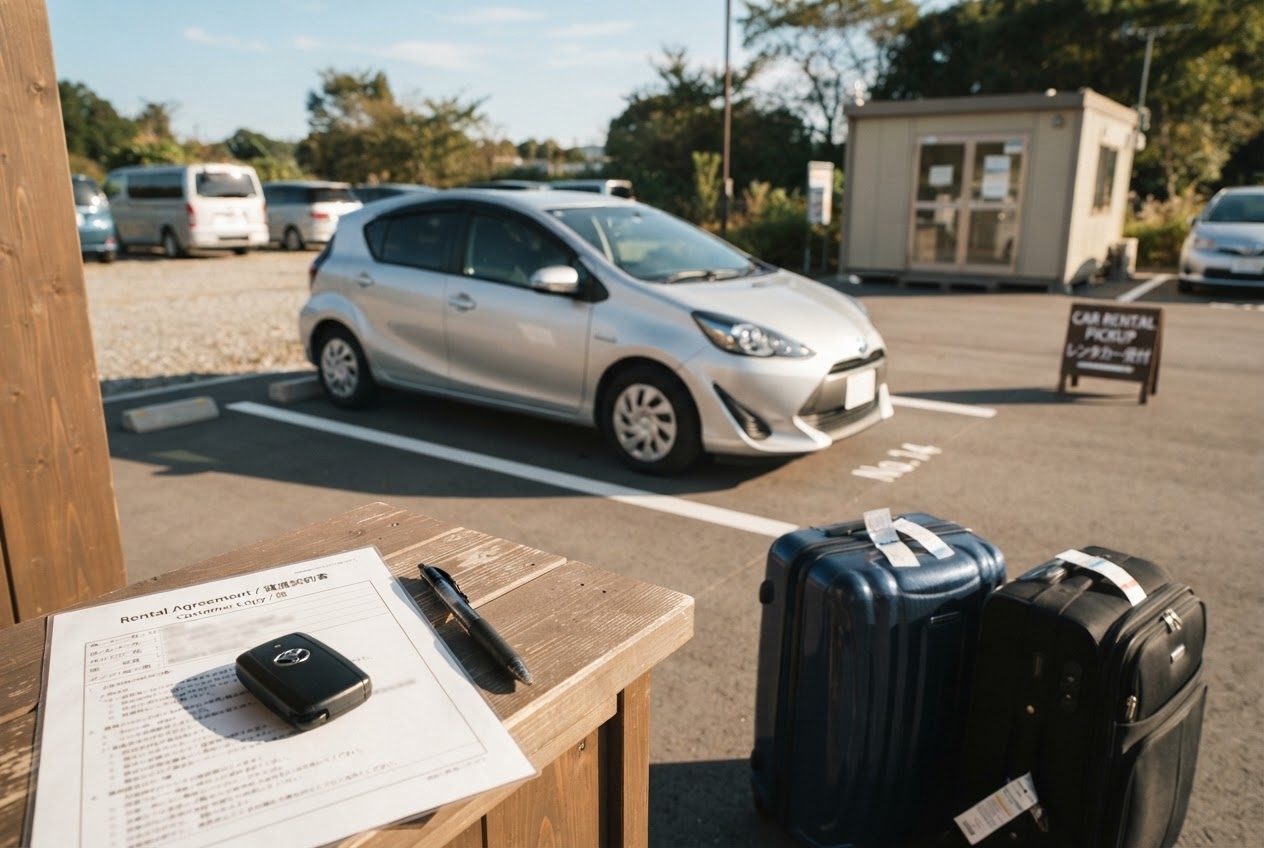
Most of Japan does not need a car. Trains reach almost every city worth visiting, and driving into Tokyo or Kyoto is an expensive way to make your day worse.
Then there is the other Japan: the Noto Peninsula, inland Kyushu, most of Hokkaido, the Japan Alps beyond the main valleys, Shikoku’s Iya Valley, the whole of rural Tohoku. Out there, buses run three times a day and stop at six in the evening, and a car is the difference between seeing a region and glimpsing it from a station.
At a glance
- Documents
- Home licence + International Driving Permit + passport. All three, every time.
- Drive on the
- Left. Right-hand drive cars.
- Typical cost
- 6,000–9,000 JPY a day for a compact, plus fuel and tolls
- Tolls
- Expensive. Tokyo to Osaka is roughly 12,000 JPY one way.
- The essential extra
- An ETC card for the tolls, or a foreign-visitor expressway pass
- Parking
- Paid, ubiquitous in cities, and the reason not to drive in one
Where driving is worth it
Hokkaido. The classic case. Distances are large, the rail network is thin, and the scenery is the point. Furano, Biei, Shiretoko and the Shakotan Peninsula are all much better by car.
The Noto Peninsula and Hokuriku coast. One railway line goes partway up and then stops.
Inland Kyushu. Aso, Kurokawa Onsen, Takachiho. The rail lines skirt the mountains; the roads go through them.
Shikoku’s interior. The Iya Valley and the Shimanami Kaido, where the cycling route is also a driving route.
Rural Tohoku and the Japan Alps. Anywhere with a national park in the name.
Where it is a mistake
Tokyo, Osaka, Kyoto, Nagoya, Fukuoka, Sapporo city centre. Parking costs 300–600 JPY per half hour, hotels charge separately for it, the roads are complicated, and the trains are better. Pick up your car when you leave the city and drop it before you return.
Booking
The three big chains — Toyota Rent a Car, Nippon Rent-A-Car and Times Car Rental — all have English sites and desks at airports and major stations. Nissan and Orix are also fine. Booking ahead is worth it in Hokkaido in summer and anywhere in Golden Week.
Cars are categorised by size class rather than model. A “compact” is a Toyota Yaris or similar; a “K-car” (軽) is the tiny yellow-plate class, cheap and legal but underpowered on mountain roads.
Automatic transmission is standard and is what you will get unless you go out of your way.
Tolls, and the ETC card
Japanese expressways are tolled, and the tolls are significant. Tokyo to Osaka is roughly 12,000 JPY each way in a normal car.
Tolls are collected electronically through ETC, a transponder system. Rental cars have the reader built in; you rent the card separately for a few hundred yen and the tolls are billed with the rental at the end. Without one you queue at the manned lane and pay cash, which works but is slower.
Better still, if your route is long: the foreign-visitor expressway passes.
| Pass | Area | Rough price |
|---|---|---|
| Hokkaido Expressway Pass | Hokkaido | From about 3,500 JPY for 2 days |
| Central Nippon Expressway Pass | Chubu, Fuji, Alps | From about 10,000 JPY for 3 days |
| Kyushu Expressway Pass | Kyushu | From about 3,500 JPY for 2 days |
| San’in–Setouchi–Shikoku Pass | Western Japan | From about 4,000 JPY for 2 days |
These are unlimited-toll passes sold only to foreign visitors, bought together with the rental car. On a Hokkaido or Kyushu road trip they save a great deal.
Driving itself
Japanese roads are in excellent condition and Japanese drivers are calm and rule-abiding. The things that actually catch visitors out are small:
- Speed limits are low. 60 km/h on ordinary roads, 80–100 on expressways. Enforcement is real.
- Everyone stops at red lights, including at 3am on an empty road.
- Left turns on red are not permitted unless a blue arrow says so.
- Railway crossings require a full stop. Every time, even with the barriers up. This is enforced.
- Drink driving is zero tolerance with severe penalties, extending to passengers who let a driver drink.
- Signs are bilingual on major roads and often not on minor ones. Route numbers in a blue shield are your reliable reference.
Navigation systems in rental cars accept map codes and phone numbers as destinations, which is far easier than typing a Japanese address. Ask for the destination’s phone number and enter that. Most cars now also let you use your own phone.
Parking
City parking is paid and metered by the half hour, in coin lots with a plate that rises under the car, or in multi-storey car parks. Shopping centres and roadside stations (michi-no-eki) are free and are excellent stopping points — toilets, local produce, and often the best lunch in the area.
Rural parking is generally free and plentiful. Onsen towns are the exception; ask your ryokan.
Fuel
Attendants at full-service stations will ask three questions: fuel type (レギュラー regular is what you want), how much (満タン mantan for full), and payment. Self-service stations are increasingly common and have an English mode.
Return the car full unless you have prepaid for fuel.
At the counter and the pump
Winter driving
Hokkaido and northern Honshu from December to March means snow tyres, which rental companies fit as standard in those regions. If you have never driven on snow, do not learn on a Hokkaido mountain pass in January. Consider basing yourself somewhere with rail access and taking day tours instead.
Questions people actually ask
Can I get an International Driving Permit in Japan?
No. It must be issued in the country of your licence, before you travel. There is no workaround and rental companies will refuse you without it.
Is my home country's licence alone enough?
Only for holders of licences from Switzerland, Germany, France, Belgium, Monaco, Slovenia and Taiwan, who instead need an official Japanese translation. Everyone else needs the 1949 Geneva Convention permit.
How expensive is it really?
For a week in Hokkaido: roughly 45,000 JPY rental, 12,000 JPY fuel, and 15,000–25,000 JPY tolls unless you buy an expressway pass. Split between two or three people it compares well with rail.
Are there child seat requirements?
Yes, for children under six. Rental companies hire them out for a small daily fee — book in advance, as stock is limited.
What happens if I have an accident?
Call 110 for police, which is legally required even for minor damage, then your rental company. Take the standard insurance and the additional non-operation charge waiver; both are cheap and the alternative is not.
Keep planning
Tokyo to Kyoto: Shinkansen, Night Bus or Plane?
The Shinkansen is the right answer for almost everyone: 2 hours 15 minutes, about 14,000 JPY, no check-in. Here is what the…
When Things Go Wrong: Missed Trains, Lost Tickets and the Last Train
You will miss a connection, feed the wrong ticket into a gate, or look up at 11:40pm and realise the last train…
Luggage in Japan: Coin Lockers, Takkyubin and Oversized Baggage Rules
Japanese trains were not built for suitcases, so Japan moves the suitcase separately. How luggage forwarding works, what the 160cm rule means,…