When Things Go Wrong: Missed Trains, Lost Tickets and the Last Train
You will miss a connection, feed the wrong ticket into a gate, or look up at 11:40pm and realise the last train has gone. Every one of these has a boring, standard fix that station staff handle dozens of times a day.
 Signpost Japan
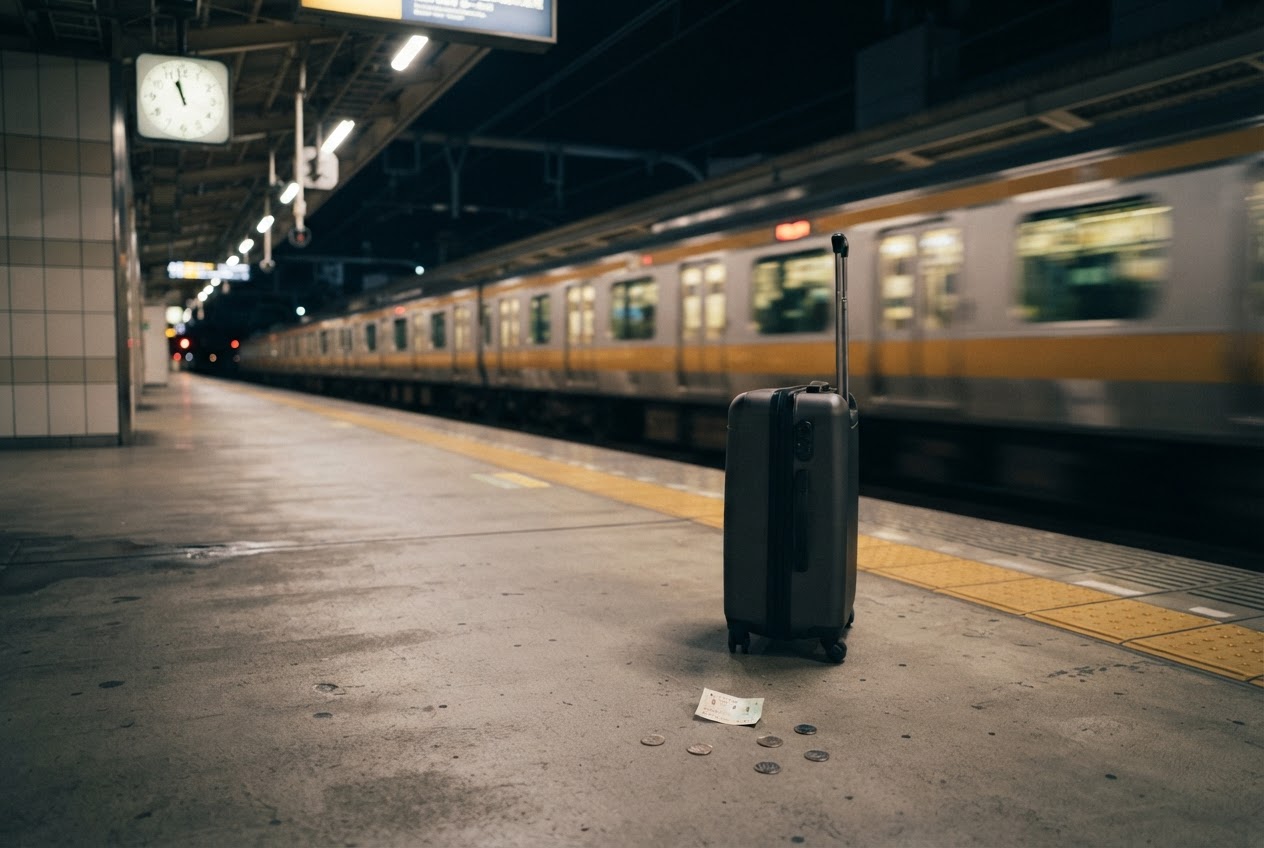
Japanese railways are so reliable that when something does go wrong, visitors assume it is a crisis. It almost never is. Every problem below is routine, and the staff at the gate deal with it before breakfast.
The single most useful habit: go to the manned window at the end of the ticket gates. Do not queue at a machine, do not try to solve it yourself. Hold out the ticket and say the problem. It will take a minute.
At a glance
- Missed a reserved train
- Your ticket is valid for a non-reserved seat on a later train the same day
- Wrong ticket, wrong fare
- Fare adjustment machine (精算機) before the gate, or the staffed window
- Lost ticket
- Explain at the gate. You may have to pay again, but they will help you.
- Last train gone
- Capsule hotel, manga café, karaoke box, or a taxi. All normal.
- Delay over 2 hours
- Limited express surcharge is refunded. Ask for a delay certificate.
You missed a reserved Shinkansen
Nothing happens. This is the most reassuring rule in Japanese rail travel.
A missed reserved ticket automatically becomes valid for a non-reserved seat on any later train the same day, on the same route. You do not need to buy anything, speak to anyone, or fill in a form. Walk to a non-reserved car and board.
If you want a seat guaranteed instead, take the ticket to a ticket office and they will re-issue the reservation, usually without charge.
The only thing that does not survive is missing the day entirely. A ticket for yesterday is dead.
The gate rejects your ticket
The commonest cause, by a long way, is feeding in one ticket when the journey needs two. Shinkansen and limited express journeys need a base fare ticket plus an express ticket, inserted together.
The second commonest is an IC card with an open journey — you tapped in somewhere and got off somewhere with no reader, so the system thinks you are still travelling.
Either way: walk to the staffed window beside the gates and hand over what you have.
At the gate
You underpaid, or went further than your ticket
Japan has a standard machine for this: the fare adjustment machine (精算機, seisanki), sitting just before the ticket gates at almost every station.
Find it before you reach the gate
Look for 精算 or “Fare Adjustment”, usually a smaller machine to one side of the gate line.
Insert your ticket or tap your IC card
The screen shows the shortfall.
Pay the difference in cash
Coins and notes. Some machines take IC cards.
Take the new ticket and go through the gate
The whole thing takes about twenty seconds.
Note that Japan operates on trust here: you can buy the cheapest ticket and adjust at the far end without penalty. This is normal and legal, not a loophole.
You lost the ticket
Be honest at the gate. In principle you may be asked to pay the fare again, and for a Shinkansen ticket that hurts. In practice, if you have the receipt, the reservation slip, the credit card used, or the seat number, staff will usually work it out.
If you bought online, the booking exists in the system and can be reprinted.
Do not try to leave through the gate with someone else’s ticket or by tailgating. It is treated seriously.
The train is delayed or cancelled
For delays over a certain threshold — generally two hours on a limited express — the express surcharge portion is refunded, though the base fare is not. Ask for a delay certificate (遅延証明書, chien shomeisho) at the gate; it is issued as a matter of routine.
Weather cancellations are announced early and honestly. In typhoon season and in Hokkaido winter, JR often announces a planned suspension (計画運休) the day before. If you see that in the news, change your plans rather than turning up to the station.
Rail passes are not refunded for individual disruptions, but you will be put on the next running service at no cost.
You missed the last train
This happens to everyone, including locals, and there is a whole small economy built around it. Trains in most cities stop between about midnight and 1am, and nothing runs until 5am.
Your options, roughly in order of cost:
- Manga café / internet café — a private booth, free drinks, a shower in many, about 1,500–3,000 JPY for the night. Bring your passport; some require ID.
- Karaoke box — an overnight “free time” rate, roughly 2,000–3,000 JPY. Loud, but warm and legal.
- Capsule hotel — 3,000–6,000 JPY, and far nicer than the name suggests. Many have a large bath.
- Late-night izakaya — drink until the trains restart. The traditional answer.
- Taxi — expensive and rising after midnight, but always available in cities. A cross-Tokyo fare can exceed 10,000 JPY.
Note that many capsule hotels and some manga cafés are single-sex or have separate women’s floors. Check before you walk in.
Something is genuinely wrong
- Lost property: Japanese railways recover almost everything. Report it at the station office with the train time, line and car number. Items are moved to a central lost property centre after a day or two, and phones, wallets and bags are returned at a rate that surprises visitors.
- Illness on a train: press the emergency button by the door or tell staff at the next station. Station staff are first-aid trained.
- Harassment: there are emergency buttons in every carriage and station staff take reports seriously. Women-only carriages exist during weekday peaks on many urban lines.
- Emergency numbers: 110 for police, 119 for fire and ambulance. Both have English-capable operators, though there may be a short wait.
Questions people actually ask
Do I get compensation for a delayed train?
For delays over roughly two hours on a limited express or Shinkansen, the express surcharge is refunded. Shorter delays are not compensated, but a delay certificate is issued free on request — it exists mainly so commuters can prove it to their employer.
What if I board a train with a reserved seat that someone is sitting in?
Show them your ticket politely. It is almost always an honest mistake, often someone in the wrong car. If it is awkward, tell the conductor.
Can I change a Shinkansen reservation?
Yes, once, free of charge, before departure — at a ticket office or reservation machine. After the departure time your ticket falls back to non-reserved validity for the rest of the day.
What if I lose my Japan Rail Pass?
It is not replaceable and not refundable. Treat it like cash. Photograph it on arrival so at least you have the number.
Are night buses an option if I miss the last train?
Only for intercity travel, and they leave from bus terminals on a fixed schedule rather than running through the night locally. Within a city, a capsule hotel or manga café is the practical answer.
Keep planning
Tokyo to Kyoto: Shinkansen, Night Bus or Plane?
The Shinkansen is the right answer for almost everyone: 2 hours 15 minutes, about 14,000 JPY, no check-in. Here is what the…
Luggage in Japan: Coin Lockers, Takkyubin and Oversized Baggage Rules
Japanese trains were not built for suitcases, so Japan moves the suitcase separately. How luggage forwarding works, what the 160cm rule means,…
Renting a Car in Japan: Licence, Tolls, ETC and Parking
The permit you must get before leaving home, why an ETC card matters more than the car, and the parts of Japan…