Mount Fuji and the Fuji Five Lakes: Where to Actually See It
The mountain is visible about eighty days a year and almost none of them are in summer. Which viewpoints work, which month to come, and the honest answer on whether to climb it.
 Signpost Japan
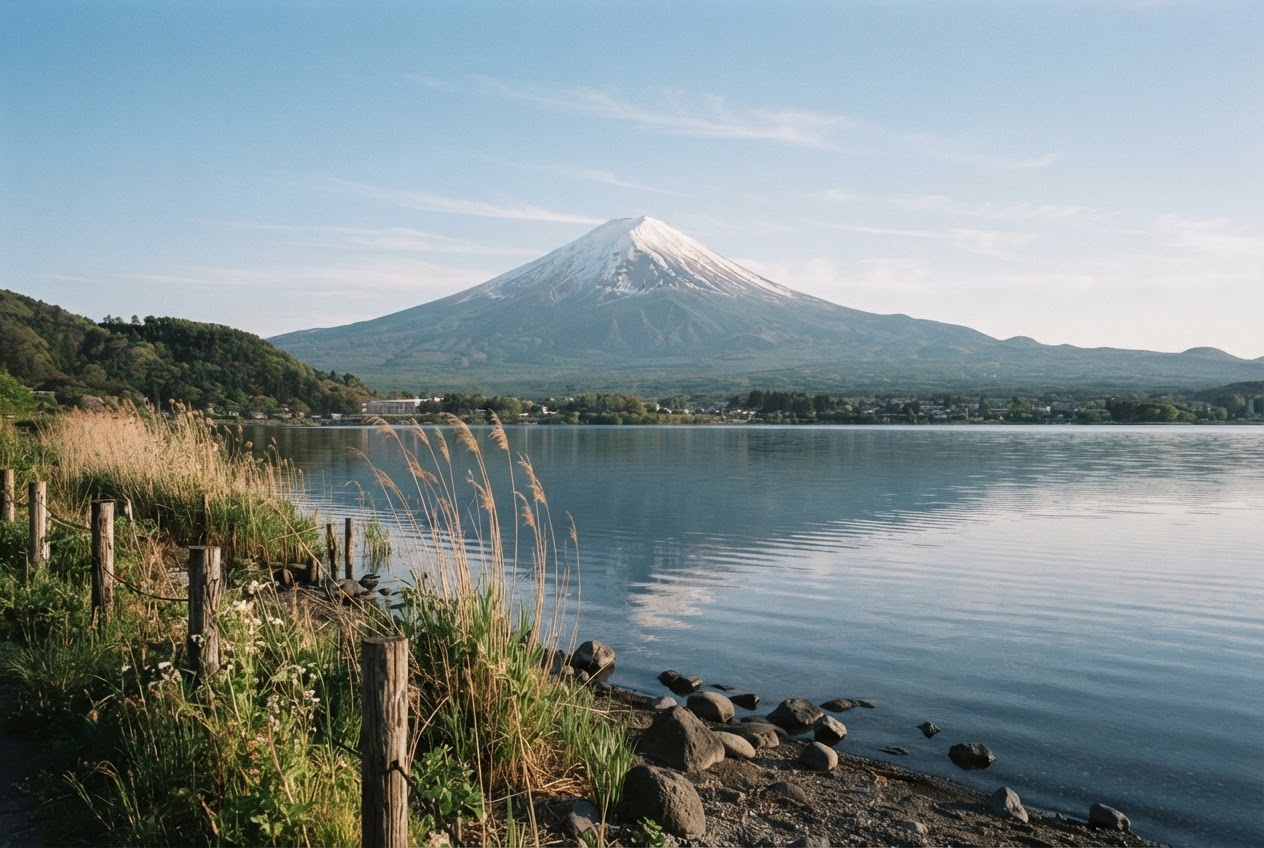
Mount Fuji is 3,776 metres, almost perfectly conical, and hidden behind cloud for most of the year. Visitors routinely spend two days at the lakes and never see it, then get a clear view from a Shinkansen window on the way back.
This is not bad luck. It is seasonal, and it is predictable enough to plan around.
At a glance
- Best months to see it
- December to February. Clear, dry air and snow on the cone.
- Worst months
- June to August. Cloud most days — and that is climbing season.
- Best time of day
- Sunrise to about 9am. Cloud builds through the day.
- Days needed
- 1 night at the lakes. A day trip risks seeing nothing.
- Getting there
- 2h from Shinjuku by direct bus to Kawaguchiko, or Fuji Excursion train
- Climbing season
- Early July to early September only
Why you cannot see it
Fuji stands alone on a plain, which is what makes it beautiful and also means it generates its own weather. Warm moist air rises against the cone and condenses; by late morning on most summer days the mountain is inside a cloud of its own making.
In winter the air is dry, cold and stable, and the mountain is visible on most mornings. The paradox is exact: the months you can climb it are the months you cannot see it.
Rough visibility, by month, from the lakes:
| Season | Chance of a clear view |
|---|---|
| Dec–Feb | High — most mornings |
| Mar–May | Moderate |
| Jun–Aug | Low — perhaps one morning in four |
| Sep–Nov | Moderate, improving through November |
Always go early. Even in a bad month, dawn is far better than midday.
The viewpoints that work
Chureito Pagoda
The photograph. A five-storey pagoda on a hillside above Fujiyoshida with the mountain framed behind it, and cherry trees in front in April.
About 400 steps up from Shimoyoshida station, 15 minutes. Arrive before sunrise if you want the shot without twenty other tripods; in blossom season, earlier still.
Lake Kawaguchiko
The most accessible of the five lakes, with the mountain reflected in still water on a calm morning. The northern shore is the side to be on — the mountain is to the south.
Oishi Park on the north shore is the standard viewpoint, with lavender in July and kochia in autumn. The Kachi Kachi ropeway climbs to a viewing platform above the lake.
Lake Motosuko
The view printed on the 1,000 yen note. Quieter, wilder, and about 40 minutes west of Kawaguchiko by bus or car.
Lake Yamanakako
The largest lake and the closest to the mountain, which makes Fuji look enormous. Good for the Diamond Fuji phenomenon — the sun setting exactly on the summit, visible from specific points in mid-October and late February.
Oshino Hakkai
Eight spring-fed ponds of snowmelt filtered through the mountain for decades, in a village of thatched houses. Extremely photogenic, extremely busy by ten in the morning.
From a train
The Tokaido Shinkansen between Tokyo and Nagoya passes Fuji at about 40 minutes from Tokyo. Sit on the right-hand side going west (seats D or E), left-hand side coming back. On a clear winter morning it is a genuinely spectacular two minutes.
Getting there
By bus: the simplest option. Direct highway buses from Shinjuku’s Busta terminal to Kawaguchiko take about two hours and cost roughly 2,200 JPY. Book ahead in autumn and at weekends.
By train: the JR Fuji Excursion limited express runs direct from Shinjuku to Kawaguchiko in about two hours, partly covered by a Japan Rail Pass with a supplement on the private section.
By car: useful for reaching the western lakes and the less-visited viewpoints, and the roads are good.
Around the lakes, a retro bus loops the shores and is the practical way to get between viewpoints without a car.
Climbing it
The honest version.
Season: roughly early July to early September, when the trails and mountain huts are open. Outside that window the mountain is a serious winter climb that kills people every year, and access is restricted.
Difficulty: no technical skill required, but it is a long, steep, high-altitude slog on volcanic scree — typically 5–7 hours up and 3–5 down, with real altitude effects above 3,000 metres.
The standard plan: climb in the afternoon, sleep a few hours in a mountain hut, and continue in the dark to reach the summit for sunrise (goraiko). Huts must be booked well in advance and are dormitory-style and basic.
Recent changes: Yamanashi prefecture introduced an entry fee and a daily cap on the Yoshida trail, along with gate closing hours to deter unprepared overnight climbers, and Shizuoka has introduced its own requirements on the trails from its side. Rules, fees and reservation systems have changed in each of the last few years — check the official prefectural climbing site before planning.
Should you? If you want the achievement and a sunrise from 3,776 metres, yes. If you want to look at Mount Fuji, no — you cannot see the mountain from on top of it, and the classic Japanese saying holds that a wise person climbs Fuji once, and only a fool climbs it twice.
What else is there
The lakes region is more than a viewing platform.
- Fuji-Q Highland — an amusement park with several record-holding roller coasters, at the foot of the mountain.
- Aokigahara — the forest on the northwest flank, growing on a lava flow, with two lava caves open to visitors.
- Fujisan World Heritage Centre — good on why the mountain is a cultural site rather than a natural one; it was inscribed by UNESCO for its role in art and religion.
- Hoto — the local dish: flat wheat noodles in a miso and pumpkin stew. Filling, warming, and everywhere.
Where to stay
Kawaguchiko has the most accommodation, from hostels to lake-view ryokan with onsen. The premium is for a room facing the mountain — worth it in winter, a gamble in summer.
Yamanakako is quieter. Fujiyoshida is cheaper and closer to Chureito.
Combine it with
Kawaguchiko connects to Hakone by bus in about two hours, making an easy pairing — Fuji from the north, then the caldera from the south. Nagano and the Alps are two hours north.
→ Hakone: the onsen loop from Tokyo
Questions people actually ask
What is the best month to see Mount Fuji?
December to February. Cold, dry, stable air means clear mornings most days, and the cone is snow-covered. November and March are the shoulder months.
Can I see Fuji from Tokyo?
On clear winter mornings, yes — from tall buildings on the west side of the city. It is unreliable and distant. Go to the lakes.
Is a day trip from Tokyo worth it?
It is a gamble. You arrive around the time the cloud builds and leave before the next morning. If your dates are tight and the forecast is clear, go; otherwise stay a night.
How hard is it to climb?
No technical skill needed, but it is a demanding 5–7 hour ascent at altitude on loose ground. Fitness, layers and a head torch matter far more than experience.
Do I need to book to climb?
Yes, increasingly. Both prefectures have introduced fees, daily caps and reservation requirements on the main trails, and the rules have changed in each of the last few years. Check the official prefectural site rather than a guidebook.
Where is the photograph with the pagoda taken?
Chureito Pagoda at Arakurayama Sengen Park, above Shimoyoshida station. About 400 steps up. Go at dawn.
Keep planning

Ghibli Park and the Ghibli Museum: How to Get Tickets
Two separate places, 350 kilometres apart, with two separate ticket systems and no tickets at the door. Both release on the 10th…

Kamakura and Enoshima: The Easiest Day Trip from Tokyo
An hour from Tokyo Station: a bronze Buddha from 1252, temples in the hills behind the town, and a tram that runs…
Nikko in a Day: The Shrines, the Lake, and Which Pass to Buy
Nikko is two day trips in one place: gilded shrines in the town, and a lake and a waterfall an hour above…