Fukuoka: Kyushu’s Gateway and Its Yatai Streets
Japan's most liveable big city, with an airport five minutes from the centre, the country's last real street-food stall culture, and the ramen that everyone else is imitating.
 Signpost Japan
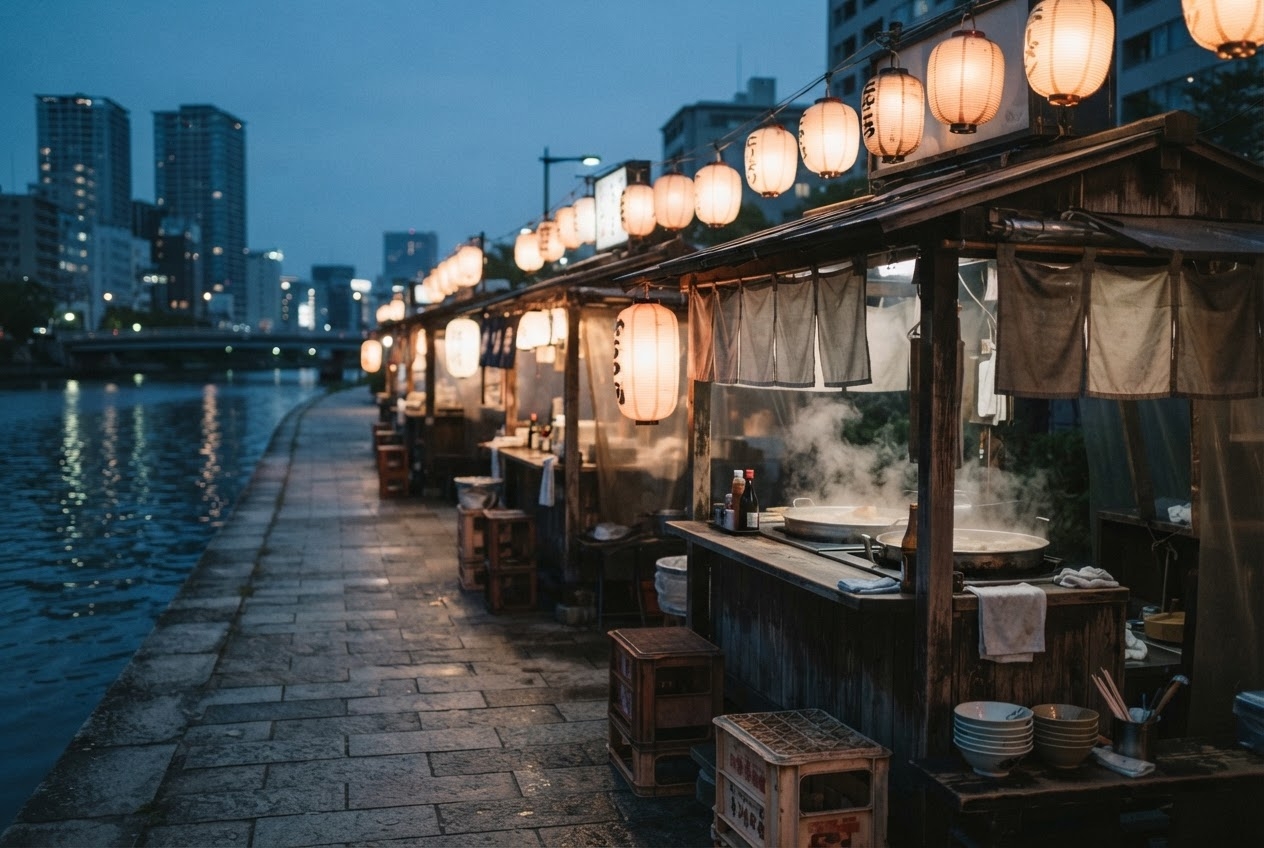
Fukuoka is closer to Seoul than to Tokyo, and it feels it. It was Japan’s window on the Asian mainland for a thousand years, it has been repeatedly voted the country’s most liveable city, and it has an international airport five minutes by subway from the main station — the shortest airport transfer of any major city in the world.
It is also the birthplace of tonkotsu ramen and the last Japanese city with a functioning street-stall culture.
At a glance
- Days needed
- 2 days, or 1 as a gateway to the rest of Kyushu
- Main gateway
- Fukuoka (FUK), 5 min by subway to Hakata. 1h 50m flight from Tokyo, 5h by Shinkansen.
- Getting around
- Subway, three lines. Most of the centre is walkable.
- Best months
- March–May, October–November. Summer is hot and humid.
- Rail pass
- JR Kyushu Rail Pass — Kyushu is compact and this one is close to essential
- Famous for
- Tonkotsu ramen, yatai food stalls, Hakata dolls, and being easy
Two centres, one city
The city merged in 1889 from two towns either side of the Naka river, and never quite agreed on a name.
Hakata, east of the river, has the main station and the older merchant history. Fukuoka, west of the river, was the samurai town and holds Tenjin, the shopping and nightlife district.
The station is Hakata. The city is Fukuoka. Nobody minds which you say.
Yatai — the reason to come
Around 100 yatai — mobile food stalls with a counter, a canvas awning and about eight seats — are wheeled out onto the pavements each evening and packed away before dawn. It is the last such culture at scale in Japan; most cities regulated theirs out of existence decades ago.
Where: Nakasu island is the famous strip, on the river, and the most tourist-oriented. Tenjin and Nagahama are where more locals go.
How it works:
Arrive after about 6pm
Stalls open in the early evening and run to around 2am. Many close in bad weather.
Look for a seat, and ask
Say sumimasen and point at an empty stool. If it is full, walk on — there are dozens.
Order a drink and one or two dishes
Beer or shochu, then ramen, oden, yakitori or gyoza. Portions are small; the point is to eat at two or three stalls in an evening.
Expect to pay cash
Roughly 2,000–3,000 JPY per person per stall. Prices are usually posted; if they are not, ask.
Do not linger over one drink
Eight seats and a queue. An hour is generous.
Ramen
Tonkotsu ramen was invented in Fukuoka: pork bone broth boiled hard for hours until the collagen emulsifies into something opaque and rich, over thin, firm, straight noodles.
Two things to know:
Noodle firmness. You order it. Futsu is normal, katame firm, barikata very firm, harigane barely cooked. Locals mostly order barikata.
Kaedama. A refill of noodles for a few hundred yen, dropped into your remaining broth. The bowls are small precisely so you can do this. Say kaedama onegaishimasu.
Where: Ichiran and Ippudo both started here and are everywhere; the local independents around Nagahama and in the arcades are better. Ichiran’s solo booths — a partition either side, a bamboo screen in front — are worth doing once as an experience in engineered introversion.
The rest of the city
Ohori Park — a large pond that was once the castle moat, with a 2km loop path, a Japanese garden and the castle ruins alongside. The best free thing in Fukuoka.
Kushida Shrine — the city’s guardian shrine, founded in 757, and home of the Hakata Gion Yamakasa festival floats.
Canal City Hakata — a 1996 shopping complex built around an artificial canal, still one of Japan’s more interesting pieces of commercial architecture.
Tenjin — the shopping district, with an underground mall running for 600 metres beneath the street.
Momochi and the Fukuoka Tower — the seafront, with a beach in the city and a 234-metre tower.
Dazaifu — 30 minutes by train, a shrine to the god of learning where students come to pray before exams, with 6,000 plum trees. The Kyushu National Museum next door is one of only four national museums in Japan.
What to eat
Beyond ramen:
- Motsunabe — offal hotpot with cabbage and garlic chives. A Fukuoka invention and better than it sounds.
- Mizutaki — chicken hotpot in a clear collagen broth.
- Mentaiko — spicy marinated pollock roe, the city’s signature souvenir. On rice, in pasta, in everything.
- Goma saba — raw mackerel in sesame and soy. Only possible where the fish is this fresh.
- Umegae mochi — grilled bean-paste cakes at Dazaifu.
Using Fukuoka as a base
This is Fukuoka’s other role, and Kyushu is compact enough that it works well.
| Destination | Time from Hakata |
|---|---|
| Dazaifu | 30 min |
| Yanagawa (river punting) | 50 min |
| Kokura and Mojiko | 15–70 min |
| Nagasaki | 1h 30m |
| Kumamoto | 40 min by Shinkansen |
| Beppu / Yufuin (Oita) | 2h |
| Kagoshima | 1h 20m by Shinkansen |
The JR Kyushu Rail Pass covers most of these and is one of the better-value regional passes in Japan.
→ Regional rail passes: the 12 that actually save money
Where to stay
Hakata Station — the best base. Every train, the airport subway, the bus terminal and a large station building full of restaurants.
Tenjin — for shopping and nightlife, and closer to the better yatai.
Nakasu — on the island itself, loud, and in the middle of the entertainment district.
Fukuoka hotels are noticeably cheaper than Tokyo, Kyoto or Osaka for equivalent quality.
Combine it with
Fukuoka is the northern gateway to Kyushu and the western end of the Sanyo Shinkansen. Natural routes: Fukuoka → Nagasaki → Kumamoto → Kagoshima down the island, or Hiroshima → Fukuoka coming from Honshu.
→ Nagasaki: a harbour city with a European past
Questions people actually ask
Is Fukuoka worth a trip on its own?
As a two-day stop, yes, particularly for food. As a gateway to Kyushu, absolutely — the island is compact and Fukuoka is the natural door.
Are the yatai touristy?
Nakasu’s riverside stalls largely are. Tenjin and Nagahama are where locals go, and they are a five-minute walk away.
How do I get from the airport?
The subway, five minutes to Hakata Station for about 260 JPY. The international terminal is across the runway, connected by a free shuttle bus of about ten minutes.
Is Hakata ramen different from other ramen?
Yes — pork bone broth, thin straight noodles, small bowls, noodle firmness ordered to preference, and refills. It is the style most non-Japanese ramen shops are imitating.
Can I do Fukuoka as a day trip from Hiroshima?
The Shinkansen takes about an hour, so yes — but you would miss the evening, which is when the city is best. Stay a night.
Is it a good base for a Kyushu trip?
The best one. Everything on the island is within two hours, the airport is a five-minute subway ride, and hotel prices are lower than anywhere comparable.
Keep planning
Ghibli Park and the Ghibli Museum: How to Get Tickets
Two separate places, 350 kilometres apart, with two separate ticket systems and no tickets at the door. Both release on the 10th…
Kamakura and Enoshima: The Easiest Day Trip from Tokyo
An hour from Tokyo Station: a bronze Buddha from 1252, temples in the hills behind the town, and a tram that runs…
Nikko in a Day: The Shrines, the Lake, and Which Pass to Buy
Nikko is two day trips in one place: gilded shrines in the town, and a lake and a waterfall an hour above…