Hakone: The Onsen Loop from Tokyo
A switchback train, a funicular, a ropeway over a volcanic vent, a boat and a bus — all on one ticket, in a circle, ninety minutes from Shinjuku. The easiest onsen night in Japan, done in the right direction.
 Signpost Japan
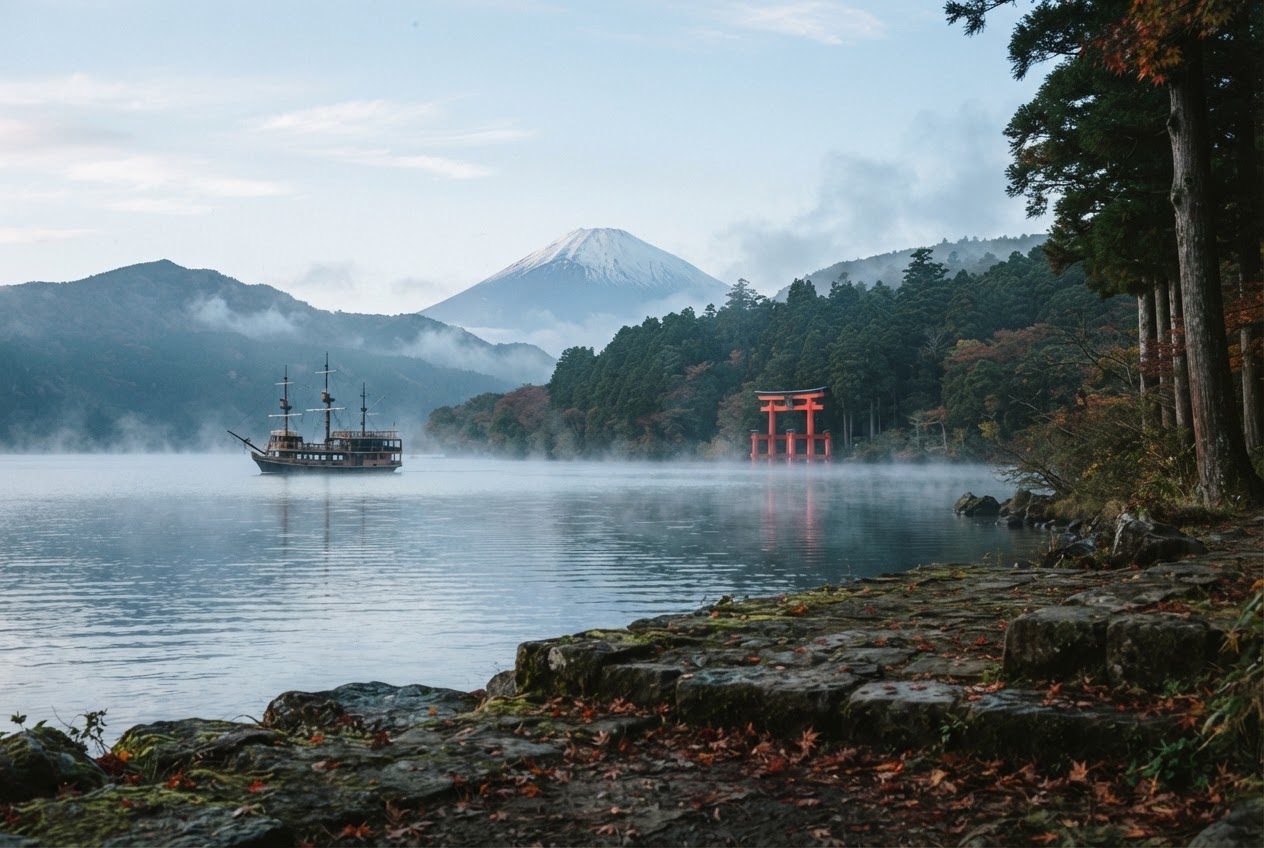
Hakone is a volcanic caldera an hour and a half from Tokyo that has been a hot spring resort since the seventeenth century, when it was a post station on the Tokaido highway. It is the standard first onsen experience for visitors, and it deserves the position: the geology is genuinely dramatic, the transport is a series of small pleasures, and there is a good chance of Mount Fuji at the end.
The whole thing is a loop, and it works far better in one direction than the other.
At a glance
- Days needed
- 1 night. A day trip works but wastes the point, which is the bath.
- Getting there
- 85 min from Shinjuku on the Odakyu Romancecar, or 2h by local trains
- Getting around
- The Hakone Free Pass covers the entire loop
- Best months
- Any. Autumn is best; winter has the clearest Fuji views.
- Cost
- Free Pass about 6,100 JPY from Shinjuku for 2 days, as of Feb 2026
- The one rule
- Go anticlockwise, and buy the pass
Buy the Hakone Free Pass
Almost nobody should do Hakone without it. It covers the mountain railway, the funicular, the ropeway, the boat, the local buses and the Odakyu line from Odawara, plus discounts at museums and some baths — all on one ticket.
Buying each leg separately costs considerably more and involves five separate ticket purchases in a place where you would rather be looking at a volcano.
Two-day and three-day versions are sold; the two-day is right for an overnight stay. Buy it at Shinjuku station’s Odakyu counter.
The Romancecar — Odakyu’s reserved limited express — costs a supplement of about 1,200 JPY on top. It is worth it for the front seats behind the driver’s glass and for not standing.
The loop, in the right direction
Do it anticlockwise: train up, ropeway across, boat back, bus home. This puts the ropeway before lunch, when the cloud has often not yet built, and finishes with the boat on Lake Ashi in the afternoon light.
Odawara or Hakone-Yumoto → Gora, by mountain railway
Japan’s only mountain railway with switchbacks — the train stops, the driver and conductor swap ends, and it reverses up the next section. Three times. About 40 minutes, through hydrangeas in June.
Gora → Sounzan, by funicular
Ten minutes, straight up.
Sounzan → Owakudani → Togendai, by ropeway
The best part. The cable car crests a ridge and the Owakudani volcanic vents open below you — bare yellow-grey rock, steam, and sulphur. On a clear day Fuji sits directly ahead.
Owakudani — get off and eat a black egg
Eggs boiled in the sulphur springs, shells blackened by the iron. Local belief holds each one adds seven years to your life. They taste like eggs.
Togendai → Hakone-machi, by pirate ship
A sightseeing boat across Lake Ashi, decorated as a galleon, which is silly and enjoyable. Twenty-five minutes with Fuji behind you.
Hakone Shrine, then the bus back
The shrine’s torii stands in the lake. Then a bus to Hakone-Yumoto and your ryokan.
Beyond the loop
Hakone Open-Air Museum — sculpture in a hillside park with mountains behind, plus a Picasso collection and a foot bath fed by a hot spring. Genuinely good, and the best rainy-day option in Hakone.
Pola Museum of Art — French Impressionists in a building half-buried in a beech forest.
Old Tokaido cedar avenue — a surviving stretch of the Edo-period highway near Lake Ashi, lined with 400-year-old cryptomeria, with the reconstructed Hakone Checkpoint where travellers were once inspected.
Owakudani hiking — trails around the vents, subject to the same gas closures.
The onsen, which is the point
Hakone has seventeen distinct hot spring areas with different water chemistry, and the reason to stay overnight rather than day-trip.
In a ryokan. The full experience: yukata, kaiseki dinner, and a bath. The best rooms have a private open-air bath (rotenburo) on a balcony, which is expensive and, on a cold clear night, worth it once.
Public baths. Tenzan Tohji-kyo near Hakone-Yumoto is a large, traditional, forested complex of outdoor pools. Yunessun is the opposite: a swimsuit-wearing spa park with wine and coffee baths, which children love.
Day-use bathing. Many ryokan sell daytime access to their baths for 1,000–2,500 JPY, which is how to get the experience without the overnight cost.
→ Onsen for beginners: rules, tattoos and the small towel → Staying in a ryokan: what actually happens, hour by hour
Will you see Fuji?
Honestly: it is a coin toss, and it depends heavily on season.
Best odds: December to February, early morning, when the air is dry and clear. Worst: June to August, when the mountain is in cloud most of the time.
The best viewpoints in Hakone are from the ropeway between Owakudani and Togendai, from Lake Ashi’s southern shore, and from the Hakone Shrine torii.
If Fuji is the priority rather than the onsen, the Fuji Five Lakes on the other side of the mountain give far better and more reliable views.
→ Mount Fuji and the Fuji Five Lakes: where to actually see it
Where to stay
Hakone-Yumoto — the entrance town, most accommodation, most convenient, least atmospheric. Gora — halfway up, good ryokan, on the railway and funicular. Sengokuhara — quiet, higher, near the pampas grass fields and the Pola Museum. Lake Ashi — the best Fuji views, the fewest restaurants.
Ryokan run from about 20,000 JPY per person with meals to well over 60,000. Business hotels exist in Yumoto for a fraction.
Combine it with
Hakone is a natural first or last stop on a Tokyo trip, and it sits neatly between Tokyo and Kyoto — Odawara is on the Tokaido Shinkansen, so you can do the loop, sleep, and continue west the next morning without backtracking.
Kamakura (1 hour) and the Izu peninsula in Shizuoka are the other Kanagawa-area additions.
Questions people actually ask
Is Hakone worth it as a day trip?
It works, and thousands do it. But the loop takes most of a day and leaves no time for a proper bath, which is the reason to come. One night changes the trip entirely.
Which direction should I do the loop?
Anticlockwise — railway, funicular, ropeway, boat, bus. It puts the ropeway earlier when Fuji is more likely to be clear, and ends with the lake in afternoon light.
Can I visit with tattoos?
Some ryokan and public baths refuse visible tattoos. Book a room with a private bath, use a ryokan that permits them, or use Yunessun, which is swimsuit-based. Ask when booking rather than on arrival.
Is the Hakone Free Pass worth it?
Almost always, unless you are only visiting one museum and going straight back. It covers five separate modes of transport that would otherwise be five separate purchases.
How busy does it get?
Very, on autumn weekends and public holidays, with real queues for the ropeway. Weekdays are considerably better, and an overnight stay lets you do the loop early.
Can I get to Hakone with a Japan Rail Pass?
Only as far as Odawara on the Shinkansen. Everything inside Hakone is Odakyu and Hakone Tozan, which no JR pass covers — buy the Free Pass from Odawara.
Keep planning
Ghibli Park and the Ghibli Museum: How to Get Tickets
Two separate places, 350 kilometres apart, with two separate ticket systems and no tickets at the door. Both release on the 10th…
Kamakura and Enoshima: The Easiest Day Trip from Tokyo
An hour from Tokyo Station: a bronze Buddha from 1252, temples in the hills behind the town, and a tram that runs…
Nikko in a Day: The Shrines, the Lake, and Which Pass to Buy
Nikko is two day trips in one place: gilded shrines in the town, and a lake and a waterfall an hour above…