Hiroshima and Miyajima in One Day
A morning that will stay with you and an afternoon on one of Japan's most beautiful islands. How to fit both into a day without doing either badly — and why you should stay until the last ferry.
 Signpost Japan
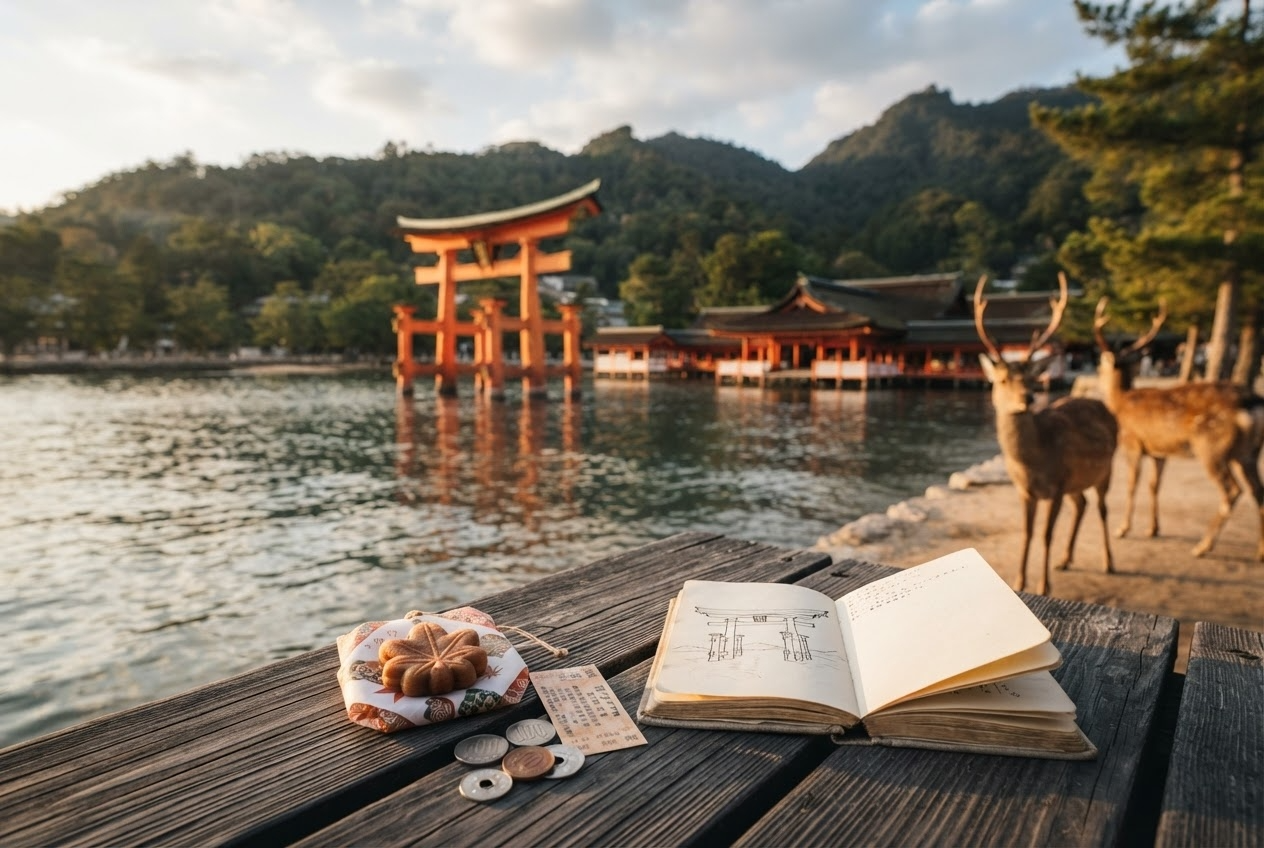
Hiroshima is a day of two halves that could not be less alike: a morning in the Peace Memorial Park, and an afternoon on an island of forested mountains and a shrine built out over the sea.
It works as one day, and a great many people do it that way. But the island empties at about five when the day-trippers leave, and what is left is one of the quietest, loveliest evenings in Japan. If you can give it a night, give it a night.
At a glance
- Days needed
- 1 long day, or 2 to do it properly with a night on Miyajima
- Getting there
- 1h 40m from Osaka, 4h from Tokyo by Shinkansen
- Getting around
- Hiroshima’s trams. Then train + ferry to Miyajima, about 45 min total.
- Best months
- Any. Autumn on Miyajima is exceptional.
- Rail pass
- JR West Kansai-Hiroshima Area Pass covers this and the ferry
- The mistake
- Leaving Miyajima at 4pm with everyone else
Morning — the Peace Memorial Park
At 8:15am on 6 August 1945 a uranium bomb detonated about 600 metres above this spot. The city has built its memorial around the one building left standing near the hypocentre.
The A-Bomb Dome was the Prefectural Industrial Promotion Hall, and it survived because the blast came almost directly from above. It has been stabilised but not restored, and it is deliberately left as it was.
The Peace Memorial Museum takes about ninety minutes and is a hard, careful, unflinching account told largely through personal objects — a lunch box, a tricycle, a watch stopped at 8:15. It does not editorialise. It does not need to.
Between the two: the cenotaph, the flame, and the Children’s Peace Monument, hung with paper cranes sent from schools around the world, for Sadako Sasaki, who died of leukaemia at twelve.
Entry to the museum is 200 JPY. Audio guides are available in several languages and are worth taking.
Midday — lunch, and Hiroshima’s other identity
Hiroshima is a city of 1.2 million that rebuilt itself completely and does not present itself primarily as a memorial. Walk ten minutes into Hondori, the covered shopping arcade, and it is an ordinary, cheerful Japanese city centre.
Eat Hiroshima-style okonomiyaki, which is a different dish from the Osaka version: layered rather than mixed, built on a thin crepe with a mound of cabbage, pork and a nest of fried noodles, pressed and turned on the griddle in front of you.
Okonomimura is a building near the arcade containing about twenty okonomiyaki stalls stacked over three floors. It is touristy and it is also genuinely where to go — sit at the counter, watch it being made.
Afternoon — Miyajima
Getting there: JR Sanyo line from Hiroshima Station to Miyajimaguchi (about 27 minutes), then the ferry (10 minutes). Both are covered by a JR pass, including the JR-operated ferry.
The island’s proper name is Itsukushima; Miyajima means “shrine island”. The whole island has been considered sacred since prehistory, which is why the shrine is built on stilts over the water — commoners were not permitted to set foot on the island itself and approached by boat through the torii.
The floating torii
The great vermillion gate stands in the sea about 200 metres offshore. It is 16 metres high, weighs about 60 tonnes, and is held in place by nothing but its own weight — the six pillars simply rest on the seabed.
Check the tide before you go. At high tide it appears to float, which is the photograph. At low tide you can walk out to it across the sand, which is a different and equally good experience. Tide tables are published on the Miyajima tourist site.
Itsukushima Shrine
A boardwalk complex over the water, first built in the 12th century in the shinden style of Heian aristocratic houses. At high tide the whole structure appears to be afloat.
Mount Misen
The island’s peak, 535 metres. A ropeway takes you most of the way up, then a 30-minute walk to the summit for the Inland Sea spread out below you with its scattered islands. There are also three walking trails from the bottom, taking 1.5–2 hours.
At the top: a hall containing a fire said to have burned continuously since Kobo Daishi lit it in 806.
The rest of the island
- Daisho-in, a hillside temple complex below Misen, with 500 small rakan statues each with a different face. Almost nobody goes; it is arguably the best thing on the island.
- Deer, semi-tame, wandering everywhere. They will eat your map.
- Momijidani Park, spectacular in November.
- Grilled oysters and momiji manju — maple-leaf-shaped cakes — on the main street.
Why to stay the night
The last ferries run into the evening, and after about five o’clock the island changes completely. The day-trippers go, the shops shut, and roughly two thousand residents and a few hundred hotel guests have the place to themselves.
The shrine is lit at night. The deer settle. You can walk the shore in near-silence with the torii glowing offshore.
Ryokan on the island are not cheap, but this is one of the two or three nights in Japan most worth paying for.
A one-day timetable
08:30 — Peace Memorial Park
The A-Bomb Dome first, then the museum. Allow two hours.
11:30 — walk to Hondori
Ten minutes on foot, or one tram stop. Coffee.
12:00 — okonomiyaki lunch
Okonomimura or any counter with a queue.
13:30 — train and ferry to Miyajima
About 45 minutes door to door from Hiroshima Station.
14:30 — Itsukushima Shrine and Daisho-in
Check the tide time before you commit to the order.
16:00 — Mount Misen by ropeway
Last ropeway down is usually around 17:00 — check on the day.
18:30 — the last ferry, or dinner and stay
Ferries run into the evening. Staying is better.
Where to stay
On Miyajima — a handful of ryokan, most with sea views and kaiseki dinners. Book well ahead, especially in November.
In Hiroshima — business hotels around the station and near the Peace Park, all reasonable and well priced. Better value, and fine if you are moving on the next morning.
Combine it with
Hiroshima sits on the Sanyo Shinkansen between Osaka and Kyushu. Natural pairings: Okayama and the Setouchi art islands to the east, Yamaguchi and Iwakuni’s Kintaikyo bridge to the west, and Fukuoka two hours further on.
→ Kagawa and the Setouchi art islands
Questions people actually ask
Is the Peace Memorial Museum suitable for children?
It is unflinching, including photographs and physical remains. Many families visit with older children and find it valuable; for under-tens, the park, the cenotaph and the Children’s Peace Monument alone may be enough.
Is one day enough for both?
It works, and it is what most people do. Two days — with a night on Miyajima — is substantially better, because the island after 5pm is the best part of it.
When should I go for the floating torii?
High tide for the floating photograph, low tide to walk out to it. Both are worth seeing; tide tables are published online, and a stay lets you see both.
Is Hiroshima safe? Is there any radiation?
Entirely safe. The bomb detonated in the air rather than at ground level, and residual radiation returned to normal background levels within years. The city has been continuously inhabited since 1945.
How do I get to Miyajima with a JR Pass?
JR Sanyo line to Miyajimaguchi and the JR-operated ferry, both fully covered. The competing private ferry from the same pier is not.
Is Hiroshima okonomiyaki really different?
Yes, and locals are firm about it. Osaka mixes the batter and cabbage together; Hiroshima layers them on a crepe and adds fried noodles. Try both and pick a side.
Keep planning
Ghibli Park and the Ghibli Museum: How to Get Tickets
Two separate places, 350 kilometres apart, with two separate ticket systems and no tickets at the door. Both release on the 10th…
Kamakura and Enoshima: The Easiest Day Trip from Tokyo
An hour from Tokyo Station: a bronze Buddha from 1252, temples in the hills behind the town, and a tram that runs…
Nikko in a Day: The Shrines, the Lake, and Which Pass to Buy
Nikko is two day trips in one place: gilded shrines in the town, and a lake and a waterfall an hour above…