Kagawa and the Setouchi Art Islands
Japan's smallest prefecture, an inland sea dotted with islands that were dying until contemporary art arrived, and a noodle culture taken seriously enough to be a regional identity.
 Signpost Japan
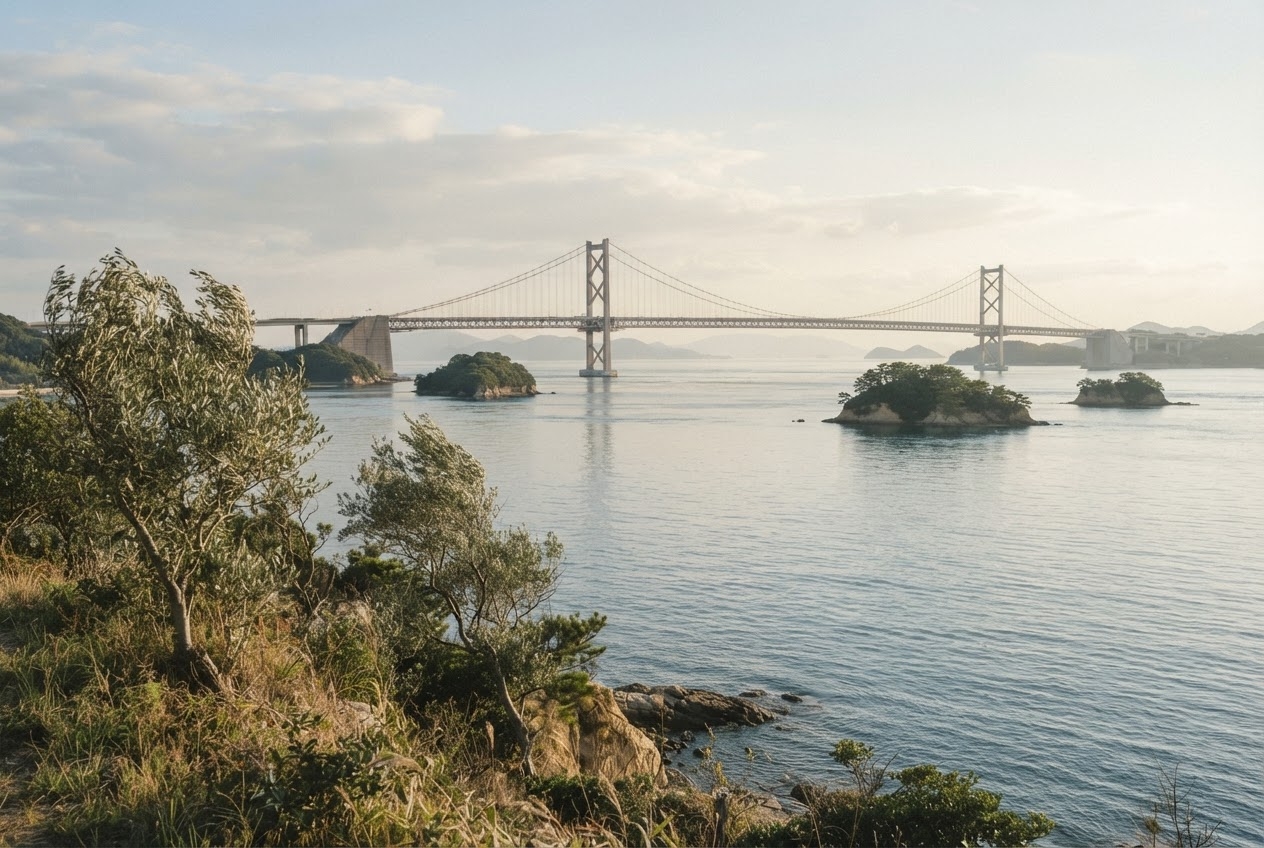
Kagawa is the smallest prefecture in Japan by area, on the north coast of Shikoku facing the Seto Inland Sea. It is known nationally for two things that could not be less alike: udon, which it produces and consumes at a rate no other prefecture approaches, and the art islands — a group of depopulating industrial islands turned into one of the more interesting contemporary art projects anywhere.
At a glance
- Days needed
- 3 days. 2 for the islands, 1 for Takamatsu and udon.
- Getting there
- Takamatsu: 55 min from Okayama across the bridge, 4h from Tokyo
- Getting around
- Ferries to the islands, and bicycles once you are on them
- Best months
- April–June, September–November. Ferries are weather-dependent in winter.
- Rail pass
- All Shikoku Rail Pass covers JR and the private railways
- Book ahead
- Chichu Art Museum and Teshima Art Museum both require timed tickets
The art islands
In the 1980s the Benesse corporation began buying land on Naoshima, an island whose copper smelter had left it polluted and whose population was collapsing. The idea was to place contemporary art in a rural landscape and see what happened.
What happened was that the model spread across the Inland Sea, and the Setouchi Triennale — held every three years, next in 2028 — now draws close to a million visitors across a dozen islands.
The reason it works is that the art is site-specific. These are not galleries that happen to be on islands; they are works made for these buildings, these hillsides and this light.
Naoshima
The main island and the busiest.
Chichu Art Museum — Tadao Ando’s building is buried in a hillside, lit entirely by daylight, holding just three artists. Five Monet water lilies in a room of white marble mosaic; a James Turrell light space; a Walter De Maria chamber with a granite sphere. Timed tickets, booked in advance, essential.
Benesse House — a museum that is also a hotel. Guests can walk the galleries at night after the day visitors have gone, which is the single best reason to stay on the island.
Lee Ufan Museum — a quieter Ando building for a single artist.
Art House Project in Honmura village — seven empty houses, a temple and a shrine converted into individual works. The best is arguably Tatsuo Miyajima’s Sea of Time ’98, LED counters in a flooded room, each set to a speed chosen by a village resident.
Yayoi Kusama’s yellow pumpkin on the pier — the island’s emblem, and the photograph everyone takes.
Teshima
Quieter, greener, and for many people the better island.
Teshima Art Museum is one work: a white concrete shell like a drop of water, with two large oval openings to the sky. Inside, water seeps continuously from thousands of tiny holes in the floor and gathers into moving beads. There is nothing else — no exhibits, no seats, no sound but wind and birds. People stay for an hour.
Teshima also has a history worth knowing: it was the site of one of Japan’s worst illegal industrial waste dumping scandals, fought by residents for decades. The art project is part of the island’s recovery.
Inujima
Smallest and strangest. A former copper refinery, closed in 1919 after ten years, preserved as an industrial ruin and converted into a museum that runs entirely on passive solar and geothermal systems.
Practicalities
Ferries run from Takamatsu (Kagawa) and Uno (Okayama). Schedules are limited and inter-island connections are infrequent — this is the single biggest planning constraint.
Rent a bicycle on arrival — electric ones are worth the extra on Naoshima’s hills.
Udon
Kagawa consumes roughly twice as much udon per head as the national average and unofficially calls itself Udon Prefecture. There are around 600 udon shops in a prefecture of under a million people.
Sanuki udon is thick, square-edged and notably chewy, made with local wheat and salt from the Inland Sea. It is eaten fast, often standing, and frequently for breakfast.
How the self-service shops work — and most of the good ones are self-service:
Say the size
Ippai (one), ni-dama (two portions). Hot (atsu) or cold (hiya).
Take the bowl and rinse or heat the noodles yourself
There is usually a basket and a vat of hot water. Dip for ten seconds.
Add broth from the tap, or dipping sauce
Then help yourself to spring onion, ginger and tempura crumbs.
Take tempura from the counter if you want it
Priced per piece. Chikuwa, prawn, sweet potato.
Pay at the end, and eat quickly
A full bowl with a piece of tempura is often under 500 JPY.
Kagawa’s tourist office publishes an udon taxi scheme — drivers certified in udon knowledge who will run you between rural shops. It sounds like a gimmick and is genuinely the best way to eat the good ones, which are often in the middle of fields.
Takamatsu
The prefectural capital and the ferry hub.
Ritsurin Garden is the reason to stop. Laid out over a century from the 1620s, six ponds and thirteen landscaped hills using Mount Shiun as borrowed scenery, and about 1,000 pines shaped by hand. It is not one of the official “three great gardens” and a good many people think it should be — it is larger and, on a quiet morning, better than any of them.
Yashima — a plateau above the city, the site of a decisive 1185 battle between the Taira and Minamoto clans, with a view over the Inland Sea.
Elsewhere in Kagawa
Kotohira-gu (Konpira-san) — a shrine to the god of seafarers, reached by 1,368 stone steps up a mountainside. Sailors have come here for centuries. The climb takes about an hour and there are palanquins for hire if you would rather not.
Shodoshima — the second-largest island in the Inland Sea, with olive groves, a gorge, and a sandbar that appears at low tide linking it to a smaller island.
Where to stay
Takamatsu — the practical base, with business hotels near the station and the port. Naoshima — Benesse House for the night access to the galleries, or guesthouses and a campsite for far less. Teshima — a handful of small guesthouses; book early.
Combine it with
Kagawa connects to Okayama in 55 minutes across the Seto-Ohashi bridge, which puts it within reach of the Sanyo Shinkansen and therefore of Kyoto, Osaka and Hiroshima. It is also the gateway to the rest of Shikoku — Tokushima, Kochi and Ehime.
→ Hiroshima and Miyajima in one day
Questions people actually ask
Is Naoshima worth the journey?
For anyone with an interest in contemporary art or architecture, yes — the Chichu Museum in particular is unlike anything else. For those without, the islands are still a pleasant day of cycling, but the effort is high.
Do I need to book museum tickets?
Yes for Chichu and Teshima Art Museum, both of which use timed entry and sell out in high season. Others can generally be bought on arrival.
Naoshima or Teshima?
Naoshima has more and is easier; Teshima is quieter and its single museum is, for many people, the more affecting experience. With two days, do both.
When is the Setouchi Triennale?
Every three years across spring, summer and autumn sessions, next in 2028. In Triennale years there is far more to see and far more competition for ferries and beds.
Is Shikoku hard to travel in?
Less than its reputation. The main cities are on the rail network and the All Shikoku Rail Pass covers the private lines too. The interior — the Iya Valley in particular — needs a car or patience with buses.
How many udon shops should I go to in a day?
Locals routinely eat two or three. The bowls are small, the shops are cheap, and hopping between them is the accepted way to do it.
Keep planning
Ghibli Park and the Ghibli Museum: How to Get Tickets
Two separate places, 350 kilometres apart, with two separate ticket systems and no tickets at the door. Both release on the 10th…
Kamakura and Enoshima: The Easiest Day Trip from Tokyo
An hour from Tokyo Station: a bronze Buddha from 1252, temples in the hills behind the town, and a tram that runs…
Nikko in a Day: The Shrines, the Lake, and Which Pass to Buy
Nikko is two day trips in one place: gilded shrines in the town, and a lake and a waterfall an hour above…