Nara: The Day Trip Everyone Rushes — and How Not To
Most visitors see Nara in three hours: the Great Buddha, some deer, and a train home. The other two-thirds of the park — lantern paths, a primeval forest, temples older than anything in Kyoto — is where the day actually is.
 Signpost Japan
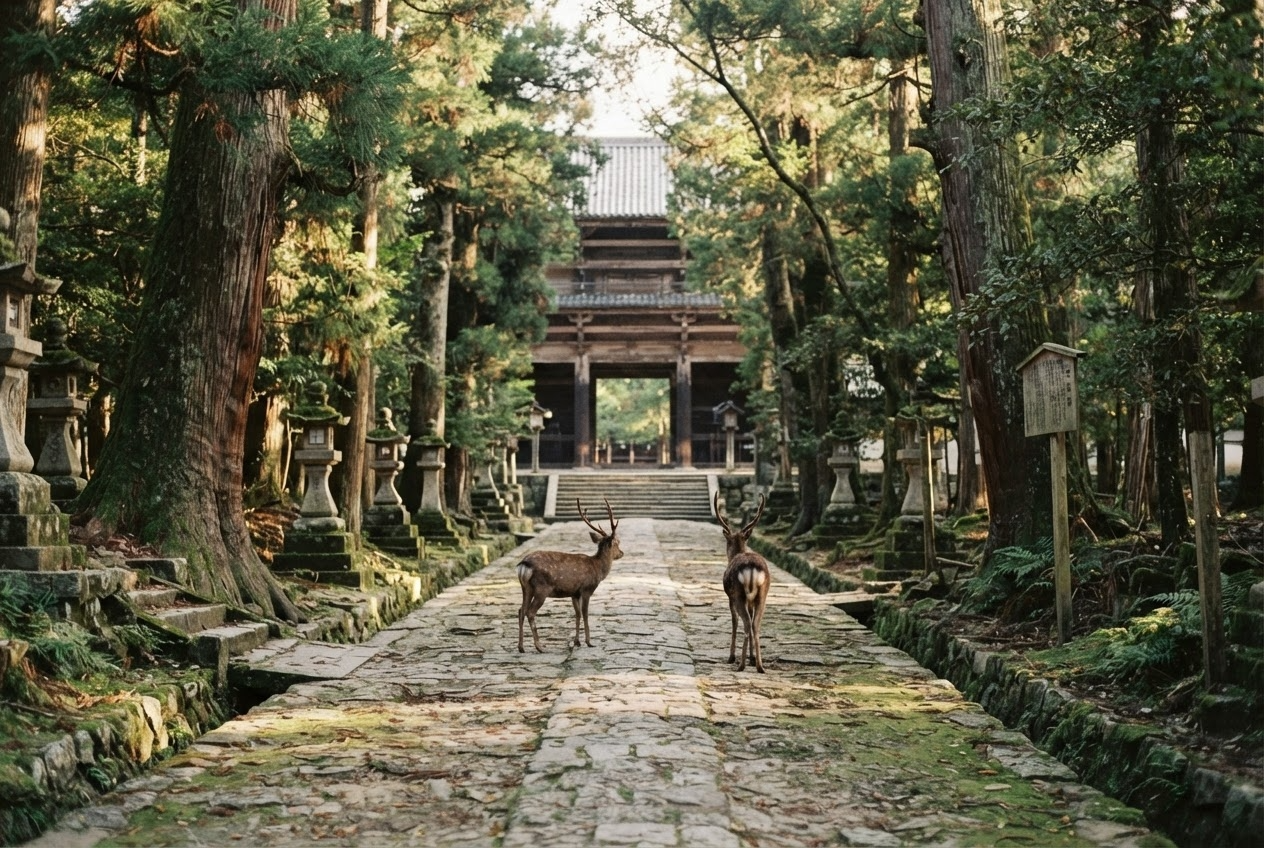
Nara was Japan’s capital from 710 to 784, seventy-four years that gave the country its first permanent city, its first written histories, and Buddhism as a state religion. When the capital moved to Kyoto, Nara simply stopped, which is why it holds buildings that are older than anything in Kyoto and a plan that is essentially unchanged.
Most visitors give it three hours. It deserves a day, and the difference is not more temples — it is walking east and uphill, where almost nobody goes.
At a glance
- Days needed
- 1 full day. A night is a genuine upgrade.
- Getting there
- 40 min from Kyoto, 40 min from Osaka, both by Kintetsu
- Which station
- Kintetsu Nara — a few minutes from the park. JR Nara is 15 minutes further out.
- Getting around
- On foot. The whole park is walkable.
- Best months
- Any. Autumn is superb; the deer are calmest in winter.
- The mistake
- Turning back after Todai-ji
Getting there — take Kintetsu, not JR
The most useful practical fact about Nara: Kintetsu Nara station sits at the edge of the park, a five-minute walk from the first temples. JR Nara station is a further fifteen minutes west, through an ordinary town centre.
No JR pass covers Kintetsu. The fare from Kyoto is modest, and if you are doing Nara and Ise, the Kintetsu Rail Pass is worth pricing.
→ Kansai transport: which pass for which trip
The deer, explained
About 1,200 wild sika deer live in Nara Park. They are not tame, not owned, and not fed by the city — they are wild animals that have habituated to people over roughly 1,300 years.
They are here because Kasuga Taisha’s founding deity is said to have arrived on a white deer, which made them sacred messengers. Killing one was a capital offence until 1637.
Deer crackers (shika senbei) are sold for about 200 JPY. Two things worth knowing: the deer can see the crackers before you do and will follow you; and the famous bowing behaviour is a learned trade, not a courtesy — bow to a deer and it will often bow back, then expect payment.
They will also eat maps, tickets, paper bags and the corner of a guidebook. Keep paper out of reach.
The route that uses the whole day
Morning — Todai-ji
Nandaimon, the great south gate, holds two 8-metre guardian figures carved in 1203 by Unkei and Kaikei in about seventy days. Look up before you walk through.
Daibutsuden, the Great Buddha Hall, is one of the largest wooden buildings in the world — and the present structure, rebuilt in 1709, is only about two-thirds the width of the original. Inside sits a 15-metre bronze Buddha cast in 752, using an amount of copper that reportedly exhausted Japan’s supply.
Behind one pillar is a hole the size of the Buddha’s nostril. Children squeeze through it for good fortune; adults occasionally get stuck.
Go at 8am opening if you can. By ten it is full of school groups.
Late morning — Nigatsu-do and Sangatsu-do
This is where most visitors stop and where the day should continue. Walk uphill behind Todai-ji, five minutes, on a stone path between earthen walls.
Sangatsu-do (Hokke-do) is the oldest building in the Todai-ji complex, from around 740, holding a group of eighth-century lacquer statues.
Nigatsu-do is a hall on stilts against the hillside, with a wooden veranda looking back across Nara to the mountains. It is free, it is almost empty, and it is the best view in the city. The Omizutori fire ceremony has been held here every March without interruption since 752.
Midday — Kasuga Taisha and the lantern paths
Walk south through the park into deep woodland. The approach to Kasuga Taisha runs for over a kilometre between roughly 2,000 stone lanterns, moss-covered, donated over eight centuries. Inside the shrine hang another 1,000 bronze lanterns.
The shrine itself is vermillion and white, rebuilt every twenty years for most of its history in the same manner as Ise.
Behind it, Kasugayama Primeval Forest has been protected from logging since 841 and is a UNESCO site. A walking trail runs through it. In 1,200 years nobody has cut a tree here.
Afternoon — Naramachi, or the western temples
Naramachi is the old merchant quarter south of the park: narrow lanes, latticed wooden townhouses, small museums, craft shops and cafés. A good, low-effort end to the day.
For more temples, Kofuku-ji‘s five-storey pagoda (currently under long-term restoration — check status) sits at the park’s western edge, and Horyu-ji, 15 minutes further by train, contains what are believed to be the oldest surviving wooden buildings in the world, from around 700.
What to eat
- Kakinoha-zushi — sushi wrapped in persimmon leaves, a preservation method from before refrigeration.
- Miwa somen — very thin wheat noodles, made in Nara prefecture for over 1,200 years.
- Narazuke — vegetables pickled in sake lees. Strong; an acquired taste.
- Mochi at Nakatanidou — a shop near Sanjo-dori where two men pound mochi at extraordinary speed, in public, several times an hour. It is a performance and the mochi is good.
Nara in half a day
If you genuinely only have four hours:
Kintetsu Nara → Todai-ji (Nandaimon, Daibutsuden) → Nigatsu-do → back through the park → Kofuku-ji → station.
That gets you the Great Buddha, the best view, and the deer, and skips Kasuga Taisha.
Where to stay
Most people do not stay, which is exactly the argument for doing so. There are business hotels near both stations, a handful of ryokan, and the Nara Hotel — a 1909 wooden building that has hosted Einstein and Audrey Hepburn.
An evening and an early morning in the park, without a single coach, is the whole case.
Combine it with
Nara is 40 minutes from both Kyoto and Osaka, so it fits either base. Going further, Mie for Ise Grand Shrine and Wakayama for Koyasan are both reachable on the Kintetsu and Nankai networks.
→ Wakayama: Koyasan and the Kumano Kodo
Questions people actually ask
Is Nara worth a full day?
Yes, if you walk east and uphill. Three hours gets you the Great Buddha and the deer; a full day gets you Nigatsu-do, the lantern paths and a 1,200-year-old forest, which are the better parts.
Are the deer dangerous?
They are wild animals and can push, butt and nip, particularly when they can see food. Males in the autumn rut are genuinely to be given space. Feed with an open hand, do not tease, and keep small children close.
Kyoto or Osaka as a base for Nara?
Either — both are about 40 minutes on Kintetsu. Kyoto is marginally more convenient for combining Nara with a temple day.
Is Nara better than Kyoto?
Different. Nara is older, smaller, greener and far less crowded, but has a fraction of Kyoto’s range. Most people find it a relief after two days in Kyoto.
Do I need a ticket for the park?
No. Nara Park is free and open. Todai-ji, Kasuga Taisha’s inner area and Kofuku-ji’s halls charge modest entry fees, cash preferred.
Is Horyu-ji worth the extra trip?
For anyone interested in architecture, yes — they are believed to be the oldest wooden buildings standing anywhere. It is quiet, 15 minutes by train, and needs about two hours.
Keep planning
Ghibli Park and the Ghibli Museum: How to Get Tickets
Two separate places, 350 kilometres apart, with two separate ticket systems and no tickets at the door. Both release on the 10th…

Kamakura and Enoshima: The Easiest Day Trip from Tokyo
An hour from Tokyo Station: a bronze Buddha from 1252, temples in the hills behind the town, and a tram that runs…
Nikko in a Day: The Shrines, the Lake, and Which Pass to Buy
Nikko is two day trips in one place: gilded shrines in the town, and a lake and a waterfall an hour above…