Nagasaki: A Harbour City with a European Past
For 218 years this was Japan's only window on the West — a single artificial island where Dutch traders were confined. The result is a city unlike any other in Japan, built on hills around a harbour.
 Signpost Japan
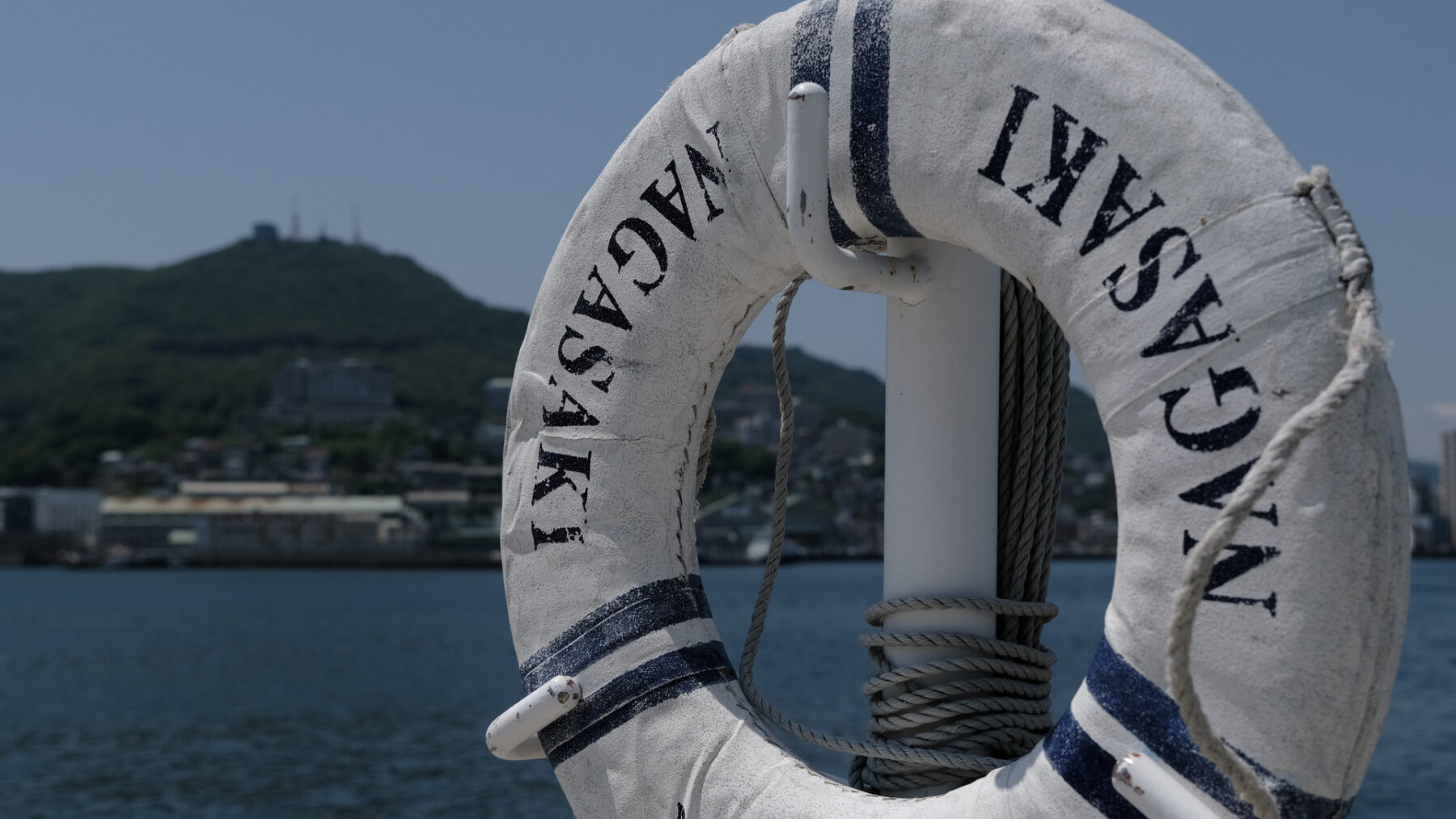
From 1641 to 1859, while Japan was closed to the outside world, all trade with Europe passed through one place: a fan-shaped artificial island in Nagasaki harbour, 120 metres across, where a handful of Dutch merchants were permitted to live under close supervision.
Everything Japan learned about Western medicine, astronomy and mechanics for two centuries came through that gate. The city that grew around it is the most cosmopolitan-feeling place in Japan, and it looks like nowhere else — a harbour ringed by steep hills, with churches, Chinese temples and Western mansions stacked up the slopes.
At a glance
- Days needed
- 2 days. 3 with Gunkanjima and the Shimabara peninsula.
- Getting there
- 1h 30m from Fukuoka by the Nishi-Kyushu Shinkansen and limited express
- Getting around
- Trams. A flat fare, and they go almost everywhere.
- Best months
- March–May, October–November. Summer is hot; the harbour helps.
- Rail pass
- JR Kyushu Rail Pass
- Famous for
- Dejima, the Hidden Christians, the atomic bombing, castella cake, and the night view
Dejima
The Dutch trading post, and the origin of everything distinctive about this city.
The island was built in 1636 to confine Portuguese traders, who were then expelled; the Dutch East India Company took it over in 1641 and stayed for two centuries. It was reclaimed into the surrounding land in the twentieth century and has since been painstakingly excavated and rebuilt — sixteen buildings restored so far, on the original footprint, with the eventual aim of restoring the water around it.
It is a good museum, and the fact of the place is more striking than any single exhibit: this small compound was the entire interface between Japan and Europe for over two hundred years.
The Hidden Christians
Christianity arrived in Japan in 1549, spread rapidly around Nagasaki, and was then banned and violently suppressed from 1614. Some communities survived for seven generations without priests, churches or written scripture, disguising their faith — a statue of Kannon holding a child stood in for the Virgin Mary — and passing it on orally.
They revealed themselves in 1865 to a French priest at Oura Church, in what is one of the more extraordinary moments in religious history. The church, built for foreign residents just weeks earlier, is now Japan’s oldest surviving Christian building and a National Treasure.
The Hidden Christian Sites in the Nagasaki Region were inscribed by UNESCO in 2018, comprising twelve locations including villages on remote islands.
Nearby, Glover Garden preserves the Western merchant houses on the hillside above the harbour, including the oldest Western-style wooden building in Japan.
The atomic bombing
At 11:02am on 9 August 1945, a plutonium bomb detonated over the Urakami valley, roughly three kilometres from the intended target, which had been obscured by cloud.
The Peace Park and the Atomic Bomb Museum sit near the hypocentre. The museum is smaller than Hiroshima’s and organised more chronologically, with more attention to the international context and the aftermath.
Urakami Cathedral, once the largest church in East Asia, stood 500 metres from the hypocentre and was destroyed. A section of its wall remains at the original site; the rebuilt cathedral stands alongside. The bombing killed a substantial proportion of the Japanese Christian community that had survived two and a half centuries of persecution — a fact the city does not let you overlook.
Gunkanjima — Battleship Island
Hashima, nineteen kilometres offshore: a coal-mining island that at its peak in 1959 held over 5,000 people on 6.3 hectares, making it the most densely populated place on earth. It had Japan’s first large reinforced-concrete apartment block, built in 1916.
The mine closed in 1974 and everyone left within weeks. The island has been empty ever since, and the concrete is collapsing.
Boat tours land on a small reinforced section; you cannot enter the buildings. Landings are weather-dependent and frequently cancelled — roughly a third of scheduled tours do not land. Book early in your stay so you have a second chance.
The island is part of a UNESCO industrial heritage listing, which is contested: Korean and Chinese forced labourers worked here during the war, and the interpretation of that history has been the subject of ongoing diplomatic dispute. Good tour operators address it; some do not.
The rest of the city
Mount Inasa — a ropeway to a viewpoint over the harbour. Nagasaki’s night view is officially ranked among Japan’s three best and, unusually for such claims, deserves it: the city wraps around black water on all sides.
Shinchi Chinatown — one of Japan’s three, and the oldest, dating to the seventeenth century when Chinese traders were confined to their own quarter.
Sofukuji and Kofukuji — Chinese Obaku Zen temples with Ming-dynasty architecture found nowhere else in Japan.
Megane-bashi — the “spectacles bridge”, built by a Chinese monk in 1634, whose two arches reflect in the river to form circles.
Oranda-zaka — “Dutch slope”, a cobbled hill of Western houses.
What to eat
Nagasaki’s food is the most obviously foreign-influenced in Japan.
- Champon — noodles in a milky pork-and-seafood broth with a mound of vegetables and squid. Invented here in the 1890s by a Chinese restaurateur for poor Chinese students.
- Sara udon — the crispy-noodle version of the same thing.
- Castella — a sponge cake brought by the Portuguese in the sixteenth century, now unmistakably Japanese. Fukusaya and Bunmeido are the old houses.
- Toruko rice — “Turkish rice”: pilaf, spaghetti and a breaded pork cutlet on one plate, with curry sauce. It has nothing to do with Turkey and is enormous.
- Shippoku — a formal banquet cuisine mixing Japanese, Chinese and European elements, served on a round table.
Beyond the city
Shimabara Peninsula — an hour east. Mount Unzen, an active volcano that erupted catastrophically in 1991, with a good hot spring town and a preserved samurai street.
Huis Ten Bosch — a large theme park near Sasebo recreating a Dutch town, which is stranger and more popular than it sounds.
The Goto Islands — five hours by ferry, with several of the Hidden Christian churches and almost no visitors.
Where to stay
Around Nagasaki Station — most convenient, and the tram network starts here. Around Dejima and the waterfront — closer to the restaurants and the old quarter. Unzen or Obama Onsen — hot spring towns an hour away, if you have a car.
Combine it with
Nagasaki is 1h 30m from Fukuoka on the Nishi-Kyushu Shinkansen and its connecting express, and fits naturally into a Kyushu loop with Kumamoto and Kagoshima to the south.
→ Fukuoka: Kyushu’s gateway and its yatai streets
Questions people actually ask
Hiroshima or Nagasaki?
If you are only doing one, Hiroshima — the museum and park are larger and the city is easier to reach. Nagasaki is the more interesting city in every other respect, with a history that has nothing to do with 1945.
Is Gunkanjima worth booking?
Yes, if you accept that roughly a third of tours cannot land. Book early in your stay so a cancellation leaves you a second attempt, and choose an operator that addresses the forced labour history.
How long do I need?
Two full days covers Dejima, Glover Garden, the Peace Park, Chinatown and the night view. Three lets you add Gunkanjima or Shimabara.
Are the trams easy to use?
Very. A flat fare of around 140 JPY anywhere, IC cards accepted, four lines, and they reach nearly every sight. A day pass is available and pays for itself in four rides.
Is the Hidden Christian history accessible to visitors?
Yes. Oura Church and its museum are in the city and well interpreted in English; the remote village sites need a car or a ferry and considerably more time.
Why does Nagasaki look so different from other Japanese cities?
Two hundred years as the only foreign trade port, a large Chinese community, a hillside harbour geography with no room for a grid, and a Christian history that produced churches where other cities have only temples.
Keep planning
Ghibli Park and the Ghibli Museum: How to Get Tickets
Two separate places, 350 kilometres apart, with two separate ticket systems and no tickets at the door. Both release on the 10th…
Kamakura and Enoshima: The Easiest Day Trip from Tokyo
An hour from Tokyo Station: a bronze Buddha from 1252, temples in the hills behind the town, and a tram that runs…
Nikko in a Day: The Shrines, the Lake, and Which Pass to Buy
Nikko is two day trips in one place: gilded shrines in the town, and a lake and a waterfall an hour above…