Wakayama: Koyasan and the Kumano Kodo
A monastery town of 117 temples on a mountain plateau, a pilgrimage route walked for a thousand years, and a night sleeping in a temple with a 6am service. The most atmospheric two days in Kansai.
 Signpost Japan
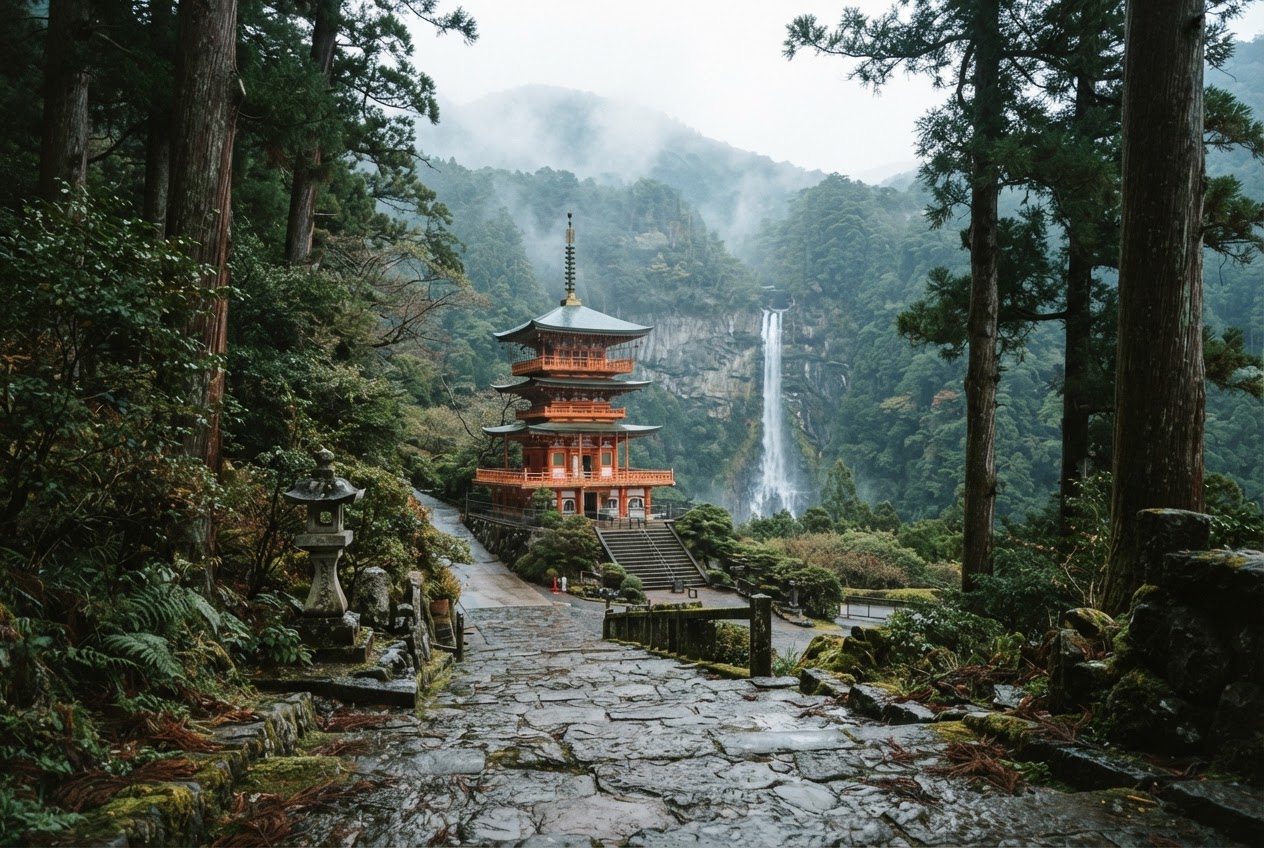
Wakayama occupies the mountainous Kii Peninsula south of Osaka, and it holds two of the more remarkable places in Japan: a monastic settlement founded in 816 on a plateau at 800 metres, and a network of pilgrimage trails so old and so continuously used that UNESCO listed them alongside the Camino de Santiago.
Neither is difficult to reach. Koyasan is two hours from Osaka. And a night in a temple is one of the few genuinely different things you can do in Japan.
At a glance
- Days needed
- 1 night for Koyasan. 3–5 days to walk a meaningful stretch of the Kumano Kodo.
- Getting there
- Koyasan: 2h from Osaka Namba via Nankai. Kumano: bus from Kii-Tanabe or Shingu.
- Getting around
- Koyasan is walkable. The Kumano Kodo needs buses and your feet.
- Best months
- April–June, September–November. Koyasan is deep in snow in winter.
- Rail pass
- No JR pass reaches Koyasan — use the Nankai Koyasan World Heritage Ticket
- Do not miss
- A night in a temple, and Okunoin cemetery after dark
Koyasan
In 816 a monk named Kukai — posthumously Kobo Daishi — was granted a mountain plateau to found a monastery for the Shingon school of esoteric Buddhism he had brought back from China. It grew into a town of temples that at its peak numbered over 1,500.
About 117 remain, along with a working monastic community, a high school, a fire station and a convenience store. It is not a museum. It is a small town whose main industry is Buddhism.
Okunoin
The single most extraordinary place in Kansai, and the reason to stay overnight.
A cemetery of over 200,000 graves stretching two kilometres through a forest of cryptomeria, some of the trees over 600 years old. Feudal lords, samurai clans, founders of Japanese corporations — Panasonic and Nissan both have company memorials here — and, at the far end, the mausoleum of Kobo Daishi.
Shingon doctrine holds that Kukai is not dead but in eternal meditation, awaiting the future Buddha. Monks deliver him two meals a day, at 6am and 10:30am, and have done so continuously for over 1,100 years. You can watch the procession.
Walk it at night. The path is lit by stone lanterns, the trees are enormous, and there is almost nobody there. Several temples run guided night walks with a monk.
Photography is not permitted beyond the Gobyobashi bridge at the end.
The rest of the town
Danjo Garan — the central temple complex, with the vermillion Konpon Daito pagoda, 45 metres high, representing the centre of a three-dimensional mandala.
Kongobu-ji — the head temple of Shingon, with painted sliding screens and Japan’s largest rock garden.
Daimon — the great gate at the western entrance, with a view over the valley at sunset.
Staying in a temple
Around fifty temples take overnight guests (shukubo), and this is how Koyasan should be done.
Arrive by 4pm
Check-in is early and firm. Monks show you to a tatami room with a futon, sliding paper doors and, usually, no lock.
Bathe before dinner
Communal baths, often with a set schedule for men and women.
Dinner at about 5:30pm
Shojin ryori — Buddhist vegetarian cuisine, entirely plant-based, no onion or garlic. Served on lacquer trays, elaborate and genuinely good. Koyasan’s sesame tofu is famous.
Walk Okunoin in the dark
Between dinner and bed. This is the point of staying.
Morning service at 6am
Optional but expected. Sutra chanting, incense, and in some temples a goma fire ritual. You sit at the back and observe.
Expect around 12,000–25,000 JPY per person with both meals. Rooms are simple, walls are paper-thin, and heating in winter is limited. Book well ahead in autumn.
Getting to Koyasan
From Osaka Namba, the Nankai Koya line to Gokurakubashi, then a five-minute cable car up the mountain, then a bus into town. About two hours total.
The Koyasan World Heritage Ticket covers the round trip from Namba, the cable car, unlimited buses in town, and discounts at the main temples. No JR pass covers any part of this route.
The train itself is worth the seat — the last section climbs through a gorge on a 1-in-20 gradient.
The Kumano Kodo
A network of pilgrimage routes across the Kii Peninsula, linking the three grand shrines of Kumano, walked continuously since at least the tenth century. Emperors made the journey from Kyoto; so did commoners, in such numbers that the traffic was described as a procession of ants.
Inscribed by UNESCO in 2004, and one of only two pilgrimage routes in the world with that status — the other is the Camino de Santiago. The two have a dual pilgrim programme: complete designated sections of both and you are formally recognised.
The three shrines
Kumano Hongu Taisha — the spiritual centre, in a cedar grove. The original site nearby, Oyunohara, is marked by the largest torii gate in the world, 34 metres high.
Kumano Nachi Taisha — beside Nachi Falls, Japan’s tallest single-drop waterfall at 133 metres, with a three-storey pagoda framed against it. This is the image of Kumano.
Kumano Hayatama Taisha — at Shingu, near the coast.
Walking it
The most-walked section is the Nakahechi route from Takijiri-oji to Hongu, roughly 40km over two or three days, through forest, over passes, staying in guesthouses in mountain villages.
You do not have to walk it all. Buses reach all three shrines, and short sections — the Daimon-zaka stone staircase up to Nachi, an hour of moss-covered steps between enormous cedars — give you the character of the route in a morning.
Luggage forwarding operates between the trail guesthouses, which is what makes a multi-day walk practical.
Also in Wakayama
Shirahama — a beach resort with white sand imported from Australia, coastal rock formations, and one of Japan’s three oldest hot springs.
Kii-Katsuura — a tuna port with an onsen resort reached only by boat, its baths in a sea cave.
Wakayama Castle — a reconstruction in the prefectural capital, worth an hour if passing.
What to eat
- Shojin ryori — the temple cuisine at Koyasan.
- Goma-dofu — sesame tofu, dense and nutty, a Koyasan speciality.
- Maguro — Kii-Katsuura lands more fresh tuna than any port in Japan; the morning auction is open to visitors.
- Mikan — Wakayama grows more mandarins than any other prefecture.
- Umeboshi — and more pickled plums, from Minabe, the centre of Japanese plum growing.
Combine it with
Koyasan pairs naturally with Osaka (2h) and Nara (2h 30m). The Kumano Kodo connects along the coast to Mie and Ise Grand Shrine, making a Kii Peninsula loop that is one of the best week-long routes in Japan for anyone who wants to walk.
→ Nara: the day trip everyone rushes, and how not to
Questions people actually ask
Do I need to be Buddhist to stay in a temple?
No. Temple lodging is open to anyone, foreign visitors are common and welcome, and the morning service is optional. Basic respect for the setting is all that is expected.
Is Koyasan a day trip from Osaka?
Possible but wasteful — two hours each way for a few hours on the mountain, and you miss Okunoin at night, which is the best part. Stay.
How difficult is the Kumano Kodo?
The Nakahechi route is moderate hill walking with sustained climbs and rough, root-covered ground, not technical but tiring. Short sections and shrine visits by bus require nothing more than ordinary fitness.
Is the food at a temple enough?
Shojin ryori is more substantial than people expect — eight or nine dishes, rice and soup. Vegans should confirm when booking, as some temples use bonito dashi.
What is Koyasan like in winter?
Cold, snowy and beautiful, with Okunoin under snow being genuinely extraordinary. Temple rooms are cold, buses are reduced, and some walking routes close.
Can I do Koyasan and Kumano together?
Yes — the Kohechi route links them directly on foot over four demanding days, or a bus connects Koyasan to Hongu in about four hours. It is one of Japan’s better slow-travel routes.
Keep planning
Ghibli Park and the Ghibli Museum: How to Get Tickets
Two separate places, 350 kilometres apart, with two separate ticket systems and no tickets at the door. Both release on the 10th…
Kamakura and Enoshima: The Easiest Day Trip from Tokyo
An hour from Tokyo Station: a bronze Buddha from 1252, temples in the hills behind the town, and a tram that runs…
Nikko in a Day: The Shrines, the Lake, and Which Pass to Buy
Nikko is two day trips in one place: gilded shrines in the town, and a lake and a waterfall an hour above…