Toyama and the Tateyama Kurobe Alpine Route
Six modes of transport in one day, from sea level to 2,450 metres, through a corridor cut in twenty metres of snow. Japan's most spectacular single journey, and the prefecture at either end of it.
 Signpost Japan
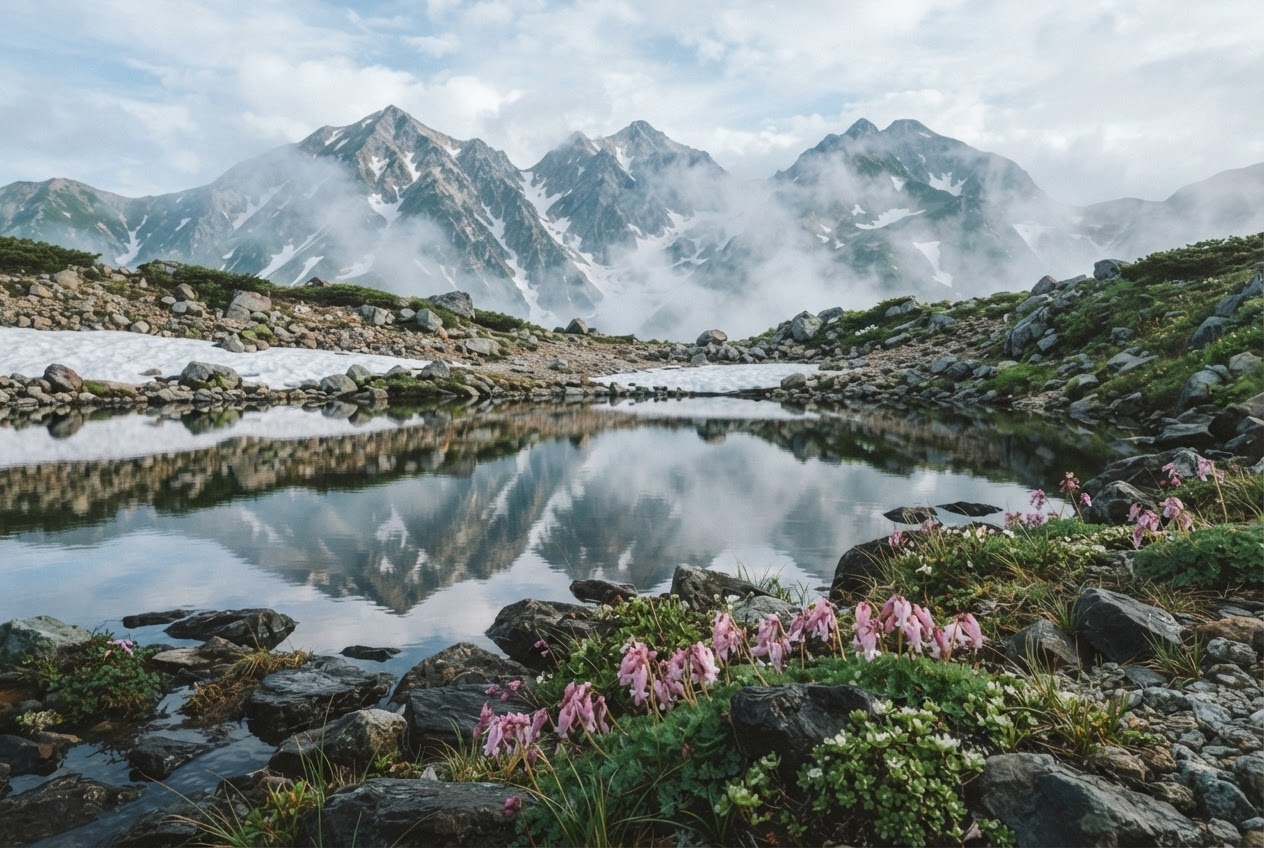
The Tateyama Kurobe Alpine Route is not a road you can drive. It is a chain of cable cars, trolleybuses, a ropeway and a funicular that crosses the Northern Japan Alps from Toyama on the Sea of Japan to Nagano’s Lake Kurobe, climbing from sea level to 2,450 metres in a single day.
For about six weeks each spring, the section at the top is cut through snow twenty metres deep, leaving a corridor with walls higher than a five-storey building. It is one of the genuinely extraordinary things you can do in Japan, and it requires almost nothing of you but a ticket.
At a glance
- Days needed
- 1 long day for the route. 2–3 to include Toyama city and Gokayama.
- Open
- Mid-April to end of November only. Closed all winter.
- Snow wall
- Mid-April to mid-June, deepest in late April
- Getting there
- Toyama: 2h 10m from Tokyo by Hokuriku Shinkansen
- Cost
- About 10,000–13,000 JPY for the full traverse, one way
- The catch
- It is one-way. Plan where you come out.
The route, section by section
The traverse runs between Dentetsu-Toyama on the west and Ogizawa in Nagano on the east, taking six to eight hours with stops.
Toyama to Tateyama — local railway, 60 min
The Toyama Chiho Railway up the valley. Rice fields, then gorge.
Tateyama to Bijodaira — cable car, 7 min
A funicular on a 29-degree gradient through beech forest.
Bijodaira to Murodo — highland bus, 50 min
The climb proper, past the 350-metre Shomyo Falls, Japan’s tallest. This is the section that runs through the snow corridor in spring.
Murodo — the top, 2,450m
Get out. Mikurigaike pond, volcanic vents, and in summer an alpine meadow. Allow at least an hour.
Murodo to Daikanbo — trolleybus through the mountain, 10 min
A tunnel bored under Mount Tateyama.
Daikanbo to Kurobedaira — ropeway, 7 min
No support pylons at all, so the view down is uninterrupted.
Kurobedaira to Kurobe Dam — cable car, then walk
Japan’s tallest dam at 186 metres. Water discharge from late June to mid-October is a spectacle in itself.
Kurobe Dam to Ogizawa — electric bus, 16 min
Out into Nagano, and a bus onwards to Shinano-Omachi station.
The snow wall
The Yuki-no-Otani — snow corridor — is the reason most visitors come. Ploughs cut a channel through the accumulated snow on the road below Murodo, and for a set period a section is opened for people to walk through it.
- Mid-April to mid-June. The wall is highest immediately after opening, typically 15–20 metres, and shrinks steadily.
- It is cold at the top even in May — often near freezing, with wind. Bring a proper coat and sunglasses; the glare off the snow is intense.
- Late April and Golden Week are extremely busy. Go on a weekday in early May or wait until late May, when the wall is still substantial and the crowds have thinned.
Booking
Sections have limited capacity, particularly the ropeway and the cable cars, and in the snow wall season and autumn colour timed reservations are effectively required. Book online in advance.
The Tateyama Kurobe Option Ticket and the Takayama-Hokuriku Area Tourist Pass both cover parts of the route and are worth pricing against individual tickets.
→ Regional rail passes: the 12 that actually save money
When to go
| Period | What you get |
|---|---|
| Mid-Apr – mid-Jun | The snow corridor. Highest in late April. |
| Jul – Aug | Alpine flowers at Murodo, hiking, cool air |
| Late Sep – Oct | Autumn colour, arriving at the top first |
| Nov | Snow returning, sections closing |
| Dec – mid-Apr | Closed entirely |
Toyama city
Worth a night at either end.
Toyama Glass Art Museum — a Kengo Kuma building of angled timber shared with the city library, and one of the better small museums in Japan. Free to enter the building; the exhibition floors are paid.
Toyama Castle Park and the Kansui Park canal-side, with a view to the Alps on a clear day.
Iwase — a preserved shipping merchant district on the coast, reached by tram, with restored warehouses and a good sake brewery.
The city’s tram network was rebuilt in the 2000s as a light rail system and is frequently cited as Japan’s best example of compact-city planning. It is also simply pleasant to use.
What to eat
Toyama Bay is deep, cold and close, which makes this one of the best seafood prefectures in Japan.
- Shiro-ebi — tiny white shrimp, translucent, caught almost nowhere else. Eaten raw over rice.
- Hotaru-ika — firefly squid, which spawn in the bay in spring and glow blue. Boiled, or raw in season.
- Buri — winter yellowtail from the bay, the best in the country.
- Masu-zushi — pressed trout sushi in a bamboo-wrapped round, a station bento classic since 1912.
- Kurobe gorge area soba, and Toyama Black ramen — a very dark, very salty soy ramen invented for post-war labourers.
Gokayama
A UNESCO site alongside Shirakawa-go, with the same thatched gassho-zukuri farmhouses and a fraction of the visitors. Two villages, Ainokura and Suganuma, both smaller and quieter than their famous neighbour.
If you have seen photographs of Shirakawa-go and want that without the coaches, come here instead. About 90 minutes by bus from Takaoka.
Kurobe Gorge Railway
A separate trip, and a good one. A narrow-gauge open-sided train built to service dam construction, running 20km up a gorge from Unazuki Onsen. Spectacular in autumn, and it ends at a hot spring.
Open roughly April to November.
Where to stay
Toyama city — business hotels near the station, well priced, and the Shinkansen is underneath. Unazuki Onsen — for the gorge railway, with ryokan along the river. Murodo — there are two hotels at 2,450 metres, which lets you see the route at dawn without the day crowds. Book far ahead. Shinano-Omachi — the Nagano end, if you traverse.
Combine it with
Toyama sits on the Hokuriku Shinkansen between Tokyo and Kanazawa — Kanazawa is 20 minutes away. Traversing the Alpine Route puts you in Nagano, which makes a natural Tokyo → Toyama → Alpine Route → Nagano → Tokyo loop.
→ Kanazawa: Kyoto without the queues → Nagano: snow monkeys, the Alps and Zenkoji
Questions people actually ask
Is the snow wall worth planning a trip around?
If you are in Japan between mid-April and mid-June, yes — there is nothing else like it. Outside that window the route is still a spectacular mountain crossing, just without the corridor.
Can I do it as a day trip from Tokyo?
Only just, and only as a return trip to Toyama rather than a traverse. It is a fourteen-hour day. A night in Toyama or at Murodo is far better.
What should I wear?
At Murodo in late April it is around freezing with wind and intense glare off the snow. A proper coat, gloves, waterproof shoes and sunglasses — even though you left sea level in shirtsleeves.
Do I need to book in advance?
In the snow wall season and during autumn colour, yes — capacity on the ropeway and cable cars is limited and timed slots sell out. Outside those periods you can usually turn up.
What do I do with my luggage?
Forward it between the two ends of the route, or between hotels. Carrying a suitcase through six changes of transport is genuinely impractical.
Is Gokayama better than Shirakawa-go?
Smaller and quieter, with the same architecture. If you want the photographs, Shirakawa-go is more dramatic; if you want to hear birds rather than coaches, Gokayama.
Keep planning
Ghibli Park and the Ghibli Museum: How to Get Tickets
Two separate places, 350 kilometres apart, with two separate ticket systems and no tickets at the door. Both release on the 10th…
Kamakura and Enoshima: The Easiest Day Trip from Tokyo
An hour from Tokyo Station: a bronze Buddha from 1252, temples in the hills behind the town, and a tram that runs…
Nikko in a Day: The Shrines, the Lake, and Which Pass to Buy
Nikko is two day trips in one place: gilded shrines in the town, and a lake and a waterfall an hour above…