Tipping in Japan, and Why Nobody Wants Your Money
There is no tipping in Japan, in any situation, and attempting it causes a small crisis. Here is why, what the charges on your bill actually are, and the two narrow exceptions where money does change hands.
 Signpost Japan
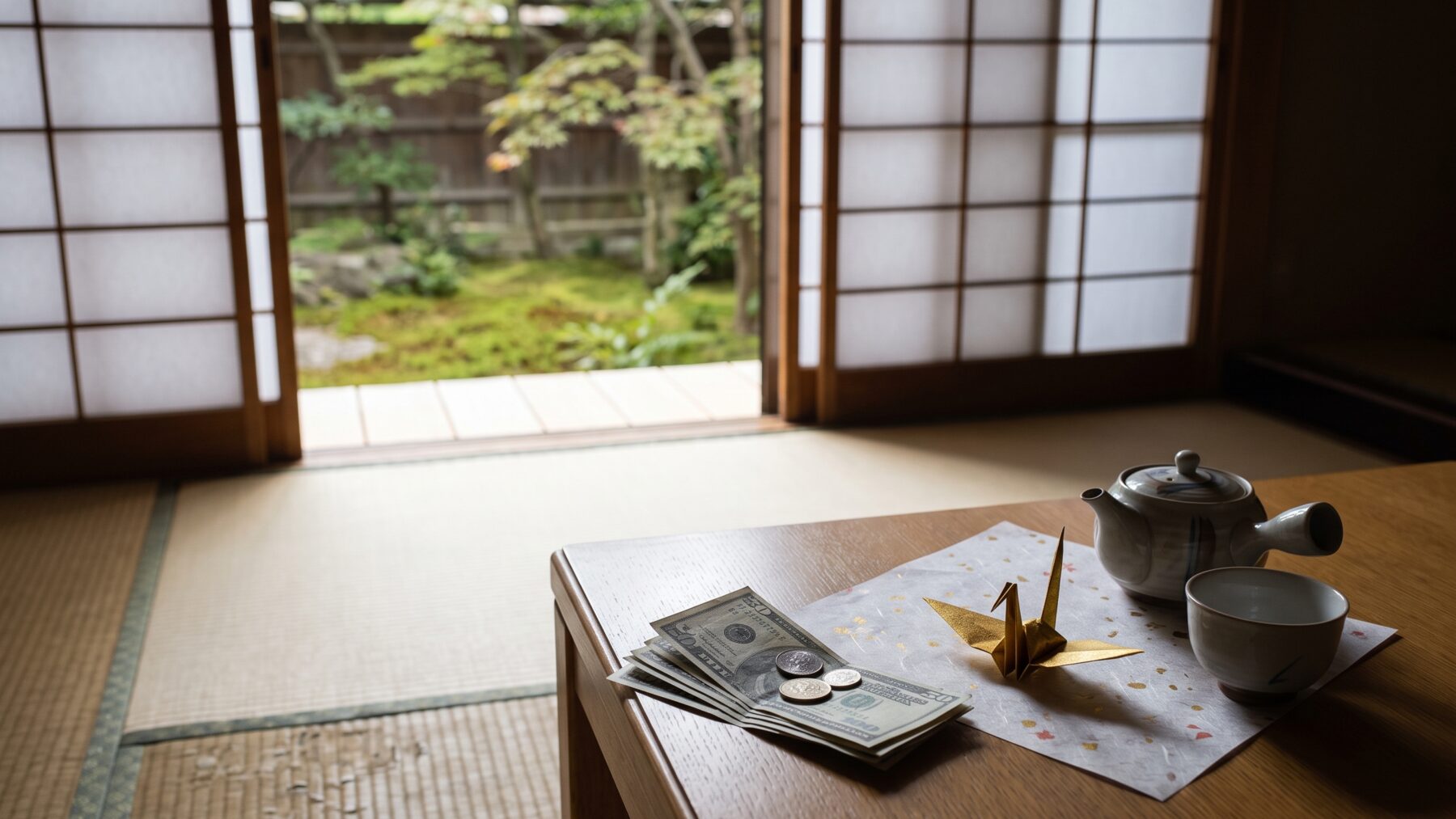
Japan is one of the few countries in the world with genuinely no tipping culture, and visitors from tipping countries find this harder to internalise than any other rule. They leave coins on tables, press notes on taxi drivers, and are then pursued down the street by someone convinced they have dropped their change.
The price you are quoted is the price you pay. That is the whole of it.
At a glance
- Restaurants
- No tip. Ever.
- Taxis
- No tip. The meter is the fare.
- Hotels
- No tip for porters, housekeeping or concierge.
- Guides and drivers
- No tip, though tour companies may include a gratuity in the package price
- The exceptions
- A ryokan kokorozuke, and some private guides used to foreign clients
- What is on the bill
- Otoshi (izakaya seat charge) and, at the top end, a service charge
Why not
Several strands, and they reinforce each other.
Service is not a variable. The concept of omotenashi treats hospitality as a standard the establishment owes you unconditionally, not a performance you can improve by paying more. Tipping implies the baseline is negotiable, which is faintly insulting to the person serving you.
Staff are paid properly. Japan has no tipped minimum wage. Restaurant workers are paid a wage that does not assume gratuities, so a tip is not filling a gap.
Prices are complete. Displayed prices include consumption tax by law, and there is no expectation of anything on top.
Handling money is formal. Cash is passed on a tray, counted, and accounted for. An unexplained extra amount is a bookkeeping problem, not a gift — many staff are simply not permitted to accept it.
What happens if you try
Predictable and slightly stressful for everyone.
- Coins on a restaurant table — a member of staff will collect them and run after you.
- Notes pressed on a taxi driver — refused, sometimes twice, and change will be counted out again.
- Money at a hotel desk — declined politely and repeatedly.
- Cash left in a hotel room — handed to reception as lost property, possibly with a phone call to you.
Nobody is offended. They believe you have made a mistake, and are trying to fix it for you.
What the charges on your bill actually are
Two things that look like tips and are not.
Otoshi
At an izakaya, a small dish arrives that you did not order, and 300–500 JPY per person appears on the bill.
This is otoshi — in Kansai, tsukidashi — a seat charge that comes with a small appetiser. It is standard, not optional, and not a scam. Think of it as a cover charge that arrives edible.
→ Izakaya etiquette: how a Japanese night out actually works
Service charge
At high-end restaurants, hotels and ryokan, a service charge of around 10–15% may be added, and it is disclosed on the menu or in the booking terms.
This is a charge to the business, not a distributed tip, and it does not replace or invite an additional gratuity.
Some bars — particularly small ones in nightlife districts — add a table charge (chaaji) of 500–1,000 JPY. Ask before sitting if it is not posted: Chaaji wa arimasu ka?
Bathing tax
In onsen towns, a per-person bathing tax (入湯税) of 150–500 JPY per night is levied by the municipality and appears on your ryokan bill. A local tax, not a tip.
The two exceptions
Narrow, and worth knowing precisely because they prove the rule.
Kokorozuke at a ryokan
At a traditional inn where a room attendant (nakai-san) looks after you personally, some Japanese guests give a kokorozuke — typically 1,000–3,000 JPY per guest, in a small envelope, handed over discreetly at the start of the stay rather than the end.
It is a gesture asking for good care, not payment for it. It is optional, increasingly rare, and never expected of foreign visitors. Cash handed over bare, or at departure, will be refused.
Private guides
Some private guides and drivers who work regularly with international clients have come to accept tips, because their clients insist. It remains not expected. If you want to, put it in an envelope and present it with both hands.
Where else money does not change hands
- Taxis — the meter is the fare. Drivers do not handle doors for tips; the rear passenger door opens automatically.
- Hotel porters — carrying your bag is part of the job.
- Housekeeping — no envelope, no coins on the pillow.
- Hairdressers, spas, massage — priced complete.
- Delivery drivers — no.
- Bar staff — no, including at high-end whisky bars where a bartender spends four minutes carving your ice.
- Tour guides at attractions — no.
What to do instead
If you had an unusually good experience and want to acknowledge it:
- Say so, clearly, at the time. Totemo oishikatta desu — it was delicious. Totemo tanoshikatta desu — it was very enjoyable.
- Write a review. Tabelog and Google reviews matter commercially to small businesses.
- Bring a small gift from home if you are staying somewhere for several nights or taking a private tour. Sweets or something regional from your own country is culturally legible in a way cash is not.
- Come back. Being a returning customer is the highest compliment available in Japanese service culture.
Saying thank you properly
Questions people actually ask
What if the service was exceptional?
Say so. Verbal thanks, a bow and a review are the accepted currency. Money would undercut the compliment rather than reinforce it.
Do I tip a private tour guide?
Not expected. Guides who work with foreign clients may accept one; if you want to, use an envelope and present it with both hands. Tour packages sometimes include a gratuity in the price, in which case nothing further is needed.
Is the 10% service charge at my hotel a tip?
No. It is a charge to the business, disclosed in advance, and it does not go to an individual. No additional tip is expected.
Why did I get a dish I did not order?
Otoshi — a seat charge at izakaya, 300–500 JPY, standard nationwide. Not optional and not a scam.
What about tipping in a taxi if the driver helped with luggage?
Still no. Say thank you. Drivers are salaried or on a fare percentage and will not take extra.
Is this changing with more tourists?
Slowly, in a small number of places aimed squarely at international visitors. The overwhelming default across the country remains no tipping, and it is safest to assume it everywhere.
Keep planning
The Japanese Year: Hanami, Tsuyu, Momiji and New Year
Japan pays more attention to the calendar than almost any country, and the whole population moves in step with it. What each…

Matsuri: What Happens at a Japanese Festival and How to Join In
Portable shrines carried by four hundred people, illuminated paper warriors, and a dance anyone can join. The dozen festivals worth planning a…
On Trains, in Queues, with Rubbish: Public Behaviour in Japan
Why Japanese trains are silent, why there are no bins, and why the escalator side changes between Tokyo and Osaka. The public…