On Trains, in Queues, with Rubbish: Public Behaviour in Japan
Why Japanese trains are silent, why there are no bins, and why the escalator side changes between Tokyo and Osaka. The public rules that visitors break most often, and what is behind each one.
 Signpost Japan
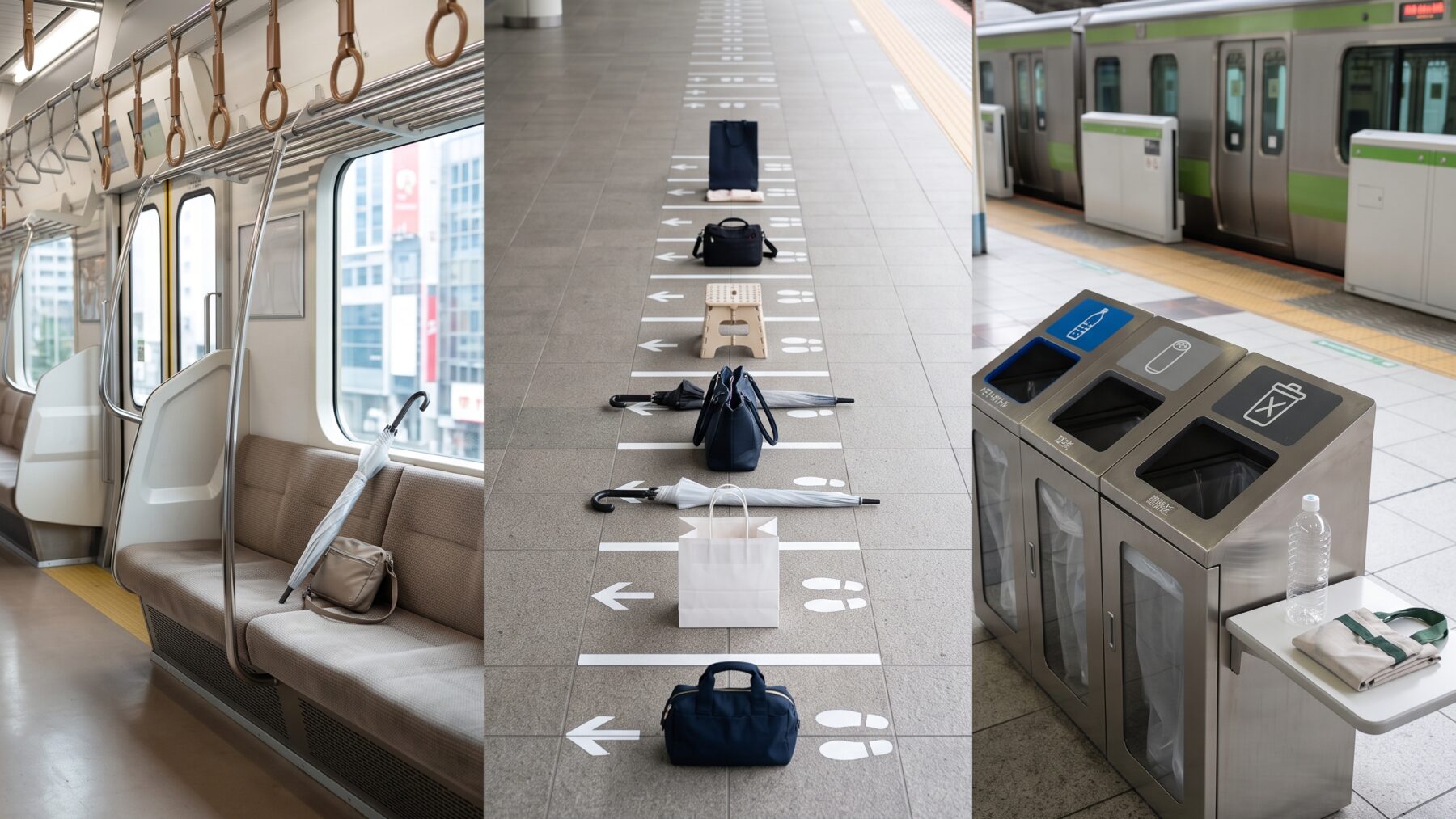
Japan’s public spaces run on a set of shared conventions that are almost never stated aloud, which is precisely why visitors break them. Nobody will tell you. You will simply be the loud one.
None of these are difficult. All of them come from the same place: a densely populated country where the cost of everyone behaving inconsiderately is very high, so almost nobody does.
At a glance
- Trains
- Near-silent. No phone calls, ever. Headphones must not leak.
- Rubbish
- Almost no public bins. Carry yours until you find one.
- Queues
- Marked positions, strictly observed. Never join at the side.
- Escalators
- Stand left in Tokyo, right in Osaka. Or stand still on either.
- Eating
- Not while walking. Not on commuter trains.
- Volume
- Half what you think is quiet
Trains
The most visible difference, and the one visitors most often get wrong.
No phone calls. Signs ask you to set your phone to silent mode (manaa mōdo) and refrain from calls. If you must take one, go to the vestibule between carriages and speak quietly. This is not a soft convention — it is universally observed and a call in a carriage will turn heads.
Keep conversation low. Groups talking at normal volume are the single most common visitor complaint. Watch how loud the locals are and go quieter.
Headphones must not leak. Audible bleed is called shakoshako and is genuinely disliked.
Priority seats. Marked, usually in a different colour, at the ends of carriages. Give them up for elderly people, pregnant passengers, those with disabilities and people with small children. Some people also switch off Bluetooth near them, a legacy of old pacemaker guidance.
Backpacks off in a crowded carriage — hold it in front or put it on the rack.
No eating on commuter trains. On Shinkansen and long-distance limited express services, eating is completely normal and expected. The distinction is local versus long-distance.
Women-only cars operate during weekday peaks on many urban lines, marked in pink on the platform edge and the door. Men should not board these at those times.
Let people off first. Stand to the side of the door, wait, then board. The floor markings show you where.
→ Tokyo trains explained: JR, Metro, Toei and the private lines
Rubbish
Japan has very few public bins, and the streets are among the cleanest in the world. Both facts are true and connected.
Most public bins were removed after the 1995 Tokyo subway sarin attack, and never came back. What replaced them is a norm: you carry your rubbish until you get home.
What to do:
- Carry a small plastic bag. Everyone does.
- Convenience stores have bins by the door — for things bought there, and nobody minds a coffee cup.
- Station platforms have bins, often separated by type.
- Vending machines have a bin beside them for cans and bottles only.
- Your hotel room bin takes the rest.
Separation matters. Burnable, plastic, PET bottles, cans, glass — often four or five categories. Bottles are meant to be emptied, the label peeled off and the cap separated. Nobody will chase you over it, but doing it correctly is easy and noticed.
Queues
Japan queues for everything, and the queue is orderly and enforced by nothing but general agreement.
- Platform markings show where each carriage door will be. Stand in the line behind them.
- Do not join at the side. Go to the back.
- Lifts and escalators are boarded in order.
- Shops and restaurants often have a line, sometimes with a ticket machine or a clipboard to write your name on.
Escalators are the exception that confuses everyone: stand on the left in Tokyo and eastern Japan, on the right in Osaka and Kansai. The dividing line is somewhere around Kyoto, and nobody agrees where.
Both regions now run campaigns asking people to stand still on both sides for safety, so standing on either side is increasingly acceptable. Watch and copy.
Volume, generally
The single most useful adjustment a visitor can make is to speak more quietly than feels natural.
This applies on trains, in restaurants, in hotel corridors, in temples, in lifts and on residential streets. Japanese public conversation runs at a lower volume than most Western countries, and a group at normal European or American volume is audibly the loudest thing in the room.
Late at night in residential areas it matters more. Walls are thin, and the person you wake gets up at six.
Eating and drinking
Not while walking. Mildly frowned upon everywhere and actively discouraged in crowded shopping streets — Kyoto has posted signs in Nishiki Market and Gion after years of dropped food and blocked lanes.
Buy the street food, stand near the stall, eat it there, put the wrapper in their bin.
Drinking alcohol in public is legal and unremarkable — a beer on the Shinkansen, in a park, at a festival. The line is noise, not alcohol.
Smoking
Reversed from what visitors expect. Smoking outdoors is restricted in most city centres, with fines in many wards, while some indoor bars still permit it.
Smoke in designated areas: glass-walled smoking rooms in stations and streets, marked outdoor corners, and dedicated rooms in some cafés. Vaping and heated tobacco fall under the same rules.
Photography
- Ask before photographing people. Always.
- Kyoto’s Gion prohibits photographing geiko and maiko on private streets, with posted fines. They are working women, not an attraction.
- Residential areas — people live there. Do not photograph into gardens or windows.
- Temples and shrines often prohibit photography inside halls. Signs are posted and vary building to building.
- Trains and stations — generally fine, but not with flash, and not blocking a platform.
Personal space and physical contact
Japan is not a physically demonstrative culture in public. Hugging on greeting is unusual, back-slapping is uncomfortable, and handshakes are used more for foreigners than between Japanese people.
Crowded trains are the exception, where everyone accepts contact that would be unthinkable elsewhere and manages it by ignoring it entirely.
What is actually fine
The list of anxieties that do not need to exist:
- Being visibly foreign. Nobody minds, and in rural areas you may get friendly curiosity.
- Not speaking Japanese. Expected. Any attempt is welcomed.
- Asking for help. Station staff, police boxes (koban) and shop staff will help, often at length.
- Being lost. Someone may walk you there.
- Tattoos in public. Only an issue at baths, pools and some gyms.
- Casual clothing. Fine everywhere a visitor goes.
In public
Questions people actually ask
Why are there so few bins?
Most were removed after the 1995 sarin attack on the Tokyo subway and never restored. The norm of carrying your own rubbish filled the gap, and it works.
Can I really not talk on the train?
You can talk quietly. What you cannot do is take a phone call — that is universally observed and immediately noticed.
Which side of the escalator do I stand on?
Left in Tokyo and eastern Japan, right in Osaka and Kansai. Both regions now encourage standing still on both sides for safety. Watch the person in front.
Is it rude to blow my nose?
In public, yes — it is considered unpleasant. Sniffing is the socially acceptable alternative, which surprises visitors. Blow your nose in a toilet.
Do I need to wear a mask?
Not required, though many people still do when unwell. Follow your own preference; nobody comments either way now.
What happens if I break one of these rules?
Almost certainly nothing. Nobody will confront you. That is exactly why it is worth knowing them — the correction that would happen elsewhere does not happen here.
Keep planning
The Japanese Year: Hanami, Tsuyu, Momiji and New Year
Japan pays more attention to the calendar than almost any country, and the whole population moves in step with it. What each…

Matsuri: What Happens at a Japanese Festival and How to Join In
Portable shrines carried by four hundred people, illuminated paper warriors, and a dance anyone can join. The dozen festivals worth planning a…
Tipping in Japan, and Why Nobody Wants Your Money
There is no tipping in Japan, in any situation, and attempting it causes a small crisis. Here is why, what the charges…