Izakaya Etiquette: How a Japanese Night Out Actually Works
The small dish you did not order, the rule about pouring your own drink, and why everyone orders a beer first. An izakaya is not a restaurant or a pub, and knowing which makes the evening work.
 Signpost Japan
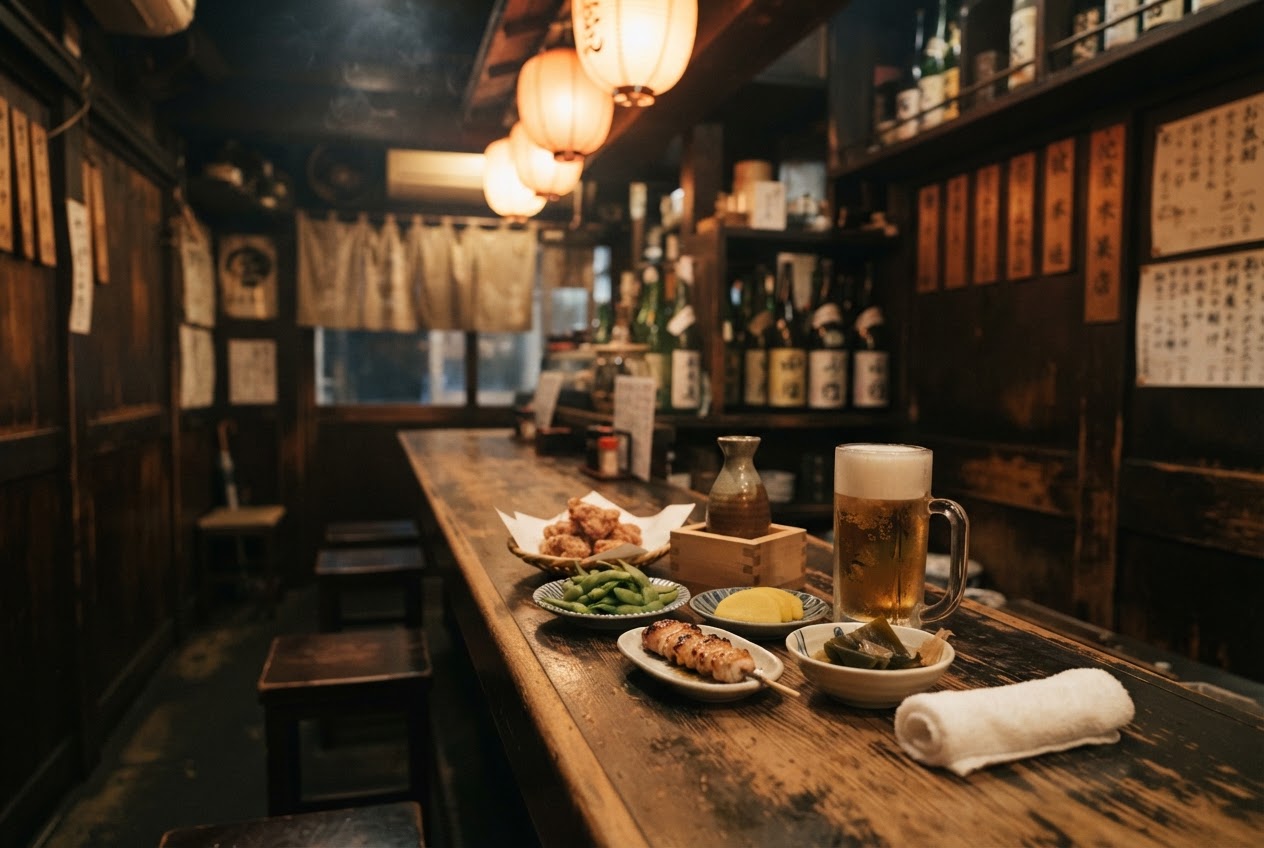
An izakaya is not a restaurant with drinks, and not a pub with food. It is a place where a group sits down for two or three hours, orders in waves, drinks steadily, and shares everything. The food arrives when it is ready rather than in courses, and nobody is waiting for anybody.
Once you understand the rhythm, it is the most enjoyable and the most economical way to eat out in Japan — and the easiest place to end up talking to strangers.
At a glance
- Cost
- 3,000–5,000 JPY per person with drinks
- Otoshi
- A small dish you did not order, 300–500 JPY. A cover charge, not a scam.
- First drink
- Everyone orders beer. It is a convention, not a rule, but it speeds things up.
- Pouring
- Pour for others, not yourself. Someone will fill your glass.
- Time limit
- Two hours is common at busy places, and stated on arrival
- Paying
- One bill, at the till, usually split evenly
Getting in
Look for a red lantern (akachochin) or a fabric curtain (noren) over the door. If the curtain is out, they are open.
You will be asked how many people. Say the number or hold up fingers. You may be asked whether you want a table, counter or tatami room, and at busy places you will be told there is a two-hour limit (nijikan sei) — this is normal and not rudeness.
Shoes come off for tatami seating and for the sunken-floor tables (horigotatsu) where your legs hang down.
Otoshi
A small dish arrives that nobody ordered. Simmered vegetables, a little salad, something pickled.
This is otoshi (or tsukidashi in Kansai), a seat charge of typically 300–500 JPY per person that comes with a small dish. It is not optional, it is not a tip, and it is not a scam. Think of it as a cover charge that arrives edible.
A few places aimed at tourists have started waiving it. Most have not.
The order of things
Order drinks immediately
Before you have looked at the food menu. Beer for everyone is the standard opening move because it arrives in ninety seconds and nobody has to decide.
Kanpai
Wait until everyone has a glass. Say kanpai, touch glasses, drink. Do not start before the toast.
Order four or five dishes to share
Edamame, karaage, sashimi, a salad, something grilled. Not one dish each — everything is shared.
Order again as you go
Two or three more waves over the evening. Ordering everything at once marks you out as a beginner and the food arrives cold.
Finish with something starchy
Rice, ochazuke, yakisoba or ramen. This is the signal that the evening is ending.
Ask for the bill at the table, pay at the till
O-kaikei onegai shimasu, or cross your index fingers into an X, which is the standard gesture.
Pouring
The one piece of etiquette that genuinely matters.
You do not pour your own drink. You pour for the people next to you, and someone will notice your glass is low and pour for you. Watch other people’s glasses; keeping them topped up is a small ongoing courtesy that structures the whole evening.
When someone pours for you, lift your glass slightly with both hands if you want to be polite. When pouring for someone senior, hold the bottle with two hands.
If nobody is pouring for you and you want a drink, top up someone else’s glass first. They will reciprocate immediately.
What to order
Openers — edamame, chilled tofu (hiyayakko), pickles, cabbage with miso dip.
Fried — karaage (fried chicken), agedashi dofu, croquettes, kushiage.
Grilled — yakitori on skewers; order tare (sauce) or shio (salt). Grilled fish, particularly hokke and saba.
Raw — sashimi platter (sashimi moriawase), which is usually good value and lets the kitchen show off.
Substantial — nabe hotpot in winter, motsunabe, yakisoba, ochazuke to finish.
If you cannot decide — osusume wa nan desu ka? (what do you recommend?). Izakaya staff enjoy this question and the answer is usually the best thing they have.
At an izakaya
Nomihodai
All-you-can-drink, usually 90 or 120 minutes, typically 1,500–2,500 JPY, often bundled with a set food course (nomihodai plus koosu).
Worth it if you will have four or more drinks. The catches: the range is limited to house options, last orders come 20–30 minutes before the end, and everyone at the table generally has to take it.
Paying
One bill. Japanese izakaya do not usually split by item — the group pays together and settles among themselves afterwards, often by dividing evenly (warikan).
Cash is safest, though cards are increasingly accepted in cities. No tipping, ever.
Types of izakaya
Chains — Torikizoku, Watami, Shirokiya. Cheap, picture menus, tablet ordering, entirely fine. Torikizoku’s flat-price yakitori is a national institution.
Independents — the small ones with eight seats and handwritten menus. Better food, more atmosphere, more likely to require some Japanese or pointing.
Tachinomi — standing bars. Cheap, fast, sociable, and the best value in Japan. Osaka’s are famous.
Yokocho — alleys of tiny bars: Omoide Yokocho and Golden Gai in Shinjuku, Nonbei Yokocho in Shibuya, Hozenji Yokocho in Osaka. Six seats, one owner, and often a cover charge.
Things worth knowing
- Smoking has been heavily restricted since 2020, but small bars below a certain size are exempt and some are still smoky. Look before you sit.
- Some yokocho bars have a cover charge of 500–1,000 JPY on top of otoshi, sometimes posted only in Japanese. Ask if you are unsure: Chaaji wa arimasu ka?
- Solo drinking is completely normal. Counter seats exist for exactly this.
- Getting drunk is socially tolerated to a degree that surprises visitors, but being loud in public afterwards is not.
- Last trains run around midnight. Watch the clock, or commit to the night.
→ When things go wrong: missed trains, lost tickets and the last train
Questions people actually ask
Can I go to an izakaya alone?
Yes, and it is common. Sit at the counter. Japan is the easiest country in the world to eat and drink alone in.
What is the small dish I did not order?
Otoshi — a seat charge of 300–500 JPY that comes with a small dish. Standard practice, not a scam, and not refusable.
Do I have to drink alcohol?
No. Oolong tea (uuron cha) is the standard non-alcoholic order and nobody comments. Non-alcoholic beer is widely available.
Is it rude to pour my own drink?
Not rude exactly, but it signals that nobody is looking after you. Pour for others and the favour returns immediately.
How much should an evening cost?
3,000–5,000 JPY per person at an ordinary izakaya with several dishes and three or four drinks. Standing bars can be half that.
Will they turn me away as a foreigner?
Rarely. Some tiny bars with regulars and no English will politely say they are full, which is occasionally a language-capacity decision rather than a hostile one. There are dozens more in the same alley.
Keep planning
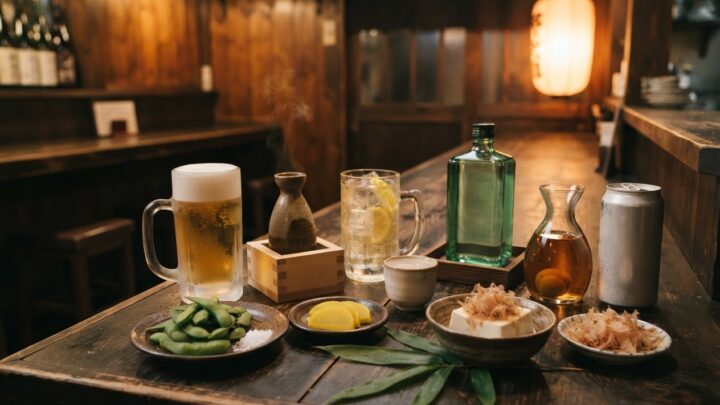
Drinking in Japan: Sake, Shochu, Highballs and Where to Try Them
How to read a sake label, why everyone is drinking whisky and soda, and the difference between a standing bar and a…
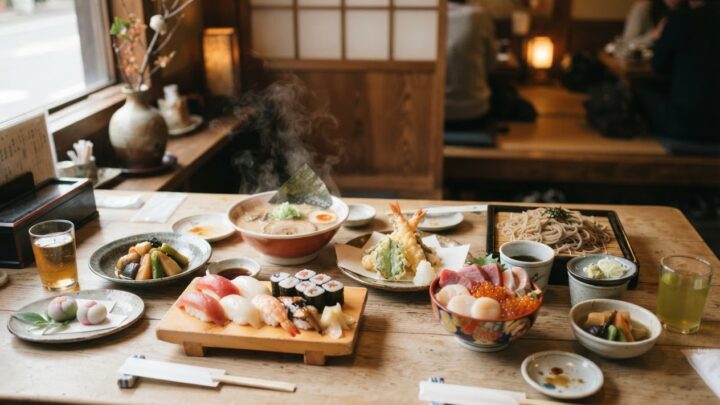
Sushi, Ramen, Udon, Soba: What to Eat Where
Six things worth eating properly at least once, what separates a good version from a bad one, and roughly what each should…
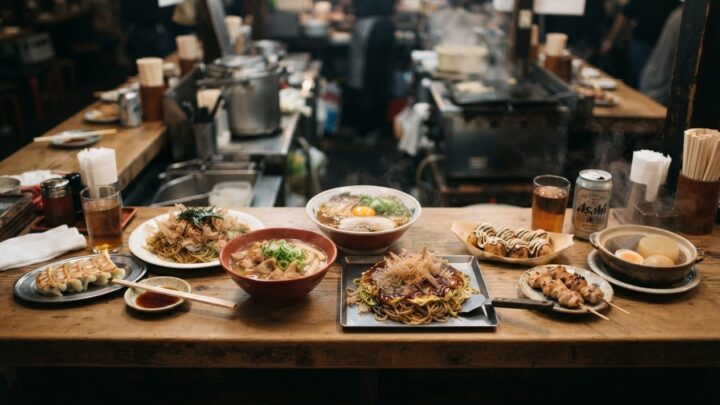
Regional Specialities, Prefecture by Prefecture
Japan organises its food by place with a seriousness other countries reserve for wine. One dish per prefecture worth changing your route…