Drinking in Japan: Sake, Shochu, Highballs and Where to Try Them
How to read a sake label, why everyone is drinking whisky and soda, and the difference between a standing bar and a place where you should not walk in. Plus the brewery visits worth planning a day around.
 Signpost Japan
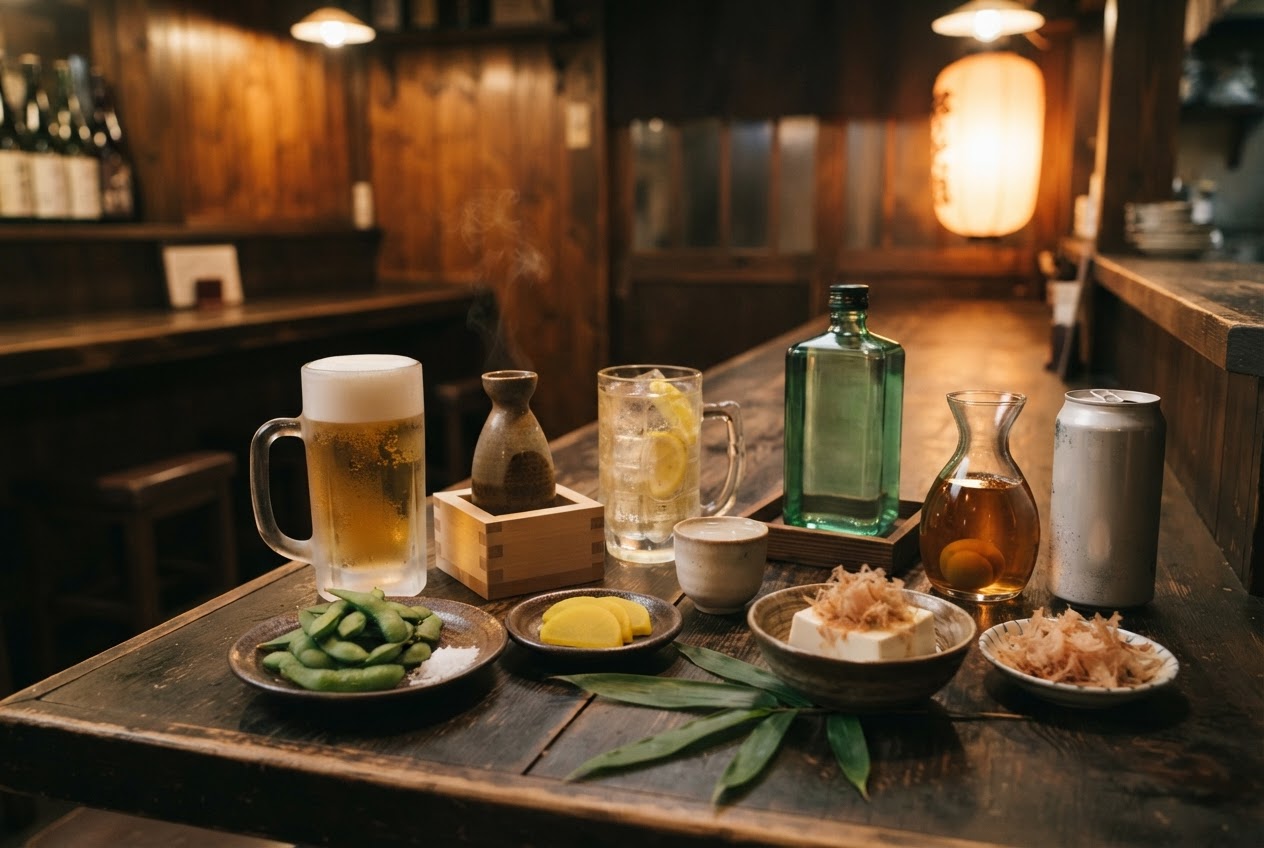
Japan drinks more variously than its reputation suggests. Sake is the obvious answer and it is not the most-consumed thing in the country — beer is, and after it shochu, and the drink you will see on more tables than any other in an izakaya is a whisky highball.
Here is what to order, how to read a label, and which bars will welcome you.
At a glance
- Legal age
- 20. ID is rarely requested but can be.
- Drinking in public
- Legal, and normal — parks, trains, festivals
- Beer
- The default first drink. Nama biiru is draught.
- Sake
- Served hot or cold. Cold is usually the better grade.
- Shochu
- Distilled, 25% ABV, drunk with water or soda
- Whisky highball
- Whisky and soda, the most ordered drink in Japan
Beer
Four big brewers — Asahi, Kirin, Sapporo and Suntory — and a serious craft scene that has grown fast since the 1990s.
Order nama (draught) rather than bottled. A large glass is 500–700 JPY at an izakaya, 220–280 JPY for a can at a convenience store.
Happoshu and new genre beers are lower-malt products designed around Japan’s beer tax bands. Cheaper, thinner, and everywhere.
Craft breweries worth knowing: Yona Yona, Baird, Hitachino Nest, Minoh, Coedo. Craft beer bars are common in Tokyo, Osaka and Kyoto.
Sake
Called nihonshu in Japan — sake just means alcohol generally.
Brewed from rice, water, koji mould and yeast. Around 15–16% ABV. The key variable is how much of each rice grain has been polished away before brewing: more polishing removes protein and fat from the outside of the grain, giving a cleaner, more aromatic result.
Reading a label
| Grade | Rice polished to | Character |
|---|---|---|
| Junmai | No minimum | Full, savoury, rice-forward |
| Honjozo | 70% or less | Light, a little added alcohol |
| Ginjo | 60% or less | Fragrant, fruity |
| Daiginjo | 50% or less | Delicate, aromatic, expensive |
Junmai on the label means no added distilled alcohol. So junmai daiginjo is the highest-polished, purest category.
Other words worth knowing: namazake (unpasteurised, fresh, must be refrigerated), nigori (cloudy, unfiltered), koshu (aged), taruzake (cedar-cask).
Hot or cold
Both are correct, but for different things.
Cold (reishu) suits ginjo and daiginjo, where aroma is the point. Warm (atsukan, around 45°C) suits junmai and honjozo, opening up savoury depth — and it is the right thing on a winter evening.
Cheap sake is often served hot because heat hides flaws. Good sake served hot is a deliberate choice, not a downgrade.
How to order
Sake comes by the go (180ml, in a small flask) or by the glass. In a good izakaya, ask for a recommendation: osusume no nihonshu wa?
Some places serve it in a glass inside a wooden box (masu), deliberately overfilled so it spills into the box — a gesture of generosity. Drink the glass, then the box.
Ordering a drink
Shochu
Distilled, typically 25% ABV, and consumed in greater volume than sake nationally.
Made from sweet potato (imo, from Kagoshima — earthy and pungent), barley (mugi, from Oita — lighter), rice (kome), or buckwheat. Kyushu is its heartland.
Usually served diluted: mizuwari (with water), oyuwari (with hot water, the winter version), or sodawari (with soda). Ordering it straight (roku, on the rocks) is fine but strong.
Awamori is Okinawa’s version, distilled from long-grain Thai rice, aged in clay pots, and stronger.
The whisky highball
The most-ordered drink in Japan, and the reason Japanese whisky sales recovered.
A highball is whisky and soda over ice, usually Suntory Kakubin, poured strong and cold. It is 500 JPY at an izakaya, sold in cans in convenience stores, and served from dedicated taps in some bars.
Japanese whisky proper — Yamazaki, Hakushu, Yoichi, Miyagikyo — has become extremely expensive since the mid-2010s as international demand outran supply. A single Yamazaki 18 in a Tokyo bar can cost more than a night’s accommodation.
A caution: the labelling rules for “Japanese whisky” were tightened by a voluntary industry standard only in 2021, and a good deal of cheap “Japanese” whisky is blended from imported spirit. For a genuine article, buy from a distillery or a reputable bar.
Distillery visits: Yamazaki (between Kyoto and Osaka), Hakushu (Yamanashi), Yoichi (Hokkaido) and Miyagikyo (Sendai) all run tours. Book months in advance — they fill immediately.
Where to drink
Izakaya — the default. Food and drink together, in a group.
→ Izakaya etiquette: how a Japanese night out actually works
Tachinomi — standing bars. Cheap, fast and sociable. Osaka’s are the best in Japan, often under railway arches, with regulars who will talk to you.
Yokocho — alleys of tiny bars. Shinjuku’s Golden Gai and Omoide Yokocho, Shibuya’s Nonbei Yokocho. Atmospheric and touristed; many have a cover charge of 500–1,000 JPY.
Kissaten and coffee bars — Japan’s coffee culture is old and serious. A kissaten is a 1960s-style café with siphon coffee, a smoking section that may still exist, and thick toast.
Whisky bars — dimly lit, seated at a counter, one bartender, hundreds of bottles, and total precision including hand-carved ice. Expect a cover charge. This is where to spend an evening if you like spirits.
Snack bars — small bars with a mama-san who talks to customers. Regular-oriented, often with an unposted charge, and generally not for walk-ins without an introduction.
Brewery and distillery visits
Sake breweries (sakagura) run tours and tastings, and many are in beautiful old buildings.
- Fushimi, Kyoto — Gekkeikan Okura Sake Museum, walkable from the city.
- Nada, Kobe — Japan’s largest sake district, with several open breweries.
- Niigata — Ponshukan at Niigata station has a vending machine wall of about 100 local sakes, 100 yen a shot. It is the most efficient sake education available.
- Saijo, Hiroshima — a street of seven breweries with brick chimneys.
Drinking culture, briefly
- Public drinking is legal and unremarkable. Beer on a Shinkansen is normal; beer in a park at hanami is the point of hanami.
- Do not pour your own drink. Pour for others and yours will be filled.
- Drink driving is zero tolerance, with severe penalties extending to anyone who let the driver drink.
- Getting drunk is tolerated far more than in most countries; being loud outside afterwards is not.
- Last trains go around midnight. Plan for it.
Not drinking
Entirely fine and increasingly common. Oolong tea (uuron cha) is the standard order and nobody comments. Non-alcoholic beer, spirits and cocktails are widely available — Japan’s non-alcoholic range is unusually good, driven by strict drink-driving law.
The one social thing to know: join the toast. Hold a glass of something and say kanpai with everyone else. What is in the glass is nobody’s concern.
Questions people actually ask
Is sake strong?
Around 15–16% — stronger than wine, much weaker than spirits. Shochu at 25% is usually diluted with water or soda before serving.
What should I order if I do not know?
A draught beer first, then ask for a recommendation. Osusume wa? is the most useful phrase in a Japanese bar.
Is Japanese whisky worth the money?
The famous aged expressions are priced by scarcity rather than quality now. Younger releases and the highball culture are where the value is.
Can I drink on the street?
Yes, legally. It is common at festivals and hanami. Drinking while walking in a busy shopping district is mildly frowned upon rather than prohibited.
Are there bars that refuse foreigners?
A small number of regulars-only bars, mostly snack bars, effectively operate on introduction. It is a tiny minority, and every yokocho has a dozen alternatives.
Where do I buy sake to take home?
Department store basements and specialist liquor shops give the best selection and will advise. Buy after airport security to avoid liquid restrictions, and check your allowance — three 760ml bottles is the standard duty-free limit for most destinations.
Keep planning
Sushi, Ramen, Udon, Soba: What to Eat Where
Six things worth eating properly at least once, what separates a good version from a bad one, and roughly what each should…
Izakaya Etiquette: How a Japanese Night Out Actually Works
The small dish you did not order, the rule about pouring your own drink, and why everyone orders a beer first. An…
Regional Specialities, Prefecture by Prefecture
Japan organises its food by place with a seriousness other countries reserve for wine. One dish per prefecture worth changing your route…