Sushi, Ramen, Udon, Soba: What to Eat Where
Six things worth eating properly at least once, what separates a good version from a bad one, and roughly what each should cost. Japan's great dishes are specialities — the shops that do them do only them.
 Signpost Japan
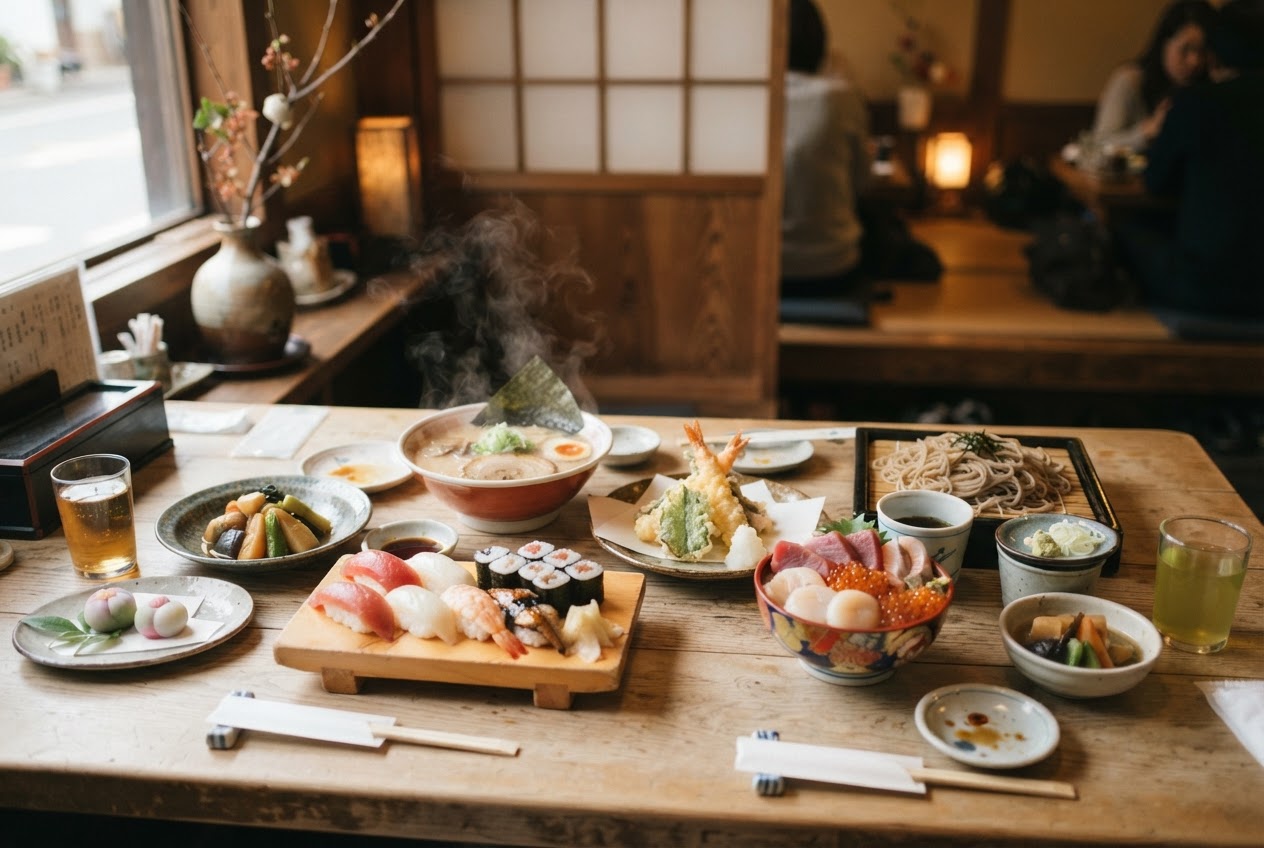
The organising principle of Japanese eating is specialisation. A sushi restaurant serves sushi. A ramen shop serves ramen. A tempura restaurant serves tempura, and has done for three generations.
A place with sushi, ramen, tempura and curry on the same menu is a family restaurant, and it will be fine and unremarkable. The good version of each dish is at a shop that does nothing else.
Here are six worth seeking out, with what to look for and what to pay.
At a glance
- Ramen
- 900–1,400 JPY. Regional styles differ enormously.
- Sushi
- 1,000 JPY at a conveyor belt, 3,000–5,000 at lunch, 20,000+ at a counter
- Udon
- 300–800 JPY. Kagawa is the place.
- Soba
- 800–1,500 JPY. Look for 100% buckwheat.
- Tempura
- 1,500 JPY at lunch, 10,000+ at a counter
- Tonkatsu
- 1,500–2,500 JPY
- The lunch trick
- The same kitchens serve set lunches at a third of dinner prices
Ramen
Not traditional — ramen arrived from China around 1900 and became a national obsession after the war. It is the most dynamic thing in Japanese food, with new styles appearing constantly.
The four broth bases:
| Style | Base | Where |
|---|---|---|
| Shoyu | Soy sauce, clear brown | Tokyo, and the default nationally |
| Miso | Fermented soybean paste, heavy | Sapporo — invented for the cold |
| Shio | Salt, light and clear | Hakodate |
| Tonkotsu | Pork bone, opaque and rich | Fukuoka |
What good looks like: clear intent in the broth, noodles cooked to order and slightly firm, and a shop that is full at an odd hour. A queue at 3pm is the strongest signal in Japanese food.
How to order: many ramen shops use a ticket machine. In tonkotsu shops you specify noodle firmness — futsu (normal), katame (firm), barikata (very firm) — and can order kaedama, a noodle refill, for a few hundred yen.
Eat it fast. Ramen is designed to be finished in ten to fifteen minutes before the noodles soften. Slurping helps and is expected.
Sushi
Three quite different experiences at three price points.
Kaitenzushi (conveyor belt) — 100–500 JPY a plate. Sushiro, Kura, Hama-zushi are the big chains, and they are genuinely decent. Touchscreen ordering in English, plates arrive on a track, and you stack them for the bill. The best introduction, and fine for families.
Lunch sets — 1,500–4,000 JPY. A proper sushi restaurant at midday, serving a fixed selection. This is the value sweet spot in Japanese dining.
The counter — 15,000–40,000 JPY, omakase, chef’s choice, eaten one piece at a time as it is made. Booked weeks ahead. Worth doing once if the budget exists.
At a counter:
- Eat each piece immediately, in one bite, within about ten seconds of it being placed.
- Fingers are fine. Sushi was street food.
- Dip fish-side down, lightly. Do not soak the rice.
- Do not add wasabi — the chef has already put the right amount inside.
- Ginger is a palate cleanser between pieces, not a topping.
Udon
Thick wheat noodles, and the least intimidating dish in Japan. Chewy, mild, cheap, and everywhere.
Sanuki udon from Kagawa is the benchmark — square-edged and notably firm. The prefecture has around 600 udon shops and many are self-service, where you rinse or heat your own noodles, add broth from a tap, and take tempura from a counter.
Hot or cold: kake (in hot broth), zaru or bukkake (cold, dipped). Cold in summer is the better version.
A bowl costs 300–800 JPY. It is the cheapest good meal in Japan.
→ Kagawa and the Setouchi art islands
Soba
Buckwheat noodles, and the more serious of the two great noodle traditions. Thin, grey-brown, nutty, and eaten cold as often as hot.
Look for juwari (十割) — 100% buckwheat, no wheat flour. Most soba is cut with wheat; the pure version has a distinct flavour and a shorter, more fragile texture.
Nagano and Shimane are the noted regions. Standing soba at a station — 400 JPY, ninety seconds, surprisingly good — is a genuine part of Japanese daily life and worth doing.
At the end of a cold soba meal you may be given a small pot of sobayu, the starchy water the noodles were cooked in. Pour it into the remaining dipping sauce and drink it.
Tempura
Not a batter dish so much as a steaming technique: the coating is thin and light, and its job is to hold moisture in the ingredient while it cooks.
Good tempura is not greasy. If it is, the oil was not hot enough.
At a counter, pieces are fried and served one at a time. Eat immediately — thirty seconds makes a difference. Dip in tentsuyu sauce with grated daikon, or in salt, which is how the better ingredients are meant to be eaten.
Lunch sets 1,500–3,000 JPY; a proper counter dinner 10,000 upwards.
Tonkatsu
A breaded, deep-fried pork cutlet, served sliced with shredded cabbage, rice and miso soup.
Two cuts: rosu (loin, with a fat cap, more flavour) and hire (fillet, leaner, more tender). Rosu is the one to order first.
The cabbage is bottomless in most shops — ask for more. You grind your own sesame seeds in a mortar and mix in the sauce.
1,500–2,500 JPY, and one of the most reliably satisfying meals in Japan.
And the rest
- Okonomiyaki — a savoury pancake, mixed in Osaka, layered with noodles in Hiroshima. Cooked at your table on a hotplate.
- Yakitori — grilled chicken on skewers, every part of the bird. Order shio (salt) or tare (sauce).
- Curry rice — Japanese curry is thick, mild and sweet, arrived via the British navy, and is comfort food rather than Indian cuisine.
- Unagi — grilled freshwater eel, expensive, and one of the great Japanese dishes. Nagoya’s hitsumabushi serves it three ways in one bowl.
- Gyudon — beef over rice, 500 JPY, served in ninety seconds at Yoshinoya or Sukiya. The Japanese fast food.
- Kaiseki — the formal multi-course meal. Expensive at dinner; many kaiseki kitchens serve a bento lunch for a fraction.
What a week of eating well looks like
| One person, one day, eating properly | Cost |
|---|---|
| Breakfast — konbini or hotel | 500 JPY |
| Lunch — sushi set at a proper restaurant | 2,200 JPY |
| Afternoon — coffee and something sweet | 800 JPY |
| Dinner — izakaya with two drinks | 2,800 JPY |
| Daily food total | 6,300 JPY |
You can eat very well in Japan for less than this. It is difficult to eat badly at any price.
Questions people actually ask
Is conveyor belt sushi any good?
Yes. The major chains are consistent and cheap, with English touchscreens. It is not a counter omakase, but it is a genuinely decent meal for 1,500 JPY.
Do I need to book restaurants?
Only high-end sushi, kaiseki and starred restaurants, which need weeks. Everywhere else, walk in and queue.
Is it rude to not finish?
Mildly awkward but not serious. Say gochisousama deshita regardless.
Which ramen style should I try first?
The local one. Tonkotsu in Fukuoka, miso in Sapporo, shoyu in Tokyo. Regional ramen tastes noticeably different and eating the local version is the point.
How do I find good places?
Queues, Tabelog scores above 3.5, department store restaurant floors, and station buildings. Avoid anywhere with someone outside trying to bring you in.
Is Japanese food expensive?
No. A superb bowl of ramen is 1,000 JPY and a set lunch at a serious restaurant is 1,500–2,000. Only the top tier — counter sushi, kaiseki, wagyu — is genuinely expensive.
Keep planning
Drinking in Japan: Sake, Shochu, Highballs and Where to Try Them
How to read a sake label, why everyone is drinking whisky and soda, and the difference between a standing bar and a…
Izakaya Etiquette: How a Japanese Night Out Actually Works
The small dish you did not order, the rule about pouring your own drink, and why everyone orders a beer first. An…
Regional Specialities, Prefecture by Prefecture
Japan organises its food by place with a seriousness other countries reserve for wine. One dish per prefecture worth changing your route…