Regional Rail Passes: The 12 That Actually Save Money
Since the national pass got expensive, the regional ones are where the value moved. Twelve passes, what each covers, and the trip shape that makes each one pay for itself.
 Signpost Japan
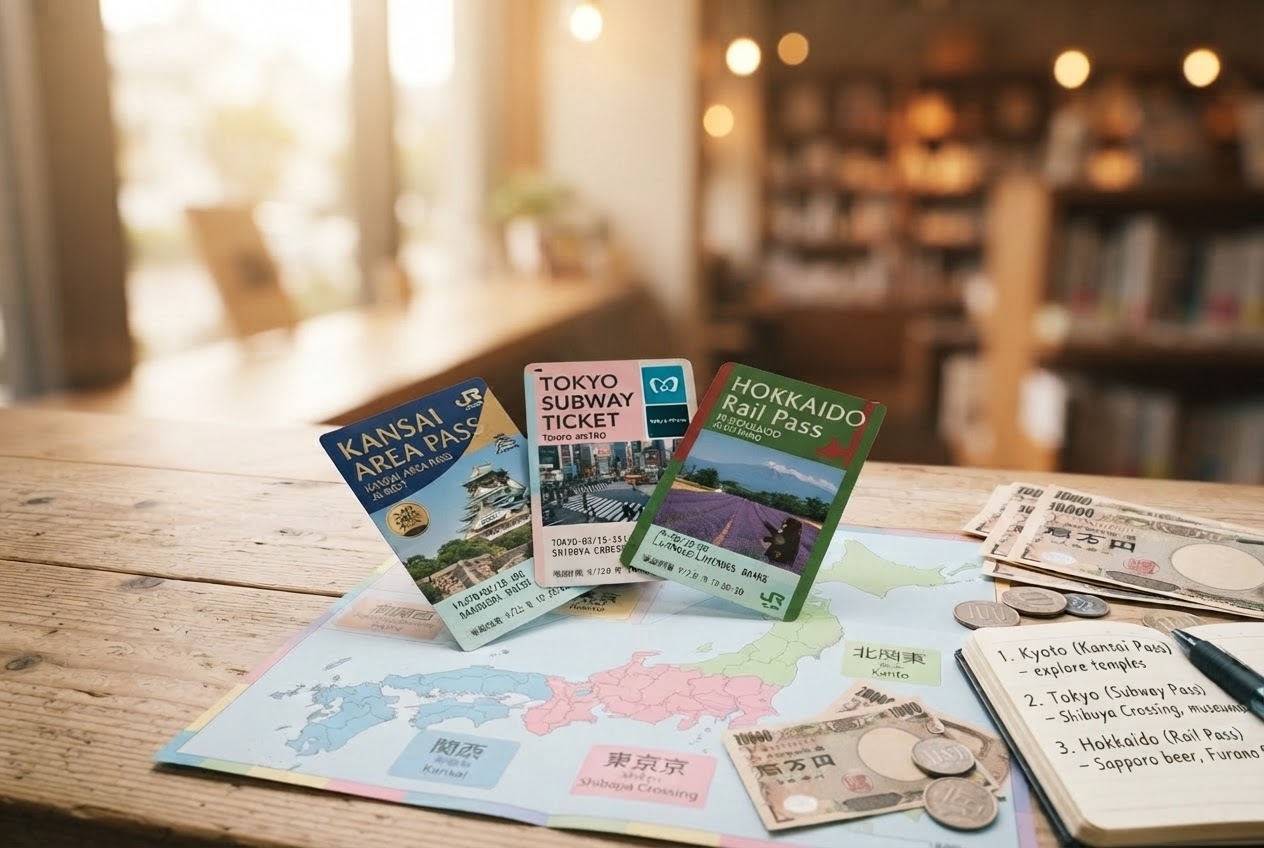
There are well over sixty rail passes in Japan and most travel writing mentions one. Since the national Japan Rail Pass rose sharply in late 2023, the regional passes are where the value went — and because each is sold by the company that operates the area, they cover exactly the ground a trip to that region uses.
The rule is simple. If your trip stays inside one or two regions, buy regional. If it crosses the whole country at speed, buy national.
At a glance
- Typical price
- 5,000–25,000 JPY, against 50,000 JPY for a 7-day national pass
- Validity
- Usually 3 to 7 consecutive days
- Where to buy
- Online before you travel, or at major stations and airports on arrival
- Passport
- Required. Most regional passes are for temporary visitors only.
- Combining
- You can hold two regional passes for different parts of one trip
How to choose in ninety seconds
- Write down every intercity journey in your itinerary.
- Price them individually with a fare calculator.
- Find the pass whose map contains all of them.
- Buy it only if it is cheaper than the sum, plus a little for the day trips you would then take for free.
Step four matters. A pass turns marginal day trips — Himeji, Nikko, Kobe, Miyajima — into free ones, and that is often where the real value sits.
Kansai and western Japan
JR West Kansai Area Pass — 1 to 4 days, from about 3,000 JPY. Osaka, Kyoto, Kobe, Nara, Himeji and the Kansai Airport express. Does not cover Shinkansen. The best-value pass in Japan for anyone based in Kyoto or Osaka doing day trips.
JR West Kansai Wide Area Pass — 5 days, about 12,000 JPY. Adds the Shinkansen as far as Okayama, plus Kinosaki, Amanohashidate and Wakayama. Pays for itself if you do Kansai plus one Shinkansen round trip.
JR West Kansai-Hiroshima Area Pass — 5 days, about 19,000 JPY. Kansai through to Hiroshima and Miyajima, Shinkansen included. This is the pass for the classic Kyoto–Osaka–Hiroshima week.
JR West Sanyo-San’in Area Pass — 7 days, about 23,000 JPY. Everything above plus the San’in coast, Tottori, Matsue and Hagi. The pass for anyone going to the quiet side of western Japan.
Tokyo and eastern Japan
JR East Tokyo Wide Pass — 3 days, about 15,000 JPY. Nikko, Karuizawa, Mount Fuji via Kawaguchiko, Izu, and the GALA Yuzawa ski Shinkansen. Three good day trips from Tokyo and it has paid for itself.
JR East Tohoku Area Pass — 5 flexible days within 14, about 30,000 JPY. Tokyo to Sendai, Aomori, Akita and everything between. Tohoku is far apart and its fares are high, so this one is unusually easy to justify.
JR East Nagano-Niigata Area Pass — 5 flexible days within 14, about 27,000 JPY. Nagano, Kanazawa via the Hokuriku Shinkansen, Niigata and Sado.
Central Japan
Takayama-Hokuriku Area Tourist Pass — 5 days, about 20,000 JPY. Nagoya, Takayama, Shirakawa-go, Kanazawa and on to Osaka. Includes the Shirakawa-go bus, which is otherwise an expensive and separately-booked leg. One of the better-designed passes in the country.
Mt. Fuji-Shizuoka Area Tourist Pass — 3 days, about 8,000 JPY. Fuji viewpoints, tea country, Shimizu.
Kyushu, Shikoku, Hokkaido
JR Kyushu Rail Pass — 3, 5 or 7 days, from about 12,000 JPY (northern Kyushu) to 25,000 JPY (all Kyushu). Fukuoka, Nagasaki, Kumamoto, Kagoshima and the Kyushu Shinkansen. Kyushu is compact and its highlights are strung along one line — this pass is close to essential.
All Shikoku Rail Pass — 3 to 7 days, from about 9,000 JPY. Covers JR and the private railways in Shikoku, which is rare and valuable, plus the Iya Valley bus.
JR Hokkaido Rail Pass — 5 or 7 days, from about 21,000 JPY. Sapporo, Hakodate, Furano, Asahikawa. Worth it in summer; in winter, check that your lines are running before you buy.
Which one for which trip
| Your trip | Buy |
|---|---|
| Based in Kyoto, day trips to Nara, Osaka, Kobe, Himeji | Kansai Area Pass |
| Kyoto, Osaka, Hiroshima, Miyajima in a week | Kansai-Hiroshima Area Pass |
| Tokyo base, day trips to Nikko, Fuji, Karuizawa | Tokyo Wide Pass |
| Tokyo to Sendai and the north | Tohoku Area Pass |
| Nagoya, Takayama, Shirakawa-go, Kanazawa | Takayama-Hokuriku Pass |
| Fukuoka, Nagasaki, Kumamoto, Kagoshima | JR Kyushu Rail Pass |
| Tokyo, Kyoto, Hiroshima and Kanazawa in seven days | National Japan Rail Pass |
Passes that are not JR
Two are worth knowing about because they cover the gaps JR leaves.
Kintetsu Rail Pass — Kyoto, Nara, Osaka, Ise and Nagoya on the Kintetsu network. Nara is served better by Kintetsu than by JR, and no JR pass covers it.
Hakone Free Pass — the Odakyu loop from Shinjuku: mountain railway, cable car, ropeway, pirate ship and bus, all included. Almost nobody should do Hakone without it.
→ Hakone: the onsen loop from Tokyo
Buying and activating
Buy online before you fly, or at the station on arrival
Online purchase usually gives a QR code or reference number and a small discount. Most passes can also be bought at the airport station or a major JR office with your passport.
Show your passport
Regional passes are almost all restricted to temporary visitors. The short-stay stamp or sticker in your passport is what they check.
Choose the start date carefully
Consecutive-day passes run from the date you nominate. Flexible passes let you pick which days within a longer window — use those days on your long journeys, not your city days.
Reserve seats where the pass allows it
Most regional passes include a number of free seat reservations. Make them at a ticket office or reservation machine.
Questions people actually ask
Can I hold two regional passes at once?
Yes, and for a trip split between two regions it is often the cheapest approach — a Kansai pass for the first week and a Kyushu pass for the second, for example. They do not conflict.
Do regional passes cover subways?
Almost never. They cover the issuing railway company’s lines. City subways are separate, so you will still want an IC card.
Are they cheaper bought abroad?
Slightly, for some. The difference is usually a few hundred yen. Buying on arrival is fine and avoids committing before you have seen the weather forecast.
What if my train is cancelled?
Passes are not refunded for individual disruptions, but JR will put you on the next available service at no cost. In heavy snow in Hokkaido and Tohoku, that can mean a long wait.
Can Japanese residents buy these?
Most are restricted to temporary visitors. A few, such as some JR West passes, have a resident version at a different price. Check the specific pass.
Keep planning
Tokyo to Kyoto: Shinkansen, Night Bus or Plane?
The Shinkansen is the right answer for almost everyone: 2 hours 15 minutes, about 14,000 JPY, no check-in. Here is what the…
When Things Go Wrong: Missed Trains, Lost Tickets and the Last Train
You will miss a connection, feed the wrong ticket into a gate, or look up at 11:40pm and realise the last train…
Luggage in Japan: Coin Lockers, Takkyubin and Oversized Baggage Rules
Japanese trains were not built for suitcases, so Japan moves the suitcase separately. How luggage forwarding works, what the 160cm rule means,…