Onsen for Beginners: Rules, Tattoos and the Small Towel
Naked, in front of strangers, in water hotter than you expect. It is easier than it sounds and better than almost anything else in Japan — here is exactly what happens, in order, including what to do with the little towel.
 Signpost Japan
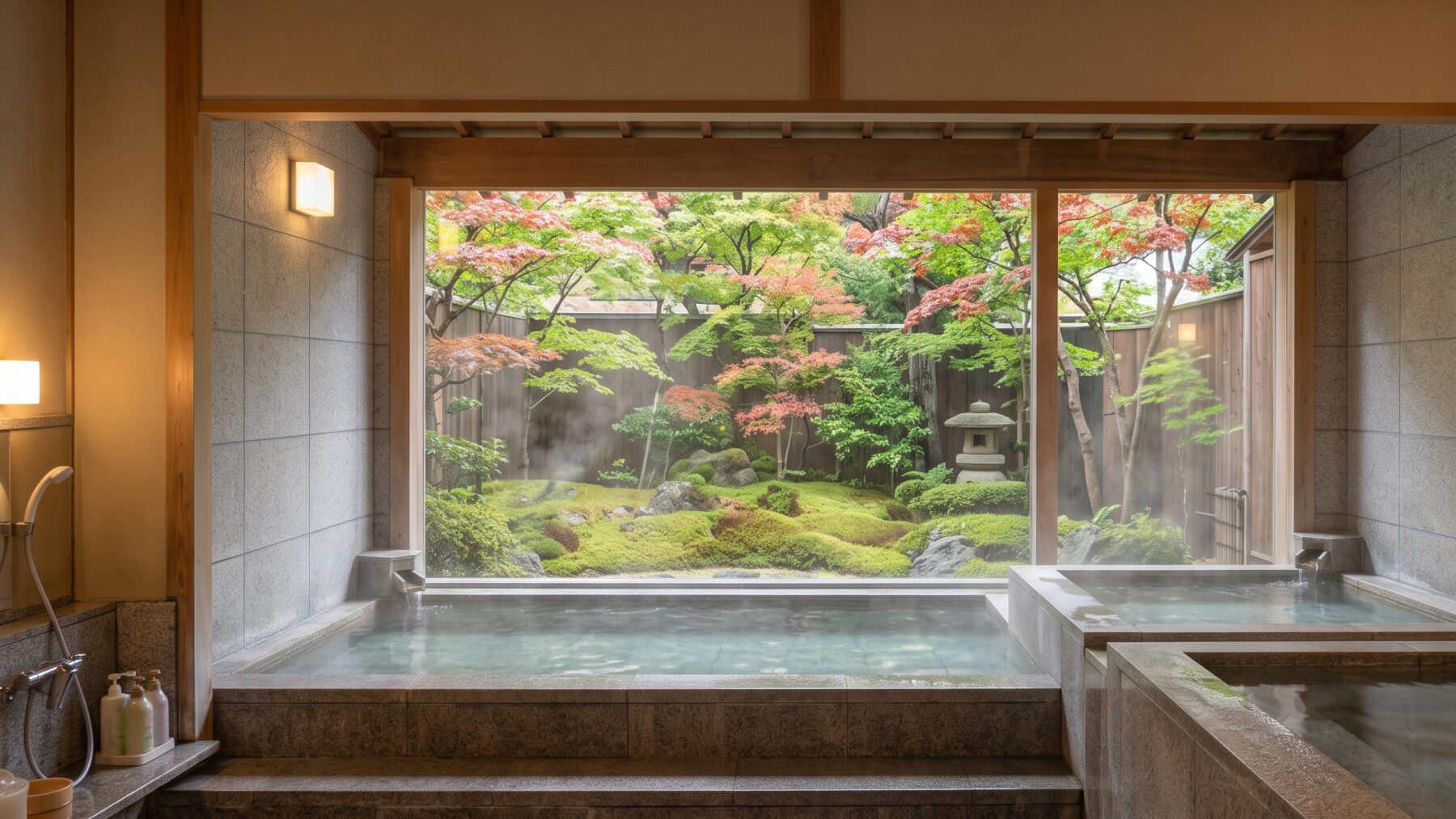
The onsen is the thing most first-time visitors are most nervous about and most glad they did. It involves being naked in front of strangers, which is a genuine hurdle for many people, and the answer to that hurdle is simply that nobody is looking. Everyone is there to get warm.
The rules are few and they exist for one reason: the water is shared and nobody washes in it.
At a glance
- The core rule
- Wash thoroughly before getting in. The bath is for soaking, not cleaning.
- Naked
- Yes. No swimwear. Gender-separated.
- The small towel
- Yours, for washing and modesty. Never goes in the water.
- Temperature
- Usually 40–43°C. Hotter than most Western baths.
- Tattoos
- Still restricted at many places. Options below.
- Cost
- 400–900 JPY for a public bath; free to guests at a ryokan
Onsen or sento?
Onsen is naturally heated mineral water from a geothermal source, legally defined by temperature and mineral content. Sento is a public bath heated artificially — the neighbourhood bathhouse. Super sento are large modern bathing complexes with saunas and restaurants.
The etiquette is identical in all three.
What actually happens, in order
Pay, and take a small towel
At a public bath, pay at the counter or a machine. A small towel (about 30x80cm) is provided or rented for a few hundred yen. A larger towel stays in the changing room.
Find the right curtain
Red or 女 for women, blue or 男 for men. Some places swap them daily — read the sign, do not go by colour alone.
Undress completely in the changing room
Everything goes in a basket or locker. No swimwear, no underwear. Take only the small towel through.
Wash at a seated shower station
Sit on the low stool. Soap, shampoo and conditioner are provided. Wash properly — this is not a rinse. Rinse every trace of soap off yourself and off the stool.
Get in slowly
The water is hotter than you expect. Enter gradually and stay still for a minute.
Put the small towel on your head, or on the side
Never in the water. On the head is traditional and practical.
Soak, cool down, repeat
Ten minutes in, a few minutes sitting on the side, back in. Two or three rounds is normal.
Do not rinse off at the end
Leave the minerals on your skin. Pat dry with the small towel before going back into the changing room so you do not soak the floor.
The small towel
It has three jobs and one prohibition.
Jobs: washing yourself; a modesty screen held in front of you when walking between the washing area and the bath; and something to fold on your head while soaking.
Prohibition: it never touches the bath water. Onsen water is often not filtered or chlorinated, so nothing goes in but people who have already washed.
The rules that actually matter
- Wash first, thoroughly.
- No towels, swimwear or hair in the water. Tie long hair up.
- No splashing, swimming or diving. These are not pools.
- Keep your voice down. Quiet conversation is fine; a loud group is not.
- No phones or cameras, anywhere past the changing room. This is absolute.
- Do not stare. Everybody is naked and everybody is ignoring everybody.
- Rinse the stool and bucket for the next person.
- No alcohol before bathing. Hot water and alcohol combine badly, and most onsen towns say so on the wall.
Tattoos
The genuine complication, and the situation is changing but not resolved.
The restriction dates from tattoos’ association with organised crime. As visitor numbers have grown, many places have relaxed, but many have not, and small traditional establishments are the most likely to refuse.
Your options, in order of reliability:
- A private bath. Kashikiri buro (rented family bath) or a room with its own open-air bath. Always fine, costs more, and is the stress-free answer.
- Tattoo-friendly onsen. There are published lists, and Tattoo Friendly and similar directories maintain them. Ask the tourist office.
- Cover stickers. Waterproof patches, sold at drugstores and sometimes at the onsen itself. Acceptable if the tattoo is small enough to be fully covered.
- Ask when booking. Not on arrival. Irezumi ga arimasu ga, daijoubu desu ka?
- Super sento and modern facilities are generally more relaxed than traditional ryokan.
Types of bath you will meet
- Rotenburo — outdoor bath. The best kind, especially in snow.
- Uchiyu — indoor bath.
- Kashikiri — private bath, rented by the hour.
- Konyoku — mixed-gender. Rare now, usually with designated women’s hours, and some provide bathing garments.
- Ashiyu — foot bath. Free, public, clothed, and found all over onsen towns. A good first step if you are unsure.
Water types
Onsen are classified by mineral content and locals take it seriously.
| Type | Water | Notable at |
|---|---|---|
| Sulphur | Milky, strong smell | Kusatsu, Noboribetsu, Nyuto |
| Iron | Brown, salty | Arima (kinsen) |
| Carbonated | Clear, bubbles on skin | Arima (ginsen), Nagayu |
| Bicarbonate | Soft, “beauty water” | Ureshino, Yufuin |
| Simple alkaline | Clear, gentle | Hakone, Gero |
Sulphur water will tarnish silver jewellery. Leave it in the locker.
Onsen towns worth planning around
- Kusatsu (Gunma) — the most concentrated sulphur water in Japan, and a wooden field of channels in the town centre.
- Kinosaki (Hyogo) — seven public baths you walk between in a yukata.
- Beppu and Yufuin (Oita) — more hot spring output than anywhere else in Japan.
- Nyuto (Akita) — milky water in a beech forest, deep snow in winter.
- Hakone (Kanagawa) — the easiest from Tokyo.
- Arima (Hyogo) — the easiest from Osaka, and one of the three oldest.
- Kurokawa (Kumamoto) — a river gorge with a pass for three baths.
→ Hakone: the onsen loop from Tokyo → Hyogo: Himeji Castle, Kobe and Arima Onsen in two days
At an onsen
Questions people actually ask
Do I really have to be naked?
Yes, in a genuine onsen. Swimsuit-permitted facilities exist — Yunessun in Hakone is the best known — but they are spa parks rather than onsen. Nobody looks at anybody.
Can I go if I have my period?
Convention says no, and most Japanese women do not. Use a private bath instead if you would rather not miss it.
How hot is it, really?
Usually 40–43°C, which is hotter than a typical Western bath. Enter slowly, and get out when you start to feel your heartbeat. Ten minutes at a time is plenty at first.
Can I bring my glasses?
Yes. Contact lenses are best removed. Phones and cameras absolutely not, at any point past the changing room.
What about children?
Small children of either gender go with a parent into either bath, and it is completely normal. Older children use their own side.
I am not comfortable being naked in public. Is there an alternative?
Yes — book accommodation with a private in-room bath, rent a kashikiri buro by the hour, or use a foot bath. You lose very little and you get the water, which is the point.
Keep planning
The Japanese Year: Hanami, Tsuyu, Momiji and New Year
Japan pays more attention to the calendar than almost any country, and the whole population moves in step with it. What each…
Matsuri: What Happens at a Japanese Festival and How to Join In
Portable shrines carried by four hundred people, illuminated paper warriors, and a dance anyone can join. The dozen festivals worth planning a…
Tipping in Japan, and Why Nobody Wants Your Money
There is no tipping in Japan, in any situation, and attempting it causes a small crisis. Here is why, what the charges…