Is the Japan Rail Pass Worth It? Run the Numbers First
The Japan Rail Pass rose about 70 per cent in late 2023, and the old advice stopped being true. Three real itineraries, priced both ways, so you can see where the line now falls.
 Signpost Japan
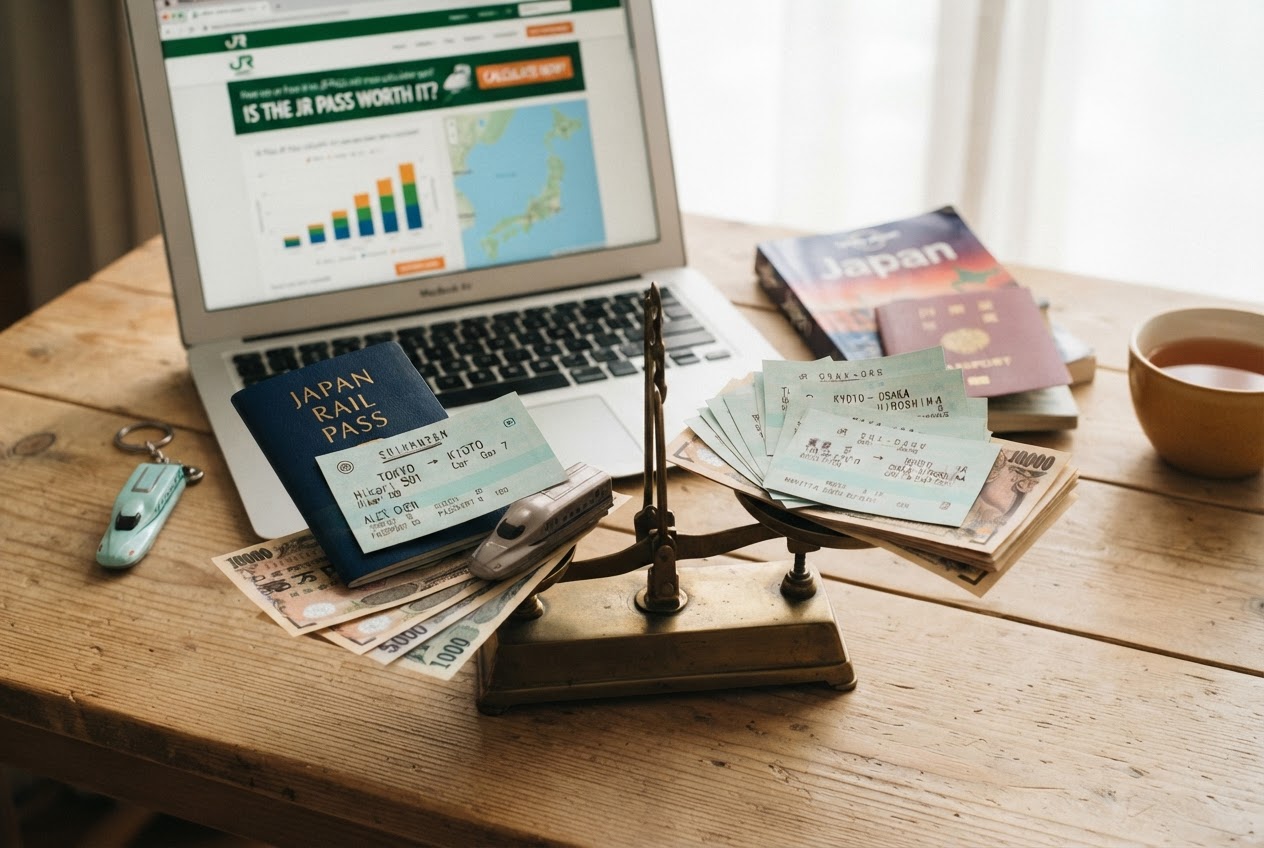
For twenty years the answer to “should I buy a Japan Rail Pass” was yes, almost regardless of the trip. In October 2023 the price rose by roughly seventy per cent, and a great deal of travel advice on the internet did not notice.
Here is the current arithmetic, worked through on three real itineraries. For a lot of first trips, the honest answer is now no.
At a glance
- 7-day ordinary pass
- About 50,000 JPY (as of February 2026)
- 14-day ordinary
- About 80,000 JPY
- 21-day ordinary
- About 100,000 JPY
- Break-even, roughly
- Two long Shinkansen round trips inside the validity period
- Not covered
- Nozomi and Mizuho services without paying a supplement
- Who should still buy
- Fast, wide itineraries. Hokkaido and Kyushu runs. Anyone doing Tokyo–Hiroshima–Kanazawa in a week.
What the pass actually is
A Japan Rail Pass is unlimited travel on JR trains — including most Shinkansen, all JR local and rapid services, some JR buses and the JR ferry to Miyajima — for 7, 14 or 21 consecutive days.
It does not cover:
- Private railways (Kintetsu to Nara, Odakyu to Hakone, Hankyu between Kyoto and Osaka)
- Subways in any city
- Nozomi and Mizuho, the fastest services on the Tokaido, Sanyo and Kyushu lines, unless you pay a supplement
That last exclusion matters more than people expect. Nozomi runs several times an hour between Tokyo and Osaka; Hikari, which the pass does cover, runs less often and takes about twenty-five minutes longer.
The arithmetic
Fares below are one-way, ordinary class, non-reserved seat, correct as of February 2026 and rounded.
| Journey | Approximate one-way fare |
|---|---|
| Tokyo – Kyoto | 13,300 JPY |
| Kyoto – Hiroshima | 11,400 JPY |
| Hiroshima – Tokyo | 19,800 JPY |
| Tokyo – Kanazawa | 14,400 JPY |
| Tokyo – Sendai | 11,200 JPY |
| Tokyo – Hakata (Fukuoka) | 23,400 JPY |
Itinerary 1 — the classic first trip
Tokyo, three nights. Kyoto, three nights, with a day trip to Nara and a day in Osaka. Back to Tokyo to fly home.
| Individual tickets | Cost |
|---|---|
| Tokyo to Kyoto | 13,300 JPY |
| Kyoto to Tokyo | 13,300 JPY |
| Nara and Osaka day trips | Mostly private railways, not JR |
| Total JR spend | About 27,000 JPY |
A seven-day pass costs about 50,000 JPY. You would lose roughly 23,000 JPY. Buy individual tickets.
Itinerary 2 — adding Hiroshima
Tokyo → Kyoto → Hiroshima → Tokyo, over eight days.
| Individual tickets | Cost |
|---|---|
| Tokyo to Kyoto | 13,300 JPY |
| Kyoto to Hiroshima | 11,400 JPY |
| Hiroshima to Tokyo | 19,800 JPY |
| Total JR spend | About 44,500 JPY |
Still below the 50,000 JPY pass — and the trip is eight days, so a seven-day pass would not cover all of it anyway. Individual tickets win, narrowly. Add one more Shinkansen day trip inside the week and it flips.
Itinerary 3 — the wide loop
Tokyo → Kanazawa → Kyoto → Hiroshima → Tokyo, inside seven days.
| Individual tickets | Cost |
|---|---|
| Tokyo to Kanazawa | 14,400 JPY |
| Kanazawa to Kyoto | 7,000 JPY |
| Kyoto to Hiroshima | 11,400 JPY |
| Hiroshima to Tokyo | 19,800 JPY |
| Day trip to Himeji | 7,000 JPY |
| Total JR spend | About 60,000 JPY |
The pass saves about 10,000 JPY, and removes the friction of buying five sets of tickets. Buy it.
The pattern
Look at the three cases and the rule falls out:
- Two cities in a week? No pass.
- Three cities in a week, one of them far? It is close. Count the day trips.
- Four cities, or anything reaching Hokkaido or Kyushu? Pass.
The other way to say it: the pass now needs roughly two long Shinkansen round trips inside its validity to break even. A trip built around staying somewhere and taking day trips will not get there.
What to buy instead
If your trip is concentrated in one region, a regional pass almost certainly beats the national one. The JR West Kansai-Hiroshima Area Pass, the JR East Tohoku Area Pass, the JR Kyushu Rail Pass and about a dozen others cost a fraction of the national pass and cover the ground most people actually use.
→ Regional rail passes: the 12 that actually save money
If you do buy one
Buy online or in Japan
Since 2020 the pass can be bought inside Japan as well as abroad, though the in-country price is slightly higher. Buying online in advance gives you an exchange order or a QR code.
Activate it on the right day
You choose the start date on activation. Do not activate on arrival day if your first long journey is three days later — that is two days of the pass wasted.
Reserve seats, free of charge
At a JR ticket office or reservation machine. Reservations cost nothing with a pass, so there is no reason to travel non-reserved.
Use the manned gate or the pass gate
Modern passes have a QR code and work at automatic gates. Older paper passes are shown to staff at the side gate.
Take Hikari, not Nozomi
Hikari is fully covered and only about twenty-five minutes slower between Tokyo and Osaka. Paying the Nozomi supplement usually erases the saving.
Questions people actually ask
Can I use the Japan Rail Pass on the Nozomi?
Only by paying a supplement, introduced in October 2023. On most itineraries the Hikari service is the better choice — fully covered, and roughly twenty-five minutes slower between Tokyo and Osaka.
Does the pass cover the subway in Tokyo?
No. It covers JR lines, which in Tokyo means the Yamanote loop and the other JR lines, but not the Tokyo Metro or Toei subways. You will still need an IC card.
Does it cover the airport train?
The Narita Express is JR and is covered. The Keisei Skyliner is not. From Haneda, the Tokyo Monorail is covered; the Keikyu line is not.
Can I get a refund if I change my mind?
An unused exchange order can usually be refunded before it is turned into a pass, with a fee. Once activated, a pass cannot normally be refunded.
Is the Green Car version worth the extra?
Only for long journeys and only if you value the space. Ordinary class on a Shinkansen is already wider and quieter than business class on most short-haul flights.
I bought a pass and now regret it. What can I do?
Use it for day trips you would otherwise have skipped — Himeji, Nikko, Kamakura, Kobe. A pass turns marginal day trips into free ones, and that is often where the value hides.
Keep planning
Tokyo to Kyoto: Shinkansen, Night Bus or Plane?
The Shinkansen is the right answer for almost everyone: 2 hours 15 minutes, about 14,000 JPY, no check-in. Here is what the…
When Things Go Wrong: Missed Trains, Lost Tickets and the Last Train
You will miss a connection, feed the wrong ticket into a gate, or look up at 11:40pm and realise the last train…
Luggage in Japan: Coin Lockers, Takkyubin and Oversized Baggage Rules
Japanese trains were not built for suitcases, so Japan moves the suitcase separately. How luggage forwarding works, what the 160cm rule means,…