Domestic Flights: When Flying Beats the Shinkansen
The train wins as far as Hiroshima. Past that, flying is faster and often cheaper — especially with the foreign-visitor fares that ANA and JAL only sell to people holding an international ticket.
 Signpost Japan
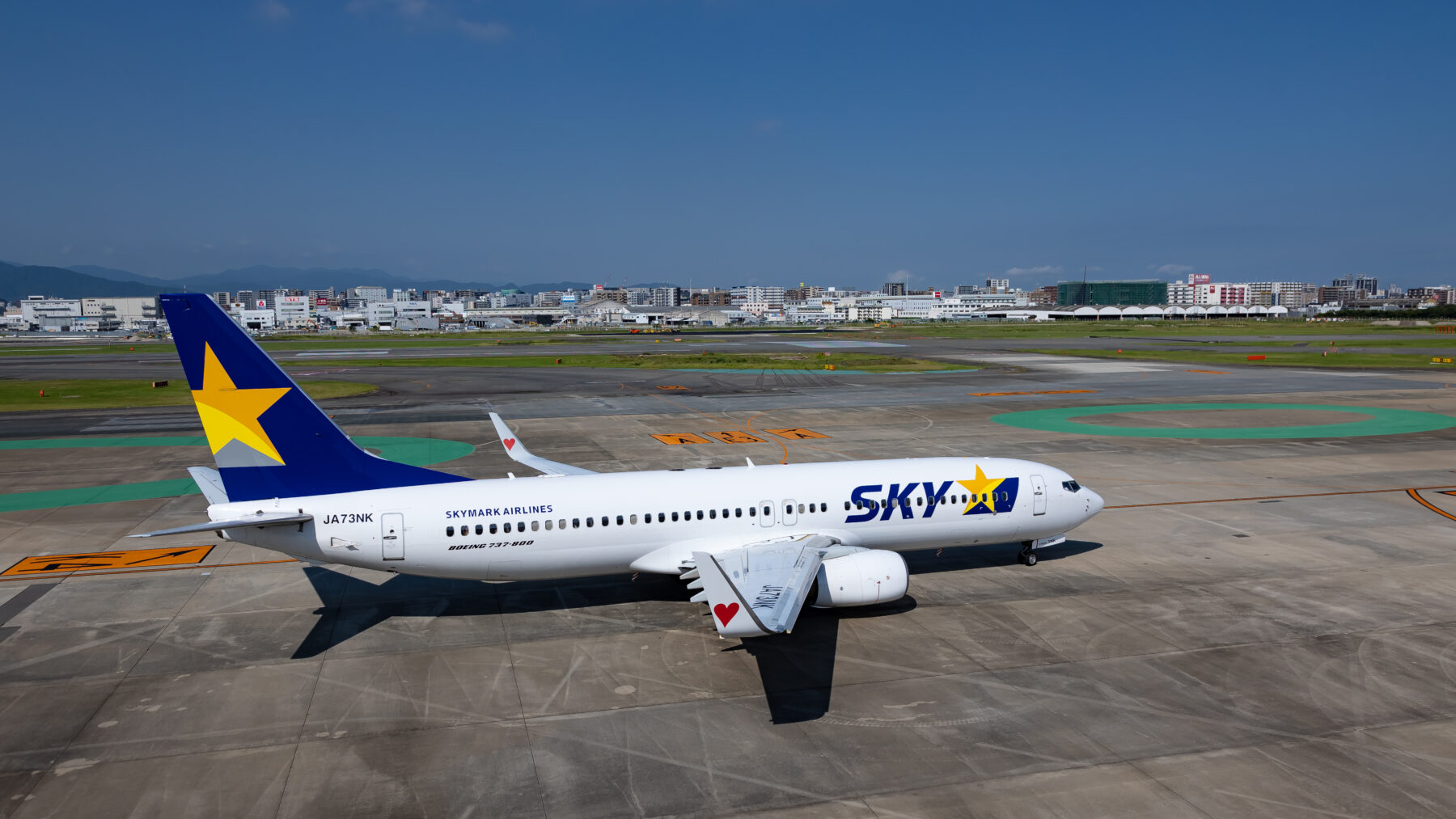
Japan is longer than it looks. Sapporo to Fukuoka is roughly the distance from London to Warsaw, and the Shinkansen, magnificent as it is, takes most of a day to cross it.
There is a clean rule for when to stop taking trains, and a genuinely good deal that most visitors never hear about.
At a glance
- The rule
- Train up to about 4 hours of rail time. Fly beyond that.
- Crossover point
- Roughly Hiroshima from Tokyo, Sendai going north
- Best value
- ANA and JAL foreign-visitor fares, sold only with an international ticket
- Budget carriers
- Peach, Jetstar Japan, Skymark, Solaseed, StarFlyer
- Watch for
- Airport transfer time at both ends, which is where the train wins
The crossover
Compare door to door, not station to station. Shinkansen stations sit in city centres; airports do not.
| Route | Rail | Flight, gate to gate | Realistic door to door by air | Winner |
|---|---|---|---|---|
| Tokyo – Kyoto | 2h 15m | 1h 10m | About 4h | Train |
| Tokyo – Hiroshima | 3h 50m | 1h 30m | About 4h 15m | Line ball |
| Tokyo – Fukuoka | 5h | 1h 50m | About 4h 30m | Plane |
| Tokyo – Sapporo | 8h+ | 1h 40m | About 4h 15m | Plane, decisively |
| Osaka – Sapporo | 9h+ | 1h 55m | About 4h 30m | Plane |
| Tokyo – Okinawa | No rail link | 2h 50m | About 5h 30m | Plane |
Hiroshima is the pivot. Anything closer, take the train and enjoy it. Anything further, fly.
Hokkaido and Okinawa are not really arguments. Tokyo to Sapporo by rail involves a change at Shin-Hakodate-Hokuto and the better part of a day; the flight is one of the busiest air routes in the world for a reason.
The deal nobody mentions
Both full-service carriers sell heavily discounted domestic fares to foreign visitors, on condition that you hold an international ticket into or out of Japan.
- ANA Experience Japan Fare
- JAL Japan Explorer Pass
These are flat or near-flat fares — typically in the region of 5,500 to 11,000 JPY per sector as of February 2026 — on routes where the walk-up fare can be three or four times that. Tokyo to Sapporo or Tokyo to Okinawa at that price is better value than the equivalent train journey would be if one existed.
You buy them on the airline’s own international site, not the Japanese domestic one, and you have to enter your international flight details. Booking windows and blackout dates apply, especially around Golden Week and New Year.
The budget carriers
Peach, Jetstar Japan, Skymark, Solaseed Air and StarFlyer run domestic networks at lower prices, with the usual trade-offs.
The particular things to watch in Japan:
- Baggage. Peach and Jetstar charge for hold luggage and enforce cabin limits. Adding a bag often erases the saving against a visitor fare.
- Secondary terminals. Peach uses Terminal 2 at Kansai and Narita’s Terminal 3, both of which are a shuttle bus ride from the main buildings and add half an hour.
- Osaka has two airports. Itami is close to the city and mostly domestic; Kansai is far out on its island. Check which one your flight uses.
- Tokyo has two. Haneda is in the city; Narita is an hour away. A cheap Narita flight can cost you two hours and 3,000 JPY in transfers.
Skymark sits usefully between the budget and full-service models: assigned seats, free hold baggage, and it uses Haneda.
Airports worth knowing
- Haneda (HND) — in Tokyo. Always prefer it for domestic flights.
- Itami (ITM) — Osaka’s close-in domestic airport, about 30 minutes from Umeda.
- New Chitose (CTS) — Sapporo, 37 minutes by rapid train.
- Fukuoka (FUK) — five minutes by subway from Hakata Station. The best-located airport in Japan.
- Naha (OKA) — Okinawa, connected to the city by monorail.
Domestic security in Japan is fast. Thirty to forty minutes before departure is genuinely enough at most airports, and both ANA and JAL will let you check in on your phone and board with a QR code.
How the flight itself differs
Japanese domestic flying is more like taking a train than most visitors expect. Announcements are brief, boarding is orderly and starts about twenty minutes out, and cabin crew are formal. On ANA and JAL you get a drink, on the budget carriers you do not.
The window seat on the left-hand side flying Tokyo to Osaka gives you Mount Fuji on a clear day, which is one of the better free things in Japanese travel.
Getting there and back
Fold the transfer into your decision:
Add both airport transfers to the flight time
Typically 45–75 minutes each end in Japan, plus security and boarding. That is roughly two and a half hours on top of the flight.
Check which airport, not just which city
Narita instead of Haneda, or Kansai instead of Itami, can add two hours and several thousand yen.
Price the visitor fare before the budget carrier
ANA and JAL visitor fares frequently beat a budget carrier once you add a hold bag and the transfer to a secondary terminal.
Consider forwarding your luggage instead of checking it
Takkyubin from hotel to hotel costs about 2,000 JPY and removes the baggage question entirely.
Questions people actually ask
Can I use the Japan Rail Pass to get to the airport?
Sometimes. The Narita Express and the Tokyo Monorail to Haneda are JR and covered. The Keisei Skyliner and Keikyu line are not.
Are the ANA and JAL visitor fares really cheaper?
On long domestic routes, substantially — often less than half the walk-up fare. On short routes the gap narrows and the train usually wins anyway.
How early do I need to arrive for a domestic flight?
Sixty minutes is comfortable at most Japanese airports, forty-five at Haneda and Fukuoka if you are travelling with hand baggage only. Domestic security is quick.
Is there an ID check for domestic flights?
For Japanese nationals, often not. As a foreign visitor, carry your passport — it is also your legal obligation to have it with you in Japan.
What about flying to smaller islands?
Japan has an extensive commuter network to the Okinawan islands, the Izu islands and rural Hokkaido, run by ANA and JAL subsidiaries. Book these early — the aircraft are small and the flights fill.
Keep planning
Tokyo to Kyoto: Shinkansen, Night Bus or Plane?
The Shinkansen is the right answer for almost everyone: 2 hours 15 minutes, about 14,000 JPY, no check-in. Here is what the…
When Things Go Wrong: Missed Trains, Lost Tickets and the Last Train
You will miss a connection, feed the wrong ticket into a gate, or look up at 11:40pm and realise the last train…
Luggage in Japan: Coin Lockers, Takkyubin and Oversized Baggage Rules
Japanese trains were not built for suitcases, so Japan moves the suitcase separately. How luggage forwarding works, what the 160cm rule means,…