Highway Buses: The Cheapest Way Between Japanese Cities
Tokyo to Osaka overnight for the price of a decent lunch. How Japanese highway buses work, which seat class is worth paying for, and how to actually sleep on one.
 Signpost Japan
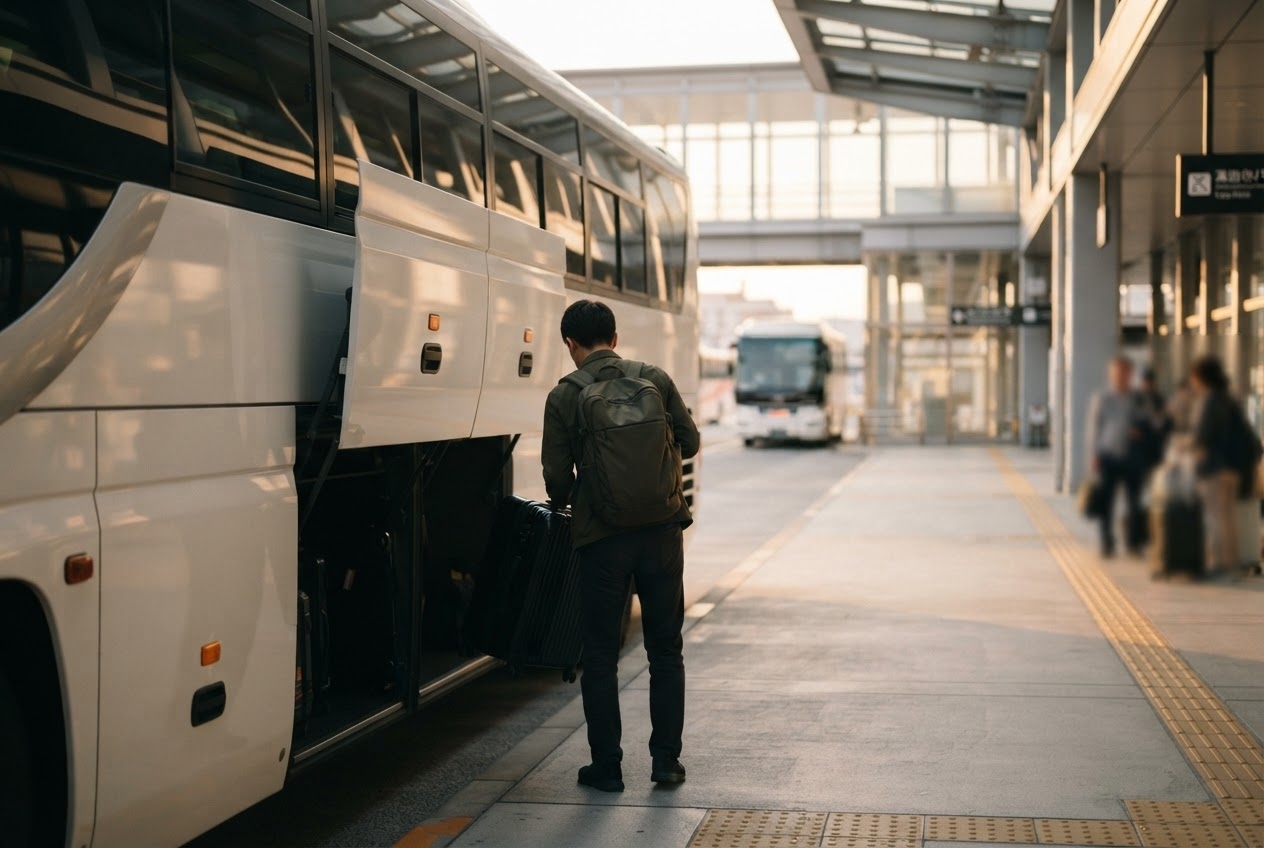
A Shinkansen from Tokyo to Osaka costs around 14,000 JPY. An overnight bus on the same route can be under 4,000 JPY, and it saves a night’s accommodation. For travellers watching a budget, Japan’s highway bus network is the single biggest saving available.
It is also better than its reputation. Japanese overnight coaches are quiet, punctual, clean, and — in the higher seat classes — genuinely comfortable in a way that intercity buses elsewhere are not.
At a glance
- Typical saving
- 60–75% against the Shinkansen on long routes
- Tokyo to Osaka
- About 8 hours overnight, from roughly 3,500 JPY
- Seat classes
- 4-across (cheapest), 3-across (the sweet spot), 2-across and pod seats
- Booking
- Willer Express, Japan Bus Online, or Kosokubus.com — all have English sites
- Not covered
- By any JR rail pass, with the exception of a few JR-operated routes
Why the overnight bus makes sense
The arithmetic is unusual. An overnight bus is not just cheaper than the train — it also replaces a hotel night. On a Tokyo–Osaka leg:
| Tokyo to Osaka, one way | Cost |
|---|---|
| Shinkansen, non-reserved | About 14,000 JPY |
| One night in a business hotel | About 9,000 JPY |
| Overnight bus, 3-across seat | About 5,500 JPY |
| Cost of a shower at arrival | About 500 JPY |
| Bus versus train plus hotel | Saving of about 19,000 JPY |
For a three-week trip on a budget, doing this three or four times funds a lot of other things.
The trade is your night’s sleep quality and your morning. You arrive at 6am, groggy, with nowhere to check in until 3pm.
Seat classes, and which to buy
This is the decision that matters most, and the difference between a fine night and a miserable one.
| Class | Layout | Rough price, Tokyo–Osaka | Verdict |
|---|---|---|---|
| Standard | 4 seats across | 3,500–4,500 JPY | Only for short daytime legs |
| Relax / 3-across | 3 seats across, no neighbour | 5,000–7,000 JPY | The right choice |
| Premium / 2-across | 2 seats across, deep recline | 8,000–11,000 JPY | Worth it if you sleep badly |
| Pod / shell seat | Individual enclosed seat | 10,000–14,000 JPY | Approaching train price |
Buy the 3-across. The extra 1,500–2,000 JPY over standard buys you no adjacent passenger, a proper recline and usually a footrest, and it is the difference between arriving functional and arriving wrecked.
Booking
Three sites cover almost everything and all have English:
- Willer Express — the largest tourist-facing operator, clearest English, and sells a Japan Bus Pass.
- Japan Bus Online — aggregates many operators.
- Kosokubus.com — good coverage, slightly clunkier.
Book a few days ahead for popular routes and weeks ahead for Golden Week, Obon and New Year. Prices are dynamic: the same seat can vary by several thousand yen depending on the day of the week.
The Japan Bus Pass from Willer offers a set number of journeys over a period. It only makes sense if you are making four or more long trips and are flexible about which buses you take.
What the night is actually like
Buses leave city bus terminals — Shinjuku’s Busta is a good example, a purpose-built four-storey terminal above the station.
Lights go out about half an hour after departure and stay out. Talking, phone calls and screen brightness are all discouraged. Most buses make two or three service-area stops for toilets and vending machines, usually announced, usually fifteen minutes.
Every seat has a curtain you can pull across the aisle side. Blankets are provided. Some buses have a toilet on board; many do not, relying on the stops instead.
Book a 3-across seat, on the upper deck if there is one
Fewer neighbours, less aisle traffic, and a smoother ride away from the wheels.
Eat before you board
There is no meal service and the service-area stops are short. A konbini dinner at the terminal is the standard move.
Bring an eye mask, earplugs and a neck pillow
The bus provides a blanket and nothing else. All three are available at any konbini for about 1,500 JPY together.
Do not plan anything before 10am on arrival day
You will land at 6am. Find a station shower, a bathhouse or a café, and start slowly.
Book a shower
Many big-city bus terminals have paid shower rooms for a few hundred yen, and a morning sento or capsule hotel day rate does the same job.
Routes worth taking
- Tokyo – Osaka / Kyoto — the classic. Frequent, competitive, cheap.
- Tokyo – Sendai — about 6 hours, useful for reaching Tohoku on a budget.
- Osaka – Hiroshima — about 5 hours, a good daytime run.
- Tokyo – Takayama — about 5.5 hours and one of the few places where the bus is also the fastest option, because the rail route is indirect.
- Kyoto – Kanazawa — competitive with the train on time and much cheaper.
That Takayama case generalises. Anywhere the railway has to go around a mountain range, the bus goes over or through it, and the bus wins.
Where buses beat everything
Highway buses are not only a budget option. In rural Japan they are frequently the only option: Shirakawa-go, much of the Japan Alps, the Iya Valley, and many national park trailheads are served by bus and nothing else.
Those routes are not overnight coaches but ordinary regional buses, often booked separately and sometimes requiring a reservation. Check before you arrive at the stop.
At a bus terminal
Questions people actually ask
Are overnight buses in Japan safe?
Yes. Operators are tightly regulated, drivers work in pairs on long routes, and terminals are staffed. Solo travellers, including women travelling alone, use them routinely.
Is there a toilet on board?
Sometimes. Many buses rely on scheduled service-area stops instead, typically every two hours. If an on-board toilet matters to you, filter for it when booking.
Does the Japan Rail Pass cover highway buses?
Only a handful of JR-operated routes. Almost all highway buses are run by private companies and are not covered.
How much luggage can I take?
One large case in the hold and a small bag with you is standard and included. There is no weight fuss.
What happens if the bus is delayed by traffic?
It happens, mostly on the Tokyo–Osaka corridor on Sunday evenings and around holidays. Delays of an hour are not unusual and are not compensated. Do not book a morning flight off the back of an overnight bus.
Keep planning
Tokyo to Kyoto: Shinkansen, Night Bus or Plane?
The Shinkansen is the right answer for almost everyone: 2 hours 15 minutes, about 14,000 JPY, no check-in. Here is what the…
When Things Go Wrong: Missed Trains, Lost Tickets and the Last Train
You will miss a connection, feed the wrong ticket into a gate, or look up at 11:40pm and realise the last train…
Luggage in Japan: Coin Lockers, Takkyubin and Oversized Baggage Rules
Japanese trains were not built for suitcases, so Japan moves the suitcase separately. How luggage forwarding works, what the 160cm rule means,…