IC Cards Explained: Suica, ICOCA, PASMO and the Rest
Ten different cards, one system. Which to buy, where it works, where it does not, and why the card that opens every gate in Tokyo will refuse you at a Shinkansen barrier.
 Signpost Japan
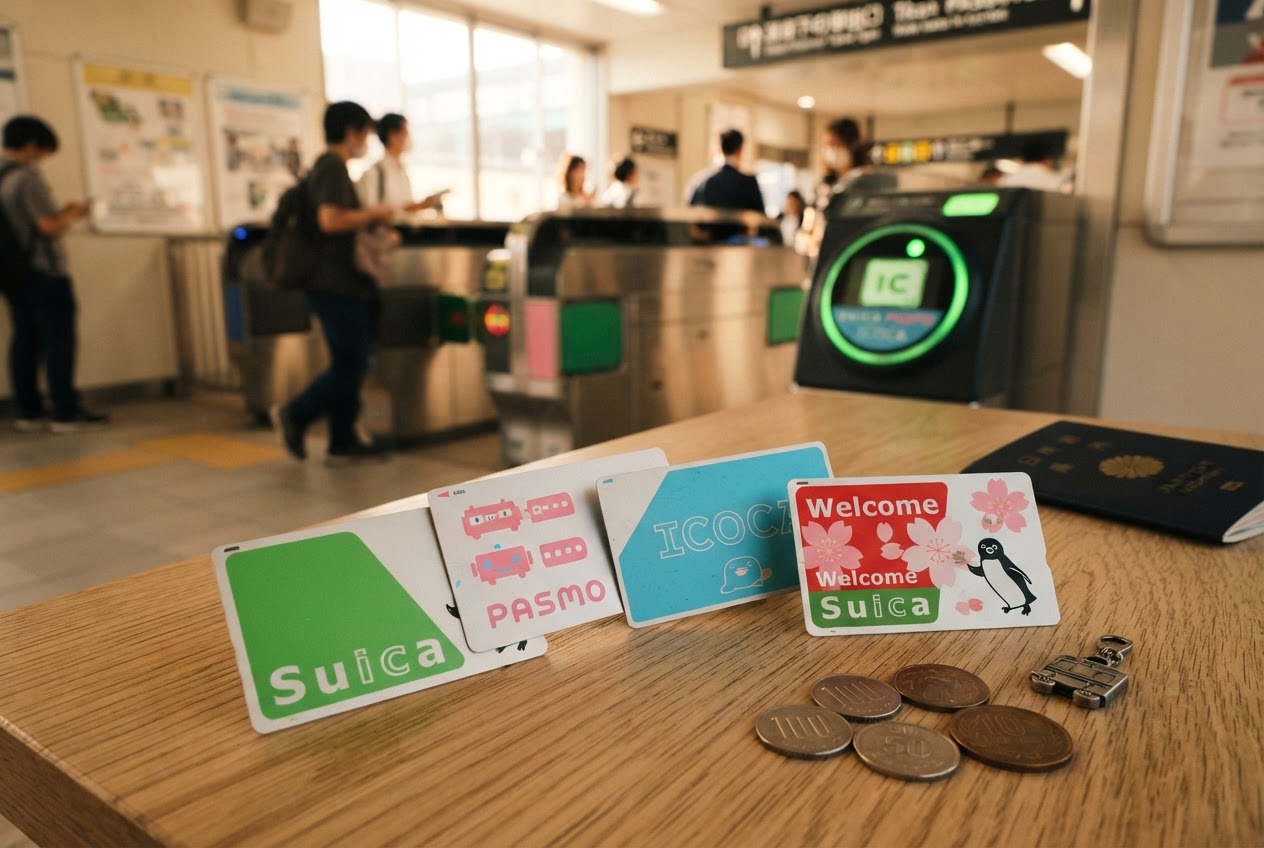
The first thing to do at a Japanese airport, after clearing customs and before finding your hotel, is to buy a rechargeable transport card. It will not save you money. It saves you from standing at a fare machine in front of a map written in kanji, twice a day, for the length of your trip.
There are ten of these cards, issued by different railway companies in different regions. Since 2013 they have been mutually compatible, which means the practical answer to “which one should I get” is: whichever one the machine in front of you sells.
At a glance
- What it is
- A prepaid contactless card. Tap in, tap out, correct fare deducted.
- Where to buy
- Airport station ticket machines and any major station. Look for the card logo on the machine.
- Cost
- 500 JPY refundable deposit plus whatever you load. Tourist versions have no deposit.
- Where it works
- Local trains, subways, city buses, convenience stores, vending machines, coin lockers — nationwide.
- Where it does not
- Shinkansen (on its own), some rural lines, most long-distance buses.
The ten cards, and why it does not matter which you get
| Card | Issuer | Home region |
|---|---|---|
| Suica | JR East | Tokyo and eastern Japan |
| PASMO | Tokyo private railways and buses | Tokyo |
| ICOCA | JR West | Kansai, Chugoku |
| PiTaPa | Kansai private railways | Kansai |
| TOICA | JR Central | Nagoya, Shizuoka |
| manaca | Nagoya railways and subway | Nagoya |
| Kitaca | JR Hokkaido | Sapporo |
| SUGOCA | JR Kyushu | Kyushu |
| nimoca | Nishitetsu | Fukuoka |
| Hayakaken | Fukuoka subway | Fukuoka |
All ten are accepted on each other’s networks. A Suica bought in Tokyo works on the Osaka subway; an ICOCA bought in Kyoto works on the Tokyo Metro. The card’s home region matters only if you need a refund, which has to be done in the issuing region.
The one genuine exception is PiTaPa, which is postpay and tied to a Japanese bank account. Visitors cannot get one and do not want one.
The tourist versions
Availability of standard cards has fluctuated in recent years, and stations have at times sold only the tourist editions. Both of these are reliably available at their airports:
- Welcome Suica — Narita and Haneda. No deposit, valid 28 days, no refund of remaining balance. Distinctive red-and-white design.
- ICOCA for tourists / Kansai One Pass — Kansai Airport. Standard deposit, and the Kansai One Pass adds small discounts at some attractions.
If you are staying longer than 28 days, ask for a standard card rather than a Welcome Suica.
Find the station ticket machines
Follow signs to the train station in the arrivals building. The IC card machines are the tall ones with the card logos on the front, next to the ticket office.
Press English, then the card option
The English button is usually top right. Choose the card purchase option rather than a single ticket.
Load 3,000 to 5,000 JPY
Machines take cash; many now take cards. A 500 JPY deposit is included in the price of a standard card and is returned when you hand the card back.
Take the card and the change, and tap straight in
No registration, no name, no activation. Touch it to the panel on the gate and walk through.
Where it will not work
This is the part that catches people out.
The Shinkansen. A charged IC card is not a Shinkansen ticket. You can register a card to a Shinkansen eTicket booked online, and then the card opens the Shinkansen gate — but the booking has to exist first. Tapping in with a card alone will be rejected at the transfer gate.
Limited express trains with reserved seats. The IC card pays the base fare. The express surcharge needs a separate ticket.
Some rural lines. Parts of Shikoku, inland Kyushu, northern Tohoku and many single-track branch lines have no IC readers at all. On these, you take a paper numbered ticket from a dispenser when you board and pay the driver in cash when you get off.
Most highway buses. Long-distance coaches are booked and paid for separately.
Topping up
Any station ticket machine with the card logo will add value, in cash, in 1,000 JPY steps. Convenience stores will also top up a card at the till — hand over the card and the cash.
The maximum balance is 20,000 JPY. There is no way to reload with a foreign credit card at a machine, which is why people carry a little cash even in a country that has otherwise gone cashless.
Using it on your phone
iPhone and Apple Watch: open Wallet, add Suica, PASMO or ICOCA, and top it up with a card. This works with most overseas cards and is genuinely convenient — you can reload on the platform in ten seconds.
Android: mobile IC cards generally require a Japanese-market handset with Osaifu-Keitai hardware. An overseas Android phone will not add a Suica. Carry a physical card.
If you use a phone, keep enough battery. A dead phone at a ticket gate is a real problem.
What it costs, and getting your money back
| A standard IC card | Cost |
|---|---|
| Card deposit | 500 JPY (refundable) |
| Initial charge | 1,500 JPY minimum, 5,000 JPY typical |
| Top-ups | Cash only, at machines or konbini |
| Refund at the end | Balance minus 220 JPY handling |
To refund a standard card, take it to a ticket office in the issuing company’s region. You get the deposit and the remaining balance back, minus a handling fee of a few hundred yen.
Most visitors keep the card. It stays valid for ten years from last use, and if you come back it will still work.
Questions people actually ask
Can I use one card for two people?
Not through a ticket gate — each person needs their own card, and the gate closes behind each tap. You can pay for two people with one card in a shop or on a bus.
What happens if I do not have enough balance to exit?
The gate closes and shows the shortfall. Use the fare adjustment machine just before the gates — insert the card, add cash, take it back and walk through. It takes fifteen seconds.
Can I use a Suica on the Shinkansen?
Not on its own. Register the card to a Shinkansen eTicket booked online and the card then opens the gate. Without that booking, the card will be rejected.
Do I get a discount for using an IC card?
On some networks the IC fare is a few yen cheaper than the paper ticket fare. It is not enough to be a reason. Convenience is the reason.
Is it worth buying a card for a three-day trip?
Yes. You will make six to ten journeys a day in a city, and buying a paper ticket for each one costs more time than the card costs money.
Keep planning
Tokyo to Kyoto: Shinkansen, Night Bus or Plane?
The Shinkansen is the right answer for almost everyone: 2 hours 15 minutes, about 14,000 JPY, no check-in. Here is what the…
When Things Go Wrong: Missed Trains, Lost Tickets and the Last Train
You will miss a connection, feed the wrong ticket into a gate, or look up at 11:40pm and realise the last train…
Luggage in Japan: Coin Lockers, Takkyubin and Oversized Baggage Rules
Japanese trains were not built for suitcases, so Japan moves the suitcase separately. How luggage forwarding works, what the 160cm rule means,…