Kanazawa: Kyoto Without the Queues
A castle town that escaped the bombing, with one of Japan's three great gardens, an intact geisha quarter, a serious modern art museum and a quarter of Kyoto's visitors. Two nights, and how to spend them.
 Signpost Japan
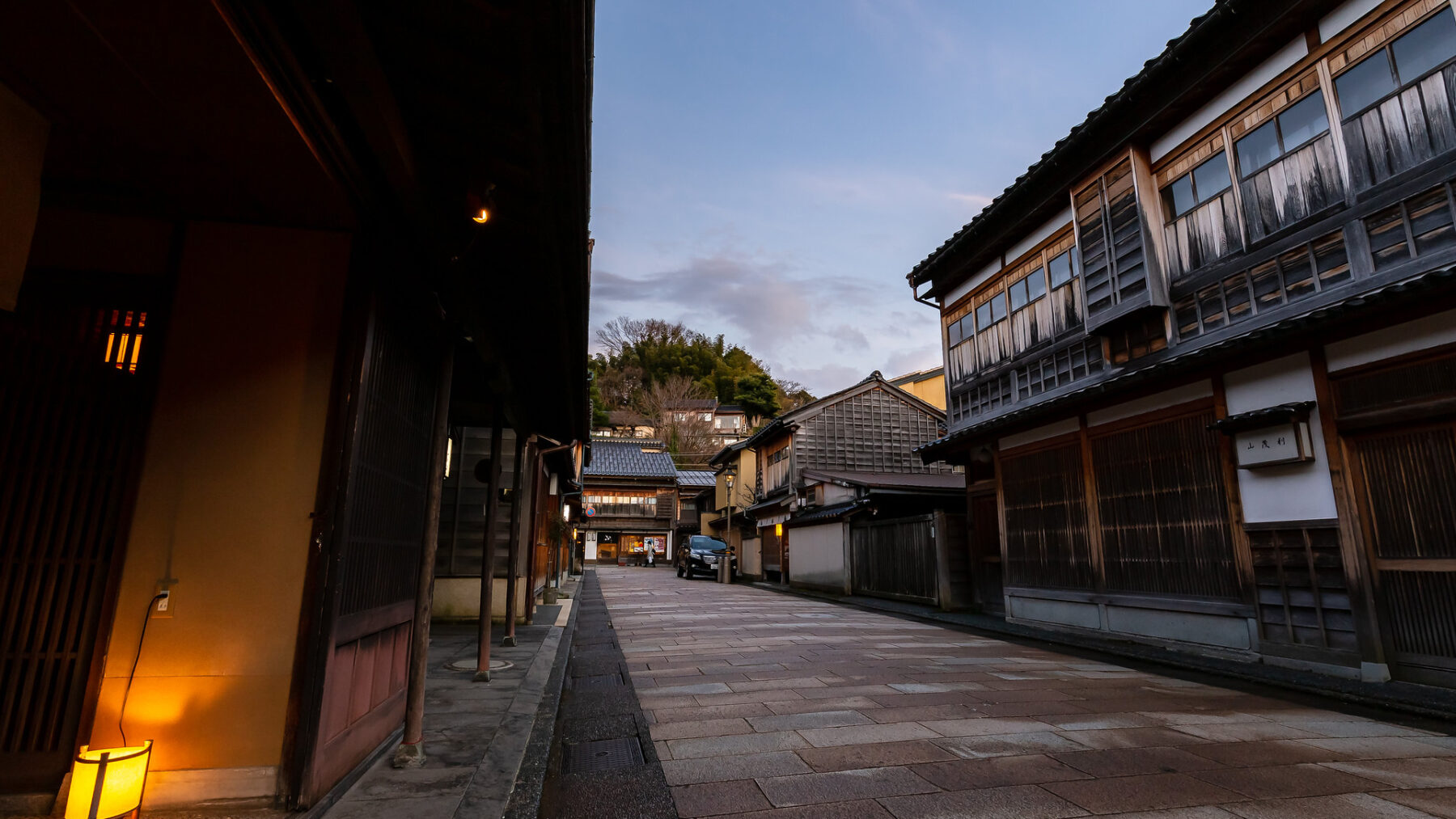
Kanazawa was the seat of the Maeda clan, the second-wealthiest domain in Japan after the shogunate itself, and it spent three hundred years pouring that wealth into craft rather than warfare. It also had no significant military industry in 1945, so it was not bombed — which means its samurai district, its tea house quarters and its garden are the real thing rather than reconstructions.
Since the Hokuriku Shinkansen reached it in 2015, it is two and a half hours from Tokyo. It is still nothing like as busy as Kyoto.
At a glance
- Days needed
- 2 nights. 1 night works but you will wish otherwise.
- Getting there
- 2h 30m from Tokyo, 2h 15m from Kyoto, both by Shinkansen
- Getting around
- Buses from the station loop past everything. Or a bicycle.
- Best months
- April–June, September–November. Winter is grey and wet but the seafood is at its best.
- Rail pass
- JR East Nagano-Niigata Area Pass, or the Takayama-Hokuriku Pass
- Famous for
- Kenroku-en garden, gold leaf, seafood, and the least-crowded old town in Japan
Kenroku-en
One of the three great gardens of Japan, and the one most people rank first. Laid out over nearly two centuries by successive Maeda lords, opened to the public in 1874.
The name means “garden of six qualities” — the six attributes a perfect garden should combine, which classical Chinese theory held could never coexist: spaciousness and seclusion, artifice and antiquity, water and views.
Go at opening, which is 7am in summer and 8am in winter, and entry before official opening hours is free. You will have it to yourself.
In winter the pines are strung with yukitsuri — rope cones tied from the trunk to support the branches under snow. They go up in November and come down in March, and they are as much a symbol of Kanazawa as the garden itself.
The three old districts
Kanazawa’s centre is small enough to walk, with three preserved quarters in different directions.
Higashi Chaya — the tea house district
The largest of Kanazawa’s three geisha quarters, and an intact street of two-storey wooden tea houses with fine wooden lattice screens. Two are open to visit: Shima, unaltered since 1820, and Kaikaro, still working, with a gold-leaf tatami room.
Go before 10am. The street is one block long and photographs poorly with people in it.
Nagamachi — the samurai district
Earthen walls, narrow lanes and water channels, on the west side of the centre. Nomura-ke is a restored middle-ranking samurai residence with a small, dense garden that is worth the entry fee.
In winter the walls are wrapped in straw matting to protect them from snow.
Kazuemachi — the quiet one
A third tea house district along the Asano river, less visited than Higashi Chaya and better in the evening when the lanterns come on.
The 21st Century Museum
A genuinely first-rate contemporary art museum in an unlikely city. Circular, single-storey, glass-walled, designed by SANAA, with no front or back — you can enter from any direction.
The permanent works include Leandro Erlich’s Swimming Pool, where visitors below the water appear to be standing underwater to those looking down. Book a timed slot for the paid galleries; the free zones are worth an hour on their own.
Omicho Market
Two hundred and eighty years old and still the city’s kitchen rather than a tourist attraction. Crab in winter, sweet shrimp, yellowtail, sea urchin.
Eat a kaisendon — a bowl of rice under raw seafood — at one of the counters. Kanazawa’s is among the best in Japan because the Sea of Japan is cold and close.
Go before noon.
Gold leaf
Kanazawa produces about 99% of Japan’s gold leaf, a craft supported by the Maeda for three centuries and sustained by the damp Sea of Japan climate, which suits the beating process.
The leaf is hammered to about one ten-thousandth of a millimetre. You can watch it made, apply it to a small object in a workshop, or eat it on soft-serve ice cream, which is ridiculous and photographs well.
What to eat
- Kaisendon — seafood over rice, at Omicho
- Jibuni — duck simmered in a thickened dashi, Kanazawa’s signature dish, served in a lacquer bowl
- Kani — snow crab from November to March, the season the whole region organises around
- Nodoguro — blackthroat seaperch, grilled; expensive and worth it
- Wagashi — Kanazawa is one of Japan’s three great sweet-making cities, alongside Kyoto and Matsue
Two days, arranged
Day 1 morning — Kenroku-en at opening
Then the castle grounds next door, and the Seisonkaku villa.
Day 1 afternoon — the 21st Century Museum
Directly opposite the garden. Then walk down to Nagamachi for the samurai houses.
Day 1 evening — Kazuemachi and the river
Dinner in the centre; Kanazawa’s izakaya are excellent and rarely need booking.
Day 2 morning — Omicho market, then Higashi Chaya
Market first for breakfast, tea house district before ten.
Day 2 afternoon — a craft workshop, or the temple district
Gold leaf application, or Teramachi across the Sai river, where seventy temples stand in a few blocks including the “Ninja Temple” with its hidden staircases and trick doors — booking required.
Beyond the city
Kaga Onsen — three hot spring towns 30 minutes south, with the restored Edo-period bathhouse at Yamashiro.
Shirakawa-go — the thatched village, about 75 minutes by bus. Combines naturally with Takayama.
The Noto Peninsula — the coast north of the city, with the Senmaida rice terraces and the Wajima morning market.
Where to stay
Near Kanazawa Station for convenience and the best business hotel rates. The station itself is worth seeing — the enormous wooden Tsuzumi Gate and glass dome are among Japan’s better pieces of recent public architecture.
Korinbo / Katamachi for the centre, walking distance to everything, and the nightlife.
Higashi Chaya for a machiya guesthouse in the old quarter.
Combine it with
Kanazawa is the western end of the Hokuriku Shinkansen from Tokyo and connects south to Kyoto and Osaka. The natural route is Tokyo → Kanazawa → Takayama → Kyoto, which is the spine of the 14-day itinerary.
→ 14 days in Japan: getting past Tokyo, Kyoto and Osaka → Toyama and the Tateyama Kurobe Alpine Route
Questions people actually ask
Is Kanazawa really like Kyoto?
It has the same ingredients — garden, tea houses, craft, temples — at perhaps a fifth of the scale and a quarter of the crowds. Kyoto has far more range; Kanazawa is more pleasant to walk around.
Is one night enough?
It works: Kenroku-en and the museum on the afternoon you arrive, Higashi Chaya and the market the next morning. Two nights lets you add Nagamachi, the temple district and a craft workshop without rushing.
When is crab season?
November to March, and it is the reason many Japanese visitors come. Snow crab from the Sea of Japan is graded and tagged by port, and prices reflect it.
How does the weather compare?
Wetter and greyer than the Pacific side — Kanazawa has one of the highest rainfall totals of any Japanese city, and locals say you should never go out without an umbrella. Winter brings heavy wet snow.
Can I visit Shirakawa-go as a day trip?
Yes, by bus in about 75 minutes each way. Book the bus in advance in autumn. Going on to Takayama afterwards rather than returning is the better plan.
Keep planning
Ghibli Park and the Ghibli Museum: How to Get Tickets
Two separate places, 350 kilometres apart, with two separate ticket systems and no tickets at the door. Both release on the 10th…
Kamakura and Enoshima: The Easiest Day Trip from Tokyo
An hour from Tokyo Station: a bronze Buddha from 1252, temples in the hills behind the town, and a tram that runs…
Nikko in a Day: The Shrines, the Lake, and Which Pass to Buy
Nikko is two day trips in one place: gilded shrines in the town, and a lake and a waterfall an hour above…