Kyoto in 3 Days: The Route That Skips the Crowds
Kyoto's problem is not that it is crowded. It is that it is crowded between ten and three, at eight specific places. Start at six and the same city is almost empty — here is the three-day route built around that.
 Signpost Japan
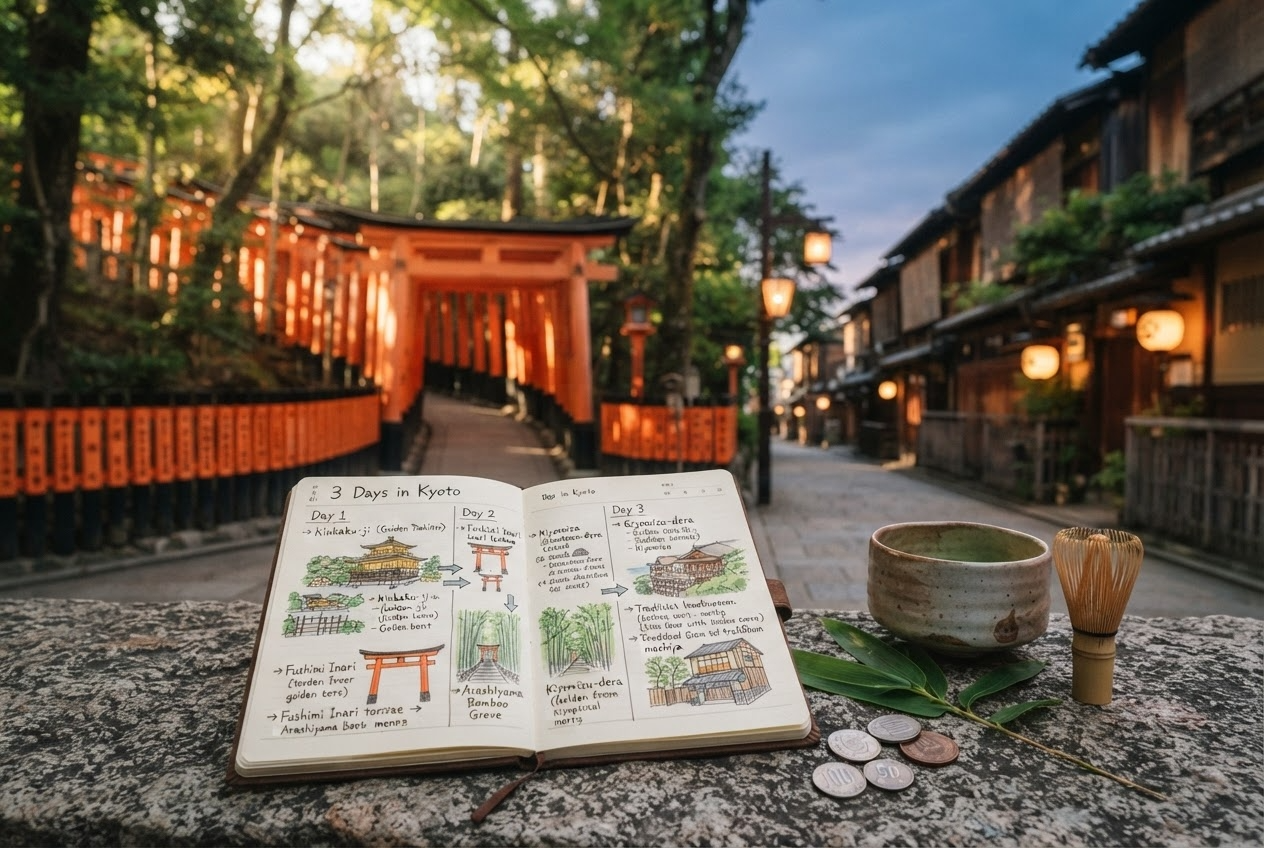
Kyoto receives more visitors than it has room for, and every article about it says so. What almost none of them say is that the crowding is extremely concentrated in time and space: eight or nine sites, between about 10am and 3pm.
Arrive at Fushimi Inari at 6:30am and you will share the mountain with a handful of joggers. Arrive at 11am and you will queue to walk uphill.
The three days below are built entirely around that fact.
At a glance
- Days needed
- 3 full days. 2 is a compromise; 4 lets you breathe.
- Main gateway
- Kansai Intl (KIX), 75 min by Haruka. Or 2h 15m from Tokyo by Shinkansen.
- Getting around
- Buses, not trains. Only two subway lines and they miss most of the temples.
- Best months
- Late March–April, late November. May and October are nearly as good and far quieter.
- Rail pass
- JR West Kansai Area Pass covers Nara, Osaka, Kobe and Himeji day trips
- The one rule
- Be at the first site by 8am. Everything else follows.
Understanding Kyoto’s geography
Kyoto is a grid, laid out in 794 on a Chinese model, in a basin closed on three sides by mountains. The interesting things are around the edges: temples climb the eastern hills (Higashiyama), the western hills (Arashiyama), and the northern hills. The middle is a modern city with a very good market and some excellent bars.
This matters because you cannot zig-zag. Each day should stay on one side of the basin.
Kyoto is also a bus city. Two subway lines cross in the middle and miss almost everything; the buses go where the temples are.
→ Kansai transport: which pass for which trip
Day 1 — the eastern hills
The best day in Kyoto, and it lives or dies on the start time.
6:30am — Fushimi Inari. Free, open all hours, and empty at dawn. Ten thousand vermillion gates climb the mountain in tunnels. Almost everyone turns back at the first viewpoint; go on to Yotsutsuji, about 30–40 minutes up, where the city opens out below you. The full loop takes two hours.
9:00am — Kiyomizu-dera as it opens. A wooden stage built out over the hillside without nails. Then walk down through Sannenzaka and Ninenzaka, the stone-stepped preserved lanes, before the coaches arrive.
11:30am — Kennin-ji. Kyoto’s oldest Zen temple, a working monastery, with painted screens and a dry garden, and rarely more than a dozen people in it.
Lunch in Gion, then the Philosopher’s Path north along the canal to Ginkaku-ji, the silver pavilion, with its extraordinary raked sand cone.
Evening — Pontocho, a lantern-lit alley one building wide between the Kamo river and Kiyamachi.
Day 2 — the west
8:00am — Arashiyama bamboo grove. It is one street long and takes ten minutes to walk. At eight there is nobody in it; by ten it is a slow-moving queue. Go early, then have the rest of Arashiyama to yourself.
8:30am — Tenryu-ji. A UNESCO temple whose garden has been essentially unchanged since the 14th century, borrowing the mountains behind it as scenery. Enter through the garden gate at the back of the bamboo grove.
10:30am — the river. Walk upstream past the Togetsukyo bridge. Boats, herons, and the Iwatayama monkey park up a steep 20-minute path if you want the view.
Afternoon — Kinkaku-ji, the golden pavilion, which takes twenty minutes and is worth them. Then Ryoan-ji‘s stone garden nearby: fifteen rocks in raked gravel, from any angle only fourteen visible.
Evening — Nishiki Market before it closes at six, then the covered arcades and a bar in Kiyamachi.
Day 3 — choose your Kyoto
Three good options depending on what the first two days made you want.
A — Nara. Forty minutes by Kintetsu. Todai-ji’s Great Buddha in the largest wooden building in the world, deer everywhere, and the lantern paths of Kasuga Taisha climbing into old forest.
B — Northern Kyoto and Ohara. An hour by bus into the mountains. Sanzen-in‘s moss garden, small villages, almost no visitors, and the sense of what Kyoto’s temples were for.
C — Slow Kyoto. The Imperial Palace grounds, Nijo Castle with its nightingale floors, a long lunch, the Kyoto Railway Museum or the Manga Museum, coffee in a 1930s kissaten, and a public bath in the evening.
→ Nara: the day trip everyone rushes, and how not to
The crowding map
| Site | Peak crush | Go instead at |
|---|---|---|
| Fushimi Inari | 10am–4pm | Before 8am or after 5pm |
| Kiyomizu-dera | 10am–4pm | 6am opening, or last hour |
| Arashiyama bamboo | 9:30am–4pm | Before 8:30am |
| Kinkaku-ji | 10am–3pm | Opening, or 4pm |
| Gion at night | 6–9pm | Any weekday morning |
What to eat
- Obanzai — Kyoto home cooking, small dishes, seasonal and vegetable-heavy.
- Yudofu — simmered tofu, a temple dish, best near Nanzen-ji.
- Nishin soba — buckwheat noodles with sweet simmered herring.
- Kaiseki — the multi-course form that started here. Expensive at dinner; many of the same kitchens serve a set lunch for a fraction.
- Nishiki Market — an eating street rather than a shopping one. Go hungry, mid-morning.
Where to stay
- Near Kyoto Station — best transport, least atmosphere, cheapest.
- Karasuma / Shijo — central, walkable, good bars and restaurants. The best compromise.
- Higashiyama / Gion — beautiful, expensive, quiet at night.
- Northern Kyoto — cheap and residential, but you will be on buses.
Kyoto accommodation prices roughly double in cherry blossom season and late November. If those dates are fixed, book four months out or stay in Osaka, 29 minutes away.
Combine it with
Nara (40 min), Osaka (29 min), Kobe (55 min), Himeji (60 min) and Uji (20 min, for tea and Byodo-in) are all day trips. Going further west, Kyoto is the natural stop between Tokyo and Hiroshima.
Questions people actually ask
Is Kyoto too crowded to enjoy?
No, but only if you start early. The city has a genuine over-tourism problem between 10am and 3pm at about eight sites. Outside those hours and those places, it is calm.
How many temples should I see?
Two or three a day, properly, beats six. They begin to blur, and the ones you remember are usually the smaller ones you sat down in.
Is the Kyoto bus one-day pass still available?
No. The bus-only pass was abolished at the end of September 2023 and replaced by a combined Subway & Bus pass at around 1,100 JPY. A great deal of online advice is still out of date on this.
Can I see Kyoto in one day?
You can see Fushimi Inari and Kiyomizu-dera in one day. You cannot see Kyoto. If a day is all you have, do the eastern hills and accept that.
Is it worth staying in a machiya townhouse?
Yes, for one or two nights. Restored wooden merchant houses rent as whole-house accommodation and give you a sense of the city’s domestic architecture that no hotel does.
When is autumn colour at its peak?
Mid to late November in the city, slightly earlier in the northern hills. It is as crowded as cherry blossom season and, many people think, better.
Keep planning
Ghibli Park and the Ghibli Museum: How to Get Tickets
Two separate places, 350 kilometres apart, with two separate ticket systems and no tickets at the door. Both release on the 10th…

Kamakura and Enoshima: The Easiest Day Trip from Tokyo
An hour from Tokyo Station: a bronze Buddha from 1252, temples in the hills behind the town, and a tram that runs…
Nikko in a Day: The Shrines, the Lake, and Which Pass to Buy
Nikko is two day trips in one place: gilded shrines in the town, and a lake and a waterfall an hour above…