Tokyo Trains Explained: JR, Metro, Toei and the Private Lines
Four operators, thirty-odd lines and the world's busiest station. You only need six lines to see Tokyo — here they are, plus the transfer that quietly costs you extra.
 Signpost Japan
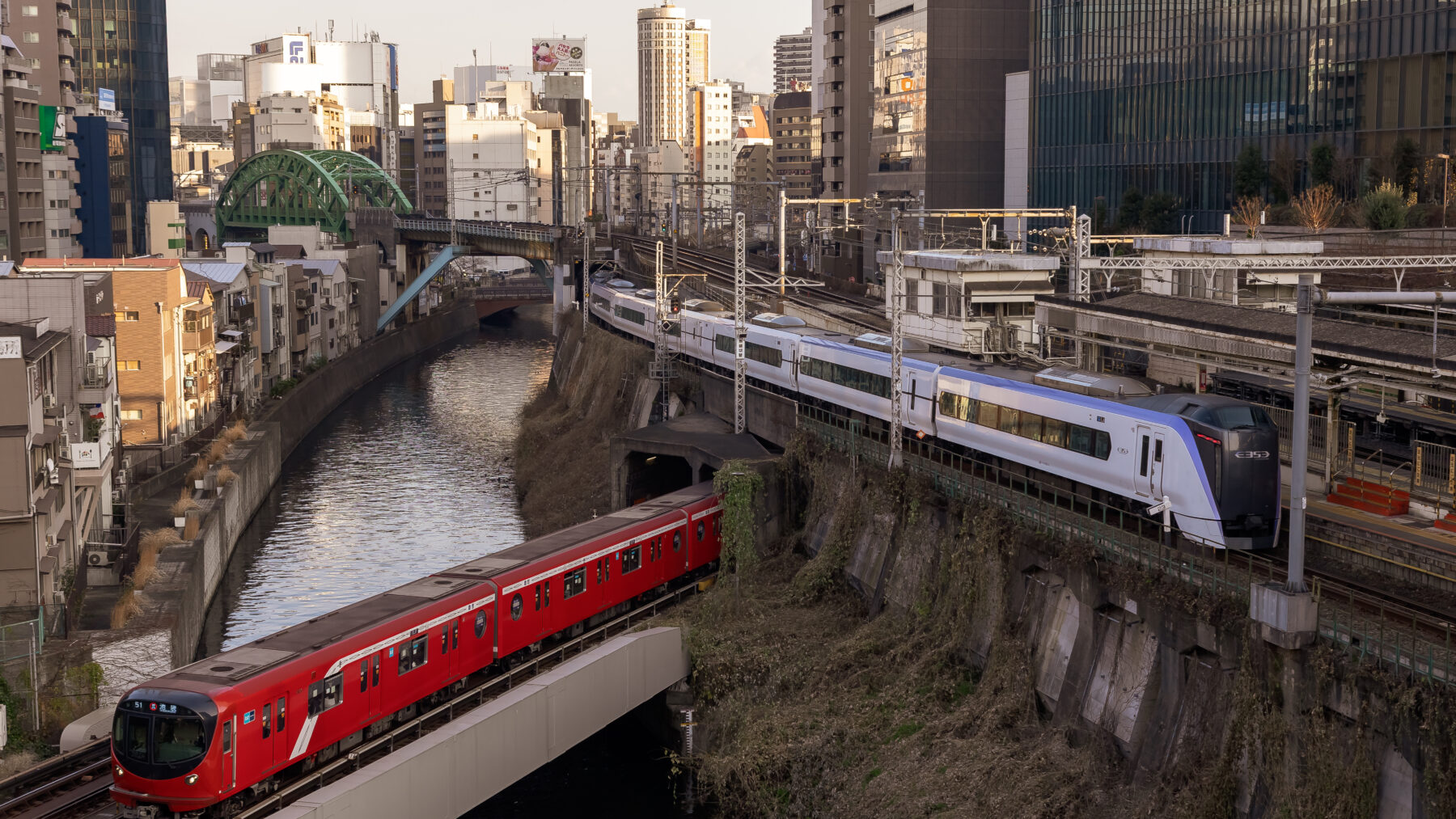
The Tokyo rail map is famously overwhelming, and almost all of that complexity is irrelevant to a visitor. Tokyo has more than thirty urban rail lines run by four different kinds of operator. A first trip uses about six of them.
At a glance
- The one to learn
- The Yamanote line — a green loop connecting almost everywhere you want to go
- Operators
- JR East, Tokyo Metro, Toei subway, and half a dozen private railways
- The catch
- Metro and Toei are separate companies. Transferring between them costs extra.
- Best ticket
- An IC card for most people; the Tokyo Subway Ticket if you are riding subways hard
- Last trains
- Around midnight to 1am. There is no night service at all.
Start with the loop
The Yamanote line is a green circle around central Tokyo. It calls at Tokyo, Ginza (via Yurakucho), Akihabara, Ueno, Ikebukuro, Shinjuku, Harajuku, Shibuya and Shinagawa. A full circuit takes about an hour and trains run every few minutes.
If your hotel is on or near the loop, you can reach most of the city without ever using a subway. Getting this right when you book accommodation is worth more than any pass.
Two other JR lines matter:
- Chuo Rapid (orange) cuts straight across the middle of the loop from Tokyo to Shinjuku, saving fifteen minutes over going round.
- Keihin-Tohoku (blue) runs parallel to the eastern side of the loop and is often less crowded.
The subways
Tokyo has two separate subway operators, and this is the single most expensive thing visitors do not know.
Tokyo Metro runs nine lines. Toei runs four. They share stations, share the map, and share a colour scheme — but they are different companies, so a journey that uses both charges you two base fares.
The six lines you are most likely to use:
| Line | Code | Colour | Goes to |
|---|---|---|---|
| Ginza | G | Orange | Asakusa, Ueno, Ginza, Shibuya |
| Marunouchi | M | Red | Tokyo, Ginza, Shinjuku, Ikebukuro |
| Hibiya | H | Silver | Ueno, Ginza, Roppongi, Ebisu |
| Chiyoda | C | Green | Meiji-jingumae (Harajuku), Omotesando |
| Oedo (Toei) | E | Magenta | Roppongi, Shinjuku, Tsukishima |
| Asakusa (Toei) | A | Rose | Asakusa, Ginza, Shinagawa |
The private railways
Six private companies run lines out of Tokyo into the suburbs and beyond. You will meet them when you take a day trip.
- Odakyu — Shinjuku to Hakone. The Romancecar and the Hakone Free Pass.
- Tobu — Asakusa to Nikko, and Tokyo Skytree.
- Keio — Shinjuku to Mount Takao.
- Seibu — Ikebukuro to Kawagoe.
- Tokyu — Shibuya to Yokohama.
- Keisei — Ueno to Narita Airport. Keikyu — Shinagawa to Haneda.
None of these are covered by any JR pass. Most have their own excellent-value day passes for the destination they serve.
Which ticket
An IC card covers everything above — JR, both subway operators, all private lines, and the buses. For most visitors this is the whole answer.
The Tokyo Subway Ticket is worth it if you are staying central and using subways heavily. It covers Tokyo Metro and Toei for 24, 48 or 72 hours, from roughly 800 JPY, and is sold at the airports, at Bic Camera and at some hotels. Three or four subway journeys a day and it pays for itself.
The JR Tokyo Wide Pass is a day-trip pass, not a city pass — see the regional passes guide.
Surviving the big stations
Shinjuku handles over three million passengers a day and has more than two hundred exits. Shibuya is a vertical maze under permanent reconstruction. Tokyo Station is really two stations either side of a very long concourse.
Three habits make all of them manageable:
Navigate to the exit, not the station
Set your destination in Google Maps and it will name the exit — “New South Exit”, “Hachiko Exit”, “Yaesu North”. Follow signs to that exit name and ignore everything else.
Use the compass points
Exits are grouped East, West, South, North and Central. Getting the compass point right puts you within a few minutes’ walk even if you take the wrong door.
Come up to street level early if you are lost
Underground navigation is harder than surface navigation, and your phone’s GPS does not work below ground. Surface, orient, walk.
Rush hour
Peak is roughly 7:30 to 9:00am inbound and 5:30 to 7:30pm outbound. The famous pushing is real on a handful of lines — Chuo, Saikyo, Tozai — but most journeys are simply very full rather than physically compressed.
If you are travelling with luggage or children, avoid those windows entirely. Many urban lines run women-only cars in the morning peak, marked in pink on the platform edge.
The last train
Tokyo shuts down between roughly midnight and 5am. There is no night bus network worth the name and no 24-hour metro.
Missing the last train is a standard Tokyo experience with a standard set of answers: a taxi (expensive, but they exist), a capsule hotel, a manga café, or an izakaya that stays open until the trains restart. Nobody will think it strange.
→ When things go wrong: missed trains, lost tickets and the last train
Questions people actually ask
Do I need a Tokyo subway pass, or is an IC card enough?
An IC card is enough for most visitors. Buy a Tokyo Subway Ticket only if you are staying centrally and making four or more subway journeys a day, which mostly means a short, intense sightseeing trip.
Is the Yamanote line covered by the JR Pass?
Yes. The Yamanote and all other JR lines in Tokyo are covered. The subways and private railways are not.
How do I get to Tokyo Disney or Skytree?
Disney is the JR Keiyo line from Tokyo Station to Maihama. Skytree is the Tobu line from Asakusa, one stop, or a fifteen-minute walk across the river.
Are Tokyo trains safe at night?
Yes, including for solo women travellers. The main risk after midnight is being stranded rather than anything else.
Can I eat on the train?
Not on urban commuter trains — it is not done. On Shinkansen and long-distance limited express trains it is completely normal.
Keep planning
Tokyo to Kyoto: Shinkansen, Night Bus or Plane?
The Shinkansen is the right answer for almost everyone: 2 hours 15 minutes, about 14,000 JPY, no check-in. Here is what the…
When Things Go Wrong: Missed Trains, Lost Tickets and the Last Train
You will miss a connection, feed the wrong ticket into a gate, or look up at 11:40pm and realise the last train…
Luggage in Japan: Coin Lockers, Takkyubin and Oversized Baggage Rules
Japanese trains were not built for suitcases, so Japan moves the suitcase separately. How luggage forwarding works, what the 160cm rule means,…