How to Read a Japanese Train Timetable, Sign and Platform
Station codes, colour bars, the four kinds of train that stop at different stations, and the one column of a timetable that tells you whether your train runs today.
 Signpost Japan
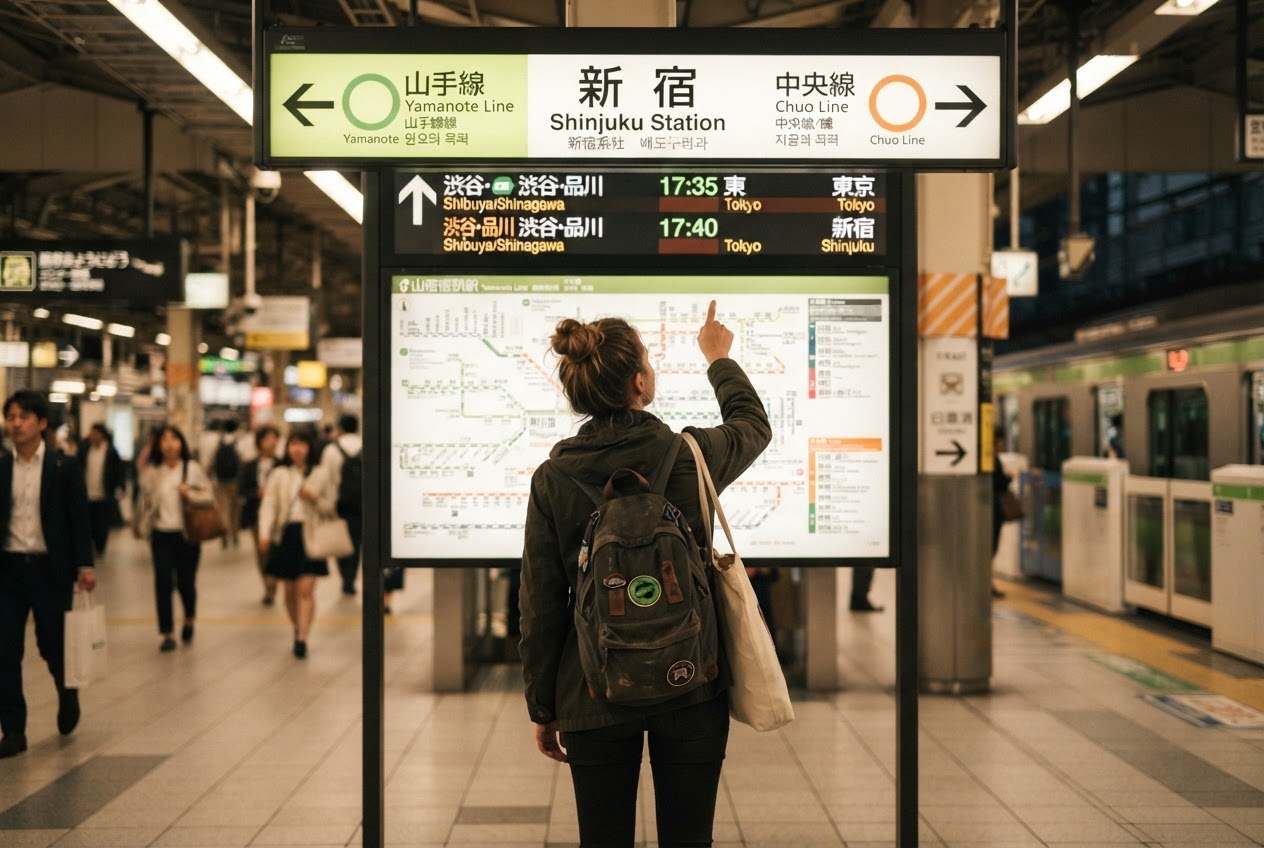
Japanese stations are covered in information and almost all of it is bilingual. The problem is not language. The problem is that the system encodes things that other countries do not encode, and nobody tells you what the encoding means.
Learn four conventions and every station in the country becomes readable.
At a glance
- Station codes
- A letter and a number: G-09, M-16. Easier to track than the name.
- Line colours
- Consistent everywhere — on maps, signs, platform edges and the train itself.
- Train types
- Local, Rapid, Express, Limited Express. They stop at different stations on the same line.
- Timetable colours
- Black for weekdays, red or blue for weekends and holidays.
- Direction
- Signs name the next station and the terminus, not “northbound”.
1. Station codes are your friend
Every station on every urban network has a code: a letter for the line, a number for the position. Shibuya on the Ginza line is G-01. Ueno is G-16.
You do not need to read or pronounce Japanese place names to use these. Count the numbers. If you are at G-04 and you want G-09, you have five stops and you are going up.
The letter also tells you the line, and the line has a colour that is used identically on the network map, the station signage, the platform edge, the train’s stripe and the app on your phone. Ginza is orange everywhere. Marunouchi is red everywhere.
2. The four kinds of train
This is the convention that costs visitors the most time, because two trains on the same platform to the same destination will not stop at the same places.
| Type | Japanese | What it does |
|---|---|---|
| Local | 各駅停車 / 普通 | Stops at every station |
| Rapid | 快速 | Skips minor stations |
| Express | 急行 | Skips more |
| Limited Express | 特急 | Few stops, usually needs a surcharge ticket |
The critical point: a Rapid or Express may not stop at your station at all. If you are going somewhere small, take the Local, even though the Express arrives first and looks faster.
Platform displays show the type in colour — often orange for Rapid, red for Express, green for Local — alongside the destination and departure time. Your navigation app names the type; trust it over the train that is sitting there now.
3. Reading a platform timetable
Paper timetables are still posted on every platform, and they are laid out the same way everywhere.
- Left column, large numbers: the hour.
- To the right: minutes past that hour, in order, each one a departure.
- Colour or symbol on the minute: the train type. A legend at the bottom explains it.
- Two or three separate grids: one for weekdays (平日), one for Saturdays (土曜), one for Sundays and public holidays (日曜・祝日). Weekday grids are black; weekend grids are usually red or blue.
That last distinction catches people out constantly on rural lines, where the Sunday service can be a third of the weekday one.
On a platform
4. Direction signs name places, not compass points
Japanese signage does not say “northbound”. It names the next station and the final destination, in that order.
So a sign reading “for Shinjuku, Ikebukuro” means the train goes towards those places. If your destination is between here and Ikebukuro, this is your train. If it is on the other side, cross to the opposite platform.
The consequence: know the terminus in your direction, not just your own stop. Your app tells you. Write it on your hand if you have to.
Kanji worth recognising
You do not need to learn Japanese. Ten characters cover almost every sign that matters.
| Kanji | Reading | Meaning |
|---|---|---|
| 駅 | eki | station |
| 出口 | deguchi | exit |
| 入口 | iriguchi | entrance |
| 東 西 南 北 | higashi nishi minami kita | east west south north (used for exits) |
| 中央 | chuo | central |
| 改札 | kaisatsu | ticket gate |
| 精算 | seisan | fare adjustment |
| 乗換 | norikae | transfer |
| 番線 | bansen | platform number |
| 各駅停車 | kakueki-teisha | local train |
The exit compass points matter more than they sound. Large stations have a dozen exits and choosing the wrong one at Shinjuku can add fifteen minutes and a wrong side of a very large building.
The things that are genuinely confusing
Stations with the same name, run by different companies. Osaka’s Umeda area has JR Osaka, Hankyu Osaka-Umeda, Hanshin Osaka-Umeda and three subway stations, all connected, all different. Your app names the company. Follow that.
Through-running. A subway train may continue onto a private railway and change its name and type halfway. You do not need to change trains; the destination display updates. This is normal.
Women-only cars. Marked in pink on the platform edge, in force during weekday rush hours on many urban lines. Men should not board these carriages during those times.
Reserved and non-reserved cars. On limited express and Shinkansen services, the platform floor is marked with car numbers and whether that car is reserved. Stand at the right mark.
Questions people actually ask
Are announcements in English?
On Shinkansen, airport lines and all major urban lines, yes — station names and transfers are announced in English. On rural lines, often not. The scrolling display above the door usually cycles through English regardless.
What if I board the wrong train?
Get off at the next stop and cross to the other platform. Your IC card handles it; if you are on a paper ticket, show it to staff at the gate and they will sort it out at no cost.
Why does my train have a different name on the display than on my ticket?
Through-running services change name when they cross onto another company’s track. As long as the destination matches, you are on the right train.
How do I know which car to board for the fastest exit?
Google Maps often tells you. Failing that, look at the platform map near the stairs — many stations mark which car number lines up with which exit and transfer.
What does it mean when the timetable is printed in red?
Weekend and public holiday service. On weekdays that grid does not apply, and on rural lines the difference can be dramatic.
Keep planning
Tokyo to Kyoto: Shinkansen, Night Bus or Plane?
The Shinkansen is the right answer for almost everyone: 2 hours 15 minutes, about 14,000 JPY, no check-in. Here is what the…
When Things Go Wrong: Missed Trains, Lost Tickets and the Last Train
You will miss a connection, feed the wrong ticket into a gate, or look up at 11:40pm and realise the last train…
Luggage in Japan: Coin Lockers, Takkyubin and Oversized Baggage Rules
Japanese trains were not built for suitcases, so Japan moves the suitcase separately. How luggage forwarding works, what the 160cm rule means,…