Money in Japan: Cash, Cards, ATMs and Tax-Free Shopping
Japan is far less cash-dependent than its reputation and still more than northern Europe. Where cards work, where they do not, which ATM to use, and the tax-free change that lands in November 2026.
 Signpost Japan
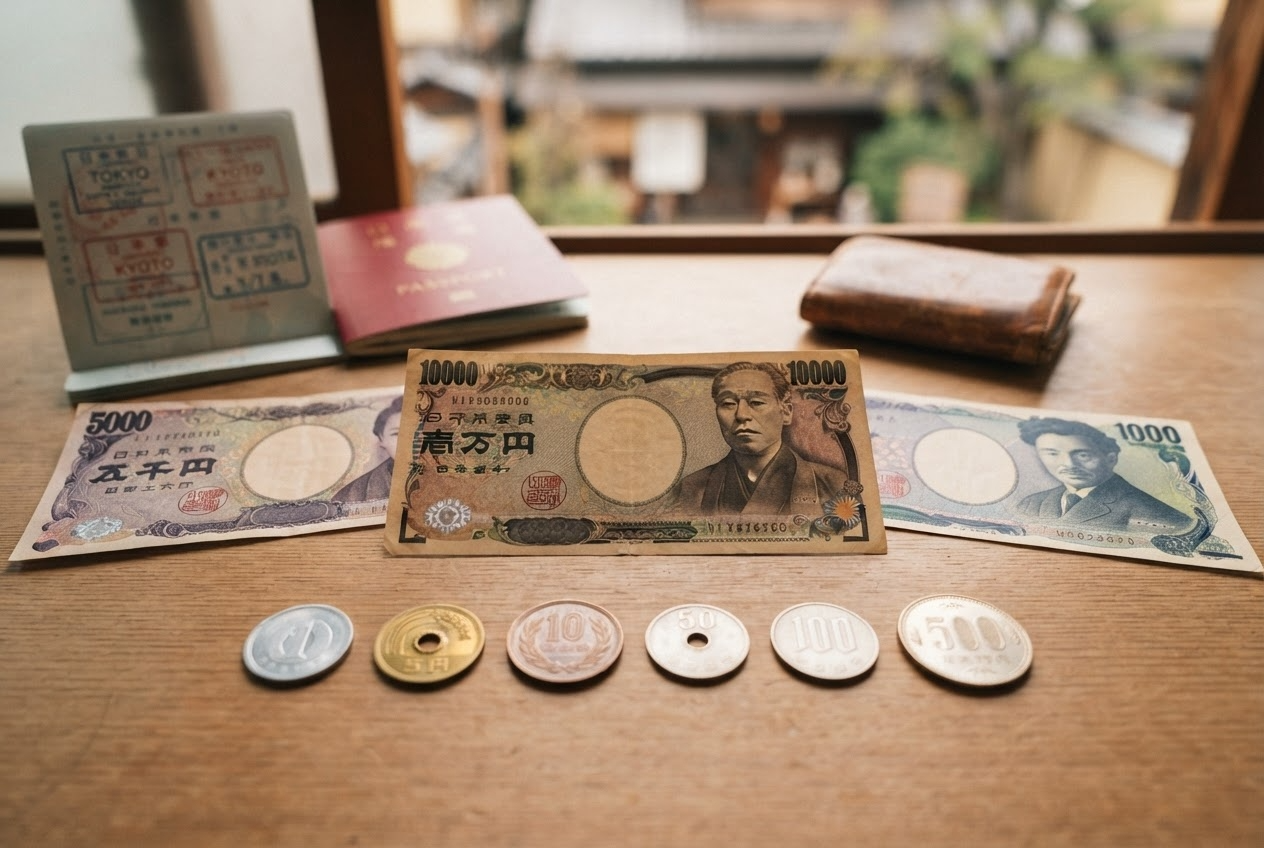
Japan’s reputation as a cash country is about a decade out of date and still not entirely wrong. In Tokyo you could go a week without touching a note. Twenty minutes outside it you will find a bus, a temple and a very good noodle shop that all want coins.
The rule that works: carry 20,000–30,000 JPY, pay by card where you can, and never let cash run to zero.
At a glance
- Currency
- Japanese yen (JPY, ¥). Notes 1,000 / 5,000 / 10,000. Coins 1 / 5 / 10 / 50 / 100 / 500.
- Best ATM
- 7-Bank, inside every 7-Eleven. Accepts foreign cards, English interface, 24 hours.
- Cards work
- Hotels, chains, department stores, most city restaurants, konbini, most stations
- Cards often fail
- Small restaurants, rural buses, temples, markets, some ryokan
- Tipping
- Never. Not in restaurants, taxis, hotels or anywhere else.
- Tax-free
- 10% off over 5,000 JPY with a passport — but the system changes on 1 Nov 2026
Getting cash
Use a 7-Bank ATM. They are inside every 7-Eleven — of which there are more than twenty thousand — they are open all hours, they have a clear English interface, and they reliably accept foreign Visa, Mastercard, Maestro, Cirrus, Amex, JCB and UnionPay cards.
Japan Post Bank ATMs in post offices are the second option, equally reliable, but post offices close.
Avoid ATMs at ordinary Japanese banks — many still do not accept foreign cards at all, and those that do often stop overnight.
Avoid currency exchange counters at airports and in tourist districts. The ATM rate is better, and so is the rate your own bank gives you.
Insert your card and press English
The language button appears immediately on the screen.
Choose Withdrawal, then Savings or Credit
Debit cards work as Savings. If Savings is refused, try Credit — some foreign cards are routed that way.
Enter the amount
Machines dispense 10,000 JPY notes for larger amounts. Take 20,000–30,000 JPY at a time to reduce per-transaction fees.
Decline the conversion offer
If the machine offers to charge you in your home currency, say no. Dynamic currency conversion costs 3–7%. Always choose to be billed in yen.
Where cards work
Reliably: hotels, department stores, chain restaurants, convenience stores, supermarkets, station ticket machines, taxis in cities, and almost everything in central Tokyo and Osaka.
Often not: small independent restaurants and bars, especially older ones. Temples and shrines — entry fees, charms and goshuin stamps are cash. Rural and community buses. Markets and street food. Some ryokan. Coin lockers, though newer ones take IC cards.
A useful heuristic: if the business has fewer than about ten seats, or is older than you, bring cash.
American Express and Discover are accepted much less widely than Visa, Mastercard and JCB. Bring a Visa or Mastercard as your primary.
Contactless and IC cards
Contactless card payment is now common in cities, but the dominant tap-to-pay in Japan is the IC transport card — Suica, ICOCA, PASMO and their siblings. These are prepaid and work in convenience stores, vending machines, many restaurants, taxis and lockers as well as on trains.
Loading one with 5,000 JPY on arrival handles almost every small purchase you make.
→ IC cards explained: Suica, ICOCA, PASMO and the rest
QR code payment apps — PayPay, Rakuten Pay, LINE Pay — dominate among residents, but most require a Japanese bank account or phone number and are not practical for visitors.
Cash etiquette
Small things that mark you out, and are easy to get right.
- Use the tray. Almost every till has a small tray for money. Put your notes and coins in it rather than into the cashier’s hand. Change comes back the same way.
- Nobody minds a 10,000 JPY note for a 500 JPY purchase. Breaking large notes is normal and expected.
- Coins accumulate fast. The 1 and 5 yen coins are nearly weightless and nearly worthless; the 100 and 500 are useful for lockers, buses and vending machines. Keep them.
- Counting your change in front of the cashier is unnecessary. It will be correct.
Tipping
There is no tipping in Japan. Not in restaurants, not in taxis, not for hotel staff, not for guides. Leaving money on a table will usually result in someone chasing you down the street to return it.
The exception, and it is narrow: a formal ryokan where a room attendant looks after you personally may accept a kokorozuke — a small amount in an envelope, given discreetly at the start of the stay. Even here it is optional and increasingly rare.
Some izakaya add a small seating charge called otoshi (お通し), 300–500 JPY, which comes with a small dish you did not order. This is not a scam and not a tip; it is a cover charge. Some restaurants add 10% service at the top end. Both are disclosed.
→ Tipping in Japan, and why nobody wants your money
Tax-free shopping
Foreign visitors on a temporary visitor stamp can buy consumption-tax-free — currently 10% — at licensed shops, on purchases over 5,000 JPY in a single store on a single day.
You need your passport, physically, with the landing sticker. Photographs are not accepted.
Two categories, historically treated differently:
- General goods — electronics, clothing, watches, bags. Usable in Japan.
- Consumables — cosmetics, food, drink, medicines. Sealed in a bag you are not supposed to open until you leave.
Budgeting
| Typical daily cash needs, mid-range traveller | Cost |
|---|---|
| Temple and shrine entry | 1,000 JPY |
| Lunch at a small restaurant | 1,200 JPY |
| Local bus and locker | 800 JPY |
| Vending machines, snacks | 500 JPY |
| Contingency | 1,000 JPY |
| Cash per day | About 4,500 JPY |
Everything else — hotels, dinner, shopping, Shinkansen tickets — goes on a card.
→ How much does a trip to Japan cost? A real daily budget
Questions people actually ask
How much cash should I bring from home?
Little or none. Withdraw at a 7-Eleven ATM on arrival at a better rate than any exchange counter will give you. Bring one small emergency reserve if it makes you comfortable.
Will my card be declined?
Tell your bank you are travelling. Beyond that, the common failures are American Express at small businesses and debit cards routed as Savings at ATMs — try Credit if Savings fails.
Is it safe to carry cash in Japan?
Yes. Japan has one of the lowest rates of street crime in the world, and lost wallets are frequently handed in intact. Ordinary care is enough.
Can I pay with my phone?
Apple Pay works with Suica and with contactless cards in most city businesses. Google Pay is more limited — Japanese mobile IC cards generally need a Japanese-market handset.
What do I do with leftover coins?
Spend them at a convenience store or load them onto your IC card at a station machine — most accept coins. Airport donation boxes take the rest.
Is it rude to ask if a place takes cards?
Not at all. Ask before you sit down: Kaado wa tsukaemasu ka? — カードは使えますか?
Keep planning
Japan with Children: What Works, and What to Skip
Japan is one of the easiest countries in the world to travel with children, with two exceptions: hotel rooms are sized for…
Where to Stay in Kyoto: The Five Areas, and the New Lodging Tax
Kyoto is a city you see before nine in the morning, which makes where you sleep matter more than it does in…
Where to Stay in Tokyo: Which Area, and What a Night Costs
In Tokyo you are not choosing a neighbourhood so much as a station. Six areas that work for a first trip, what…