Japan with Children: What Works, and What to Skip
Japan is one of the easiest countries in the world to travel with children, with two exceptions: hotel rooms are sized for two people, and stations have stairs. Both are solvable if you know before you book.
 Signpost Japan
Children are well looked after in Japan. The trains are quiet and punctual, the food is mild and familiar enough, the toilets have changing tables, nappies and formula are in every pharmacy, and nobody minds a toddler on a train at seven in the evening.
Two things catch families out, and both are decided at the booking stage rather than on the trip: Japanese hotel rooms are built for two people, and a lot of stations expect you to carry your bag up a flight of stairs. Plan around those and the rest is easier than at home.
At a glance
- Train fares
- Under 6 travel free, 6 to 11 pay half. Two free children per adult
- Hotel rooms
- Priced and registered per person. A family of four rarely fits in one Western room
- The fix
- Japanese-style rooms with futons, or an apartment with a washing machine
- Pushchairs
- Fine in new buildings, awkward in old stations. Lifts exist and are badly signed
- The best trick
- Send the suitcases ahead and travel with a day bag
- Pace
- One big thing a day, two cities in two weeks
Where to sleep
This is the one that needs attention. A standard business hotel room is 12 to 15 square metres and is sold for one or two people; hotels register the number of guests sleeping in a room and will not let four people into a twin, even if the children are small.
Three answers, in order of how well they work:
- A Japanese-style room. Tatami, futons laid out after dinner, and space for four in one room — often cheaper per head than two Western rooms. Children usually love them.
- An apartment or a whole house. A kitchen, a washing machine and no front desk. For a stay of three nights or more in one city this is normally the cheapest and the sanest option.
- A family room at a chain hotel. Some chains do bunk rooms or triples, in limited numbers, which go early.
→ Where to stay in Japan: the six kinds of place, and what each is for
Trains with children
Children under six travel free on JR, up to two per fare-paying adult, and six to eleven pay half. That makes a Japan Rail Pass worth less for a family than the headline price suggests — work it out per person before buying.
Reserve seats for anything over an hour. Non-reserved carriages on a busy Shinkansen mean standing with a child on your hip for two hours, which is a bad afternoon. Three-across seats put a family of four across the aisle from each other.
And use the luggage forwarding service. Sending the big cases to the next hotel for a couple of thousand yen each turns a moving day from an ordeal into a normal journey, and it is the single best thing a family can do in Japan.
→ Luggage in Japan: forwarding, lockers and moving days
Pushchair or carrier?
A carrier for a baby, a compact pushchair for a toddler, and low expectations of either in old stations. Big interchanges have lifts, but they are often at one end of a 300-metre platform and signed only in small print. New buildings, department stores and museums are all fine.
Many large stations and shopping centres rent pushchairs by the hour, which is worth knowing if you want to travel without one.
What works, by age
Under three. Parks, aquariums, trains as entertainment in themselves, and the quiet floors of department stores where the baby rooms are. Temples are a pushchair problem and a nap opportunity.
Four to eight. The theme parks, the big aquariums, monkeys, deer at Nara, and anything with a train in it. This is the age at which Japan is at its easiest.
Nine to twelve. Samurai and ninja museums, teamLab, go-karts, the Shinkansen itself, Fuji from a distance. Old enough to walk a city day.
Teenagers. Shibuya, Akihabara, food, and being left alone in a safe city for an afternoon, which is a freedom they will not get at home.
→ teamLab Planets or Borderless: which one to book
Food
Easier than parents expect. Conveyor-belt sushi restaurants are designed for families and have a touchscreen in English. Family restaurant chains do a children’s menu with a drink bar. Convenience stores sell rice balls, fruit and sandwiches at every hour. Department store food halls solve the problem of four people wanting four different things.
If you are dealing with allergies, read up before you go: cross-contamination is common and the labelling conventions are not the ones you are used to.
→ Allergies and halal food in Japan: what to ask, and the words for it
A realistic pace
One big thing a day. A temple in the morning and a park in the afternoon, not three temples. Two bases in two weeks rather than five, because every change of city costs you most of a day in packing, trains and check-in.
Build in an afternoon back at the hotel. Japanese cities are intense, the walking distances are long, and a two-hour break at four in the afternoon is what makes the evening possible.
→ Seven days in Japan: the itinerary that does not exhaust you
Before you fly
Check the medicine rules. Several common cold and allergy remedies — anything containing pseudoephedrine, and codeine-based painkillers — are prohibited, and the quantity limits on ordinary medicines are real. Bring what you need in its original packaging, and check the list rather than assuming.
→ Entry requirements for Japan: what you need before you fly
Questions people actually ask
Is Japan safe for children?
Unusually so. Japanese children ride trains to school alone from about seven, and the social expectation that nobody will bother them holds for visitors too.
Can babies and toddlers go in an onsen?
Most public baths allow children, often with a lower age limit and no nappies in the water. A private family bath, which many ryokan rent by the hour, is the easier answer.
Will I find nappies and formula?
Yes, in any pharmacy, supermarket or large convenience store. Brands differ; sizes run small by European standards.
Are restaurants child-friendly?
Chains and conveyor sushi, very much. Small counter restaurants with eight seats, less so — not because children are unwelcome, but because there is nowhere to put them.
Do we need a car?
Not for the cities, and the trains are part of the fun. A car earns its place in Hokkaido, Okinawa and rural areas, where it saves hours of waiting for buses.
What about summer?
July and August are genuinely dangerous for small children in the cities — over 35 degrees with high humidity. If you must travel then, go north, plan indoor afternoons, and carry more water than you think you need.
Keep planning
Where to Stay in Kyoto: The Five Areas, and the New Lodging Tax
Kyoto is a city you see before nine in the morning, which makes where you sleep matter more than it does in…
Where to Stay in Tokyo: Which Area, and What a Night Costs
In Tokyo you are not choosing a neighbourhood so much as a station. Six areas that work for a first trip, what…
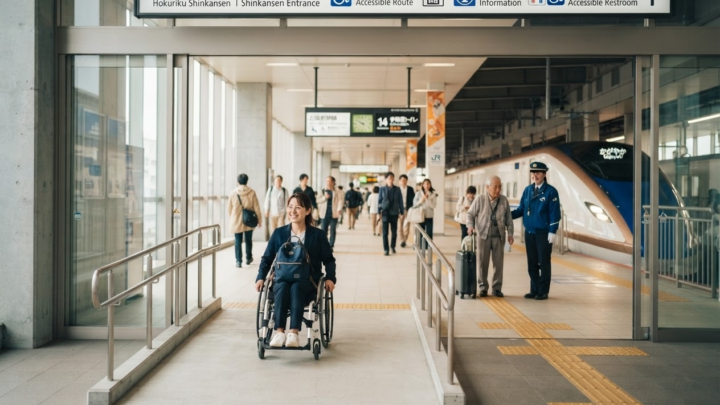
Accessible Japan: Travelling with Limited Mobility, a Buggy or Big Luggage
Japan is better than almost anywhere for step-free rail travel and worse than you would expect at the last hundred metres. What…