What to Pack for Japan — and What to Buy After You Land
Pack for 15,000 steps a day, small hotel rooms and a lot of taking your shoes off. Half the list everyone tells you to bring is cheaper at a Japanese convenience store, and one item genuinely matters more than the rest.
 Signpost Japan
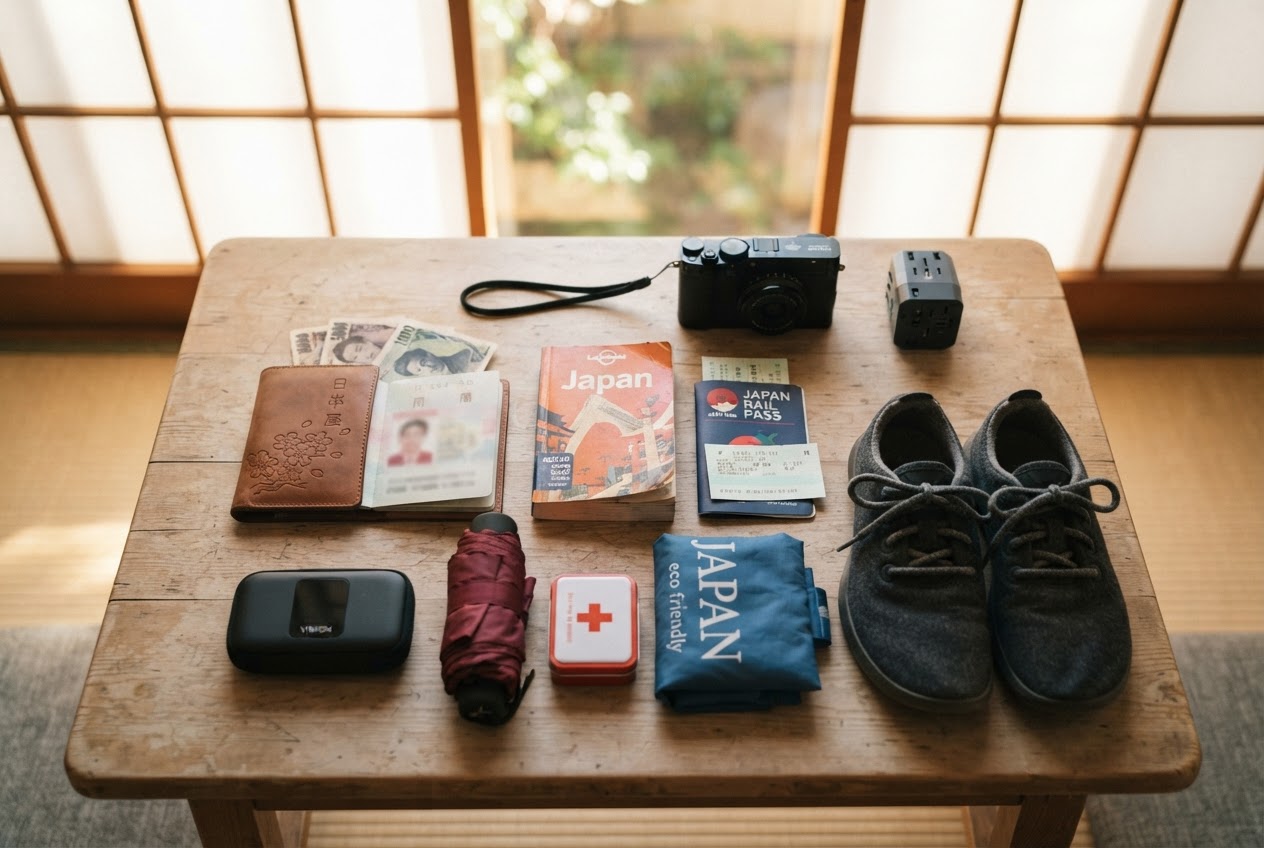
The Japan packing problem is not what to bring. It is that most people bring too much, into a country of small hotel rooms, narrow train aisles and stations with a lot of stairs.
Pack light and buy what you are missing. Japan is exceptionally good at selling you a well-made small thing at 11pm.
At a glance
- The one thing that matters
- Comfortable, broken-in walking shoes that slip off easily
- Bag size
- Cabin plus a day bag is enough for two weeks, with laundry
- Laundry
- Coin laundries everywhere; most business hotels have machines
- Do not pack
- Umbrella, toiletries, adapters in bulk, towels, a hairdryer
- Plug
- Type A, two flat pins, 100V. US plugs fit; most modern electronics handle the voltage.
Shoes: the whole game
You will walk 15,000 to 20,000 steps a day, on pavement, and you will take your shoes off several times — at temples, at ryokan, in some restaurants, and in changing rooms.
Bring shoes you can slip on and off without sitting down, that you have already worn for a full day at home. Loafers, slip-on trainers, or laced shoes you can leave loosely tied.
Do not bring new boots, anything that needs a shoehorn, or sandals as your only pair. And bring socks without holes — you will be standing in them in front of strangers more often than you expect.
One pair plus one backup. That is all.
Clothes
Japanese dress is neat rather than formal. Nobody will judge your clothes, but scruffy stands out more than it does in Europe or North America, and shorts on adult men are less common in cities outside high summer.
Bring:
- Layers. Buildings are heated and cooled room by room, so you are constantly going from cold corridor to warm room.
- One thing you can wear to a nice dinner. No jacket needed anywhere except the very top end.
- More socks than you think.
By season:
| Season | The specific thing |
|---|---|
| Spring / autumn | A light waterproof layer. Weather turns quickly. |
| Summer | Loose cotton or linen, a hand towel for sweat, a hat. Air conditioning is aggressive, so bring one long sleeve. |
| Winter | Layers rather than one thick coat — you will be indoors and outdoors constantly. Uniqlo Heattech is made for this and is cheap in Japan. |
| Rainy season | Waterproof shoes matter more than a coat. |
Do not pack these
Every one of these is cheaper, better or more available in Japan.
- An umbrella. Every convenience store sells a clear plastic one for about 700 JPY. Everyone has one. Do not carry one from home.
- Toiletries. Hotels provide shampoo, conditioner, body wash and often toothbrushes. Drugstores are excellent and cheap.
- A towel. All hotels provide them. Ryokan provide yukata too.
- A hairdryer. In every hotel room.
- Snacks. You are going to Japan.
- Multiple adapters. Bring one, buy a cheap multi-socket at a 100-yen shop if you need more.
Do pack these
- Medication, in original packaging with a copy of the prescription. Check it against Japan’s restricted list first — this is the packing item with real consequences.
- A small day bag. You will leave your case at the hotel and walk all day.
- A power bank. You will use maps and translation constantly.
- A foldable tote. Shops charge for bags and Japan is a country that will make you buy things.
- A hand towel. Many public toilets have no dryer or paper. Japanese people carry a small towel; you should too.
- Cash card that works abroad. Check your bank allows Japanese ATM withdrawals.
→ Japan entry requirements: Visit Japan Web, customs and duty-free
Electricity
Japan runs on 100V, 50Hz in eastern Japan and 60Hz in the west, with Type A two-flat-pin sockets.
US and Canadian plugs fit directly. UK, EU and Australian plugs need an adapter. Almost all modern phone, laptop and camera chargers accept 100–240V, so you need an adapter and not a transformer — check the small print on your charger to be sure. Hair straighteners and travel kettles are the usual exceptions.
Luggage strategy
Bring less than the trains can comfortably take, because the trains are the constraint.
- Cabin-sized case plus a day bag is enough for two weeks if you do one load of laundry.
- Anything over 160cm total dimensions needs an oversized baggage reservation on the main Shinkansen lines.
- Use takkyubin forwarding between cities and travel with the day bag. About 2,000 JPY, hotel to hotel, overnight.
→ Luggage in Japan: coin lockers, takkyubin and oversized baggage rules
Laundry
Coin laundries (コインランドリー) are everywhere, cost about 300–500 JPY to wash and the same to dry, and take IC cards in newer machines. Most business hotels have a machine on an upper floor; many Dormy Inn and APA branches have free washing with paid drying.
Detergent is usually dispensed automatically. Two loads across a fortnight halves what you need to pack.
Buying clothes in Japan
Worth knowing if you are planning to shop rather than pack.
- Sizing runs small. A Japanese L is roughly a European M. Uniqlo and Muji carry international sizing in tourist-heavy stores.
- Shoes above about EU 45 / US 11 are hard to find outside specialist shops.
- The 100-yen shops — Daiso, Seria, Can Do — sell genuinely useful travel items: laundry bags, containers, phone stands, umbrellas, socks.
- Don Quijote is open late, chaotic, and has everything.
For specific trips
Ryokan and onsen. Nothing special. Yukata, towels and toiletries are provided. If you have tattoos, read the onsen guide before you go.
Hiking. Japanese trails are well maintained but steep and often unshaded. Proper boots, and more water than you think in summer.
Winter in Hokkaido or the Japan Sea coast. Add proper waterproof boots with grip. Pavements ice over and city shoes are genuinely dangerous.
→ Onsen for beginners: rules, tattoos and the small towel
Questions people actually ask
Can I get by with hand luggage only?
Yes, for two weeks, with one laundry stop. It makes trains, stairs and small hotel rooms substantially easier, and Japan sells anything you forget.
Do I need a plug adapter?
If your plug is not the US two-flat-pin type, yes. Voltage is 100V, and nearly all modern chargers handle that without a transformer.
Should I bring a suit or smart clothes?
Only if you have a business meeting. No restaurant a visitor is likely to book requires a jacket, though very few high-end places do have dress codes — check when you reserve.
Is there anything I genuinely cannot buy in Japan?
Your own prescription medication, shoes above about EU 45, and specific sizes of clothing. Everything else, including quite specialised camera and outdoor gear, is available and often cheaper.
How many outfits for two weeks?
Four to five days’ worth plus one laundry run. Japanese hotels and coin laundries make this easy, and you will want the case space for what you buy.
Keep planning

Japan with Children: What Works, and What to Skip
Japan is one of the easiest countries in the world to travel with children, with two exceptions: hotel rooms are sized for…
Where to Stay in Kyoto: The Five Areas, and the New Lodging Tax
Kyoto is a city you see before nine in the morning, which makes where you sleep matter more than it does in…
Where to Stay in Tokyo: Which Area, and What a Night Costs
In Tokyo you are not choosing a neighbourhood so much as a station. Six areas that work for a first trip, what…