Accessible Japan: Travelling with Limited Mobility, a Buggy or Big Luggage
Japan is better than almost anywhere for step-free rail travel and worse than you would expect at the last hundred metres. What genuinely works, what does not, and how to ask for help in a system that is built to give it.
 Signpost Japan
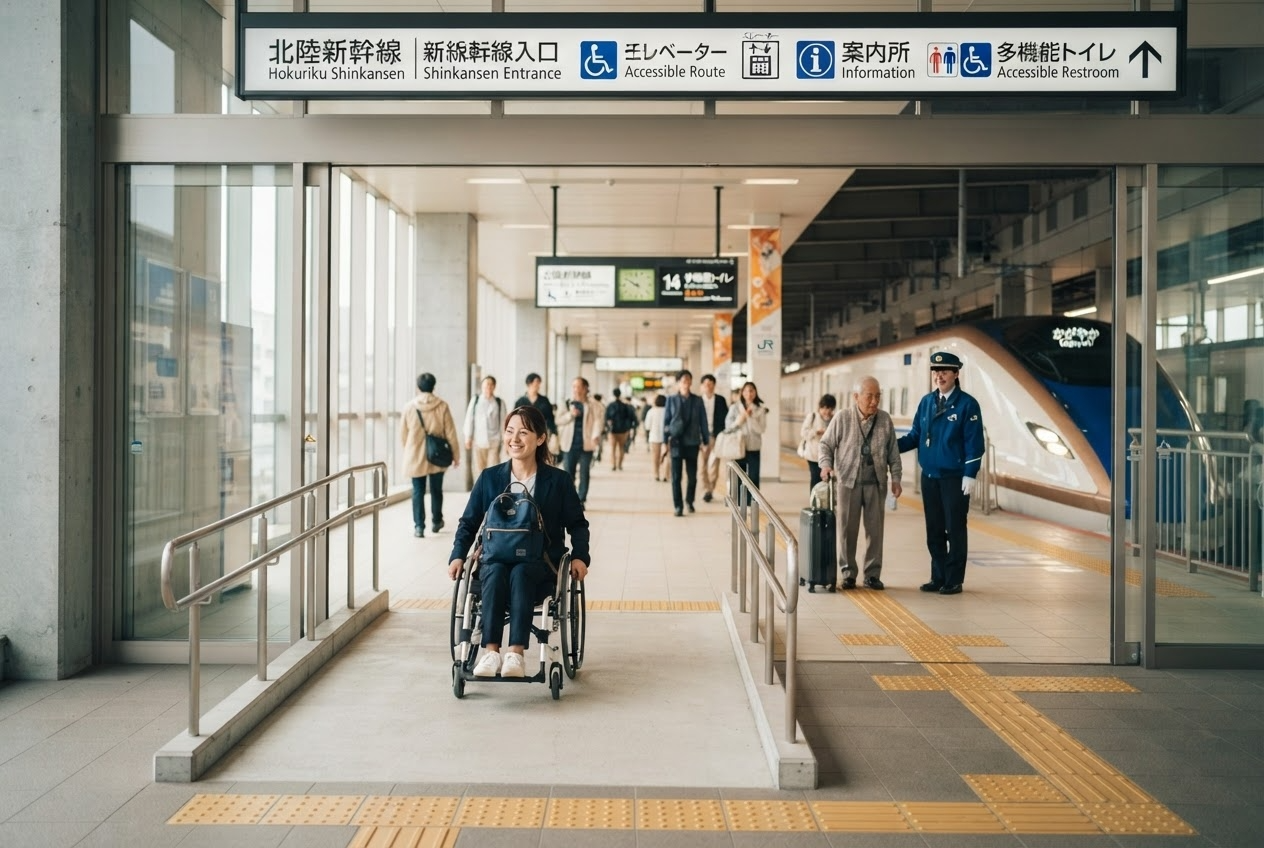
Japan’s accessibility is uneven in a specific and predictable way. The rail network is outstanding — station staff will physically escort you, ramps are produced within a minute, and every Shinkansen has wheelchair spaces. The hundred metres between the station and the restaurant is where it gets hard: narrow pavements, entrance steps, and upstairs rooms in buildings with no lift.
Plan around that pattern and Japan is very manageable. This guide covers wheelchair users, travellers with limited walking range, families with buggies, and anyone moving with heavy luggage — the practical problems overlap more than they differ.
At a glance
- Trains
- Excellent. Staff assistance is free, reliable and does not need booking on most lines.
- Shinkansen
- Wheelchair spaces on every train. Book in advance for the dedicated seats.
- Stations
- Almost all major stations are step-free. Small rural ones often are not.
- Restaurants
- The weak point. Many are up or down stairs with no alternative.
- Toilets
- Very good. Multi-purpose accessible toilets are common and well signed.
- Ask for help
- Go to the staffed gate. This is a normal, everyday request.
Trains: how assistance actually works
This is the part Japan does better than almost any country, and it is worth understanding because it removes most of the anxiety.
Go to the staffed window beside the ticket gates
Every station of any size has one. Say your destination station name.
Staff will confirm the train and call ahead
They telephone the destination station so somebody meets you there. This happens automatically.
A member of staff escorts you to the platform
Using the lift route, which is often not the obvious route.
They lay a ramp at the door and note your car number
Portable ramps live on every platform. Boarding takes under a minute.
Staff meet you at the other end
With a ramp, at the right door, usually before the train has stopped.
No booking is needed on ordinary lines — walk up and ask. Allow fifteen or twenty minutes at a large station. For Shinkansen wheelchair spaces, book in advance.
Asking for help
The Shinkansen
Every Shinkansen has designated wheelchair spaces. Since 2021 the Tokaido, Sanyo and Kyushu lines have offered larger multi-purpose spaces on newer sets, bookable through JR ticket offices and by phone.
Book these in advance — there are only a handful per train. A JR ticket office (Midori no Madoguchi) will arrange the seat, the assistance at both ends, and the ramp.
Ordinary reserved seats also work if you can transfer, with the wheelchair stored in the space behind the last row.
Stations: what to expect
Major city stations — Tokyo, Shinjuku, Kyoto, Osaka, Nagoya, Hakata — are step-free throughout, with lifts to every platform and multi-purpose toilets. The lift route can be long and indirect, so allow time.
Suburban and mid-sized stations are usually step-free but sometimes with a single lift serving one exit only.
Small rural stations frequently have a footbridge with stairs and no alternative. This is the thing to check station by station rather than assume.
Every station’s facilities are listed on the operating company’s website, and Google Maps flags step-free routing when you enable the accessibility option in transit settings.
Buggies and small children
Most of the above applies. Two Japan-specific points:
Folding is expected on crowded trains. At rush hour on urban lines, a buggy is genuinely difficult and the social pressure is real. Travel between 10am and 4pm.
Nursing rooms are excellent. Department stores, station buildings and shopping centres have dedicated baby rooms with changing tables, nursing booths, hot water for formula and often a microwave. They are well signed and free.
Department stores are your friend generally: lifts, clean toilets, baby facilities, and a restaurant floor with space.
Where it gets hard
Restaurants. The single biggest limitation. A great many good Japanese restaurants are on the second floor of a narrow building, or down a flight of stairs, with no lift. Many have a small step at the door and a raised tatami platform inside.
What works: department store restaurant floors, station building restaurants, hotel restaurants, chain restaurants, and anything in a modern shopping complex. All are step-free and none are a compromise on food quality in Japan.
Older streets. Kyoto’s Gion, Takayama’s old town and similar preserved districts have uneven stone paving and narrow pavements without dropped kerbs.
Temples and shrines. Highly variable. Major sites — Senso-ji, Todai-ji, Kiyomizu-dera’s main hall — have ramps or lift access to at least part of the complex. Mountain temples and anything reached by a long stone stairway do not.
Ryokan. Traditional inns often have steps at the entrance, futons on the floor, and deep baths. Some have accessible rooms and private baths — ask specifically, in advance, rather than assuming.
Accommodation
Search for バリアフリー (barrier-free) alongside “accessible” — Japanese booking sites use the former.
International chains and newer Japanese hotels have accessible rooms with roll-in showers. Business hotels are usually step-free to the room but have compact unit bathrooms with a lip at the shower.
Ask specifically about: door widths, bathroom threshold height, whether the bed is fixed, and whether the entrance has a step.
Luggage — the same problem, a different cause
Everything above applies to anyone hauling a large suitcase, and the solution is the same one Japanese travellers use: do not haul it.
Forward your case hotel to hotel by takkyubin for about 2,000 JPY and move with a day bag. This turns most of the station-stairs problem into a non-problem.
→ Luggage in Japan: coin lockers, takkyubin and oversized baggage rules
Equipment and hire
- Wheelchair hire is available in major cities and at some airports; several companies rent electric chairs and mobility scooters to visitors.
- Free wheelchair loan is offered at most large stations, department stores, museums and major temples — ask at the information desk.
- Accessible taxis exist in cities, including the widely used JPN Taxi model with a ramp. Book by phone or through a hotel rather than hailing.
Toilets
Genuinely good news. Japan’s multi-purpose toilets (多目的トイレ) are common in stations, department stores, convenience stores and public buildings. They are spacious, clean, free, and typically include a changing table, an ostomate facility and grab rails.
They are well signed in English and marked on Google Maps.
Questions people actually ask
Do I need to book station assistance in advance?
Not for ordinary trains — walk up to the staffed gate and ask, allowing fifteen to twenty minutes. For Shinkansen wheelchair spaces, book ahead at a JR ticket office.
Is Kyoto manageable in a wheelchair?
The city and its transport are; some of its most famous sites are not. Kiyomizu-dera involves a long uphill approach, and parts of Gion have uneven paving. Nijo Castle, Toji and the Imperial Palace grounds are much more accessible.
Are buses accessible?
City buses are almost all low-floor with a ramp the driver deploys. Rural and community buses often are not.
What about the language barrier when asking for help?
Station staff deal with assistance requests constantly and the process is largely non-verbal — pointing at your destination on a map works. Assistance is a routine, expected request rather than an imposition.
Can I bring my own mobility scooter?
Yes. Airlines have their own battery rules for lithium batteries, so check with the carrier well in advance. On trains it is treated the same as a wheelchair.
Is there an accessible way to see Mount Fuji?
Yes — the Fuji Five Lakes area, the Hakone ropeway and the Shinkansen itself all give views without any climbing. The mountain trails themselves are not accessible.
Keep planning

Japan with Children: What Works, and What to Skip
Japan is one of the easiest countries in the world to travel with children, with two exceptions: hotel rooms are sized for…
Where to Stay in Kyoto: The Five Areas, and the New Lodging Tax
Kyoto is a city you see before nine in the morning, which makes where you sleep matter more than it does in…
Where to Stay in Tokyo: Which Area, and What a Night Costs
In Tokyo you are not choosing a neighbourhood so much as a station. Six areas that work for a first trip, what…