Where to Stay in Japan: Hotel, Ryokan, Business Hotel or Minpaku
Six kinds of Japanese accommodation, what each actually costs, and why the cheapest chain hotels are better than the international brands at twice the price. Plus the one night worth spending real money on.
 Signpost Japan
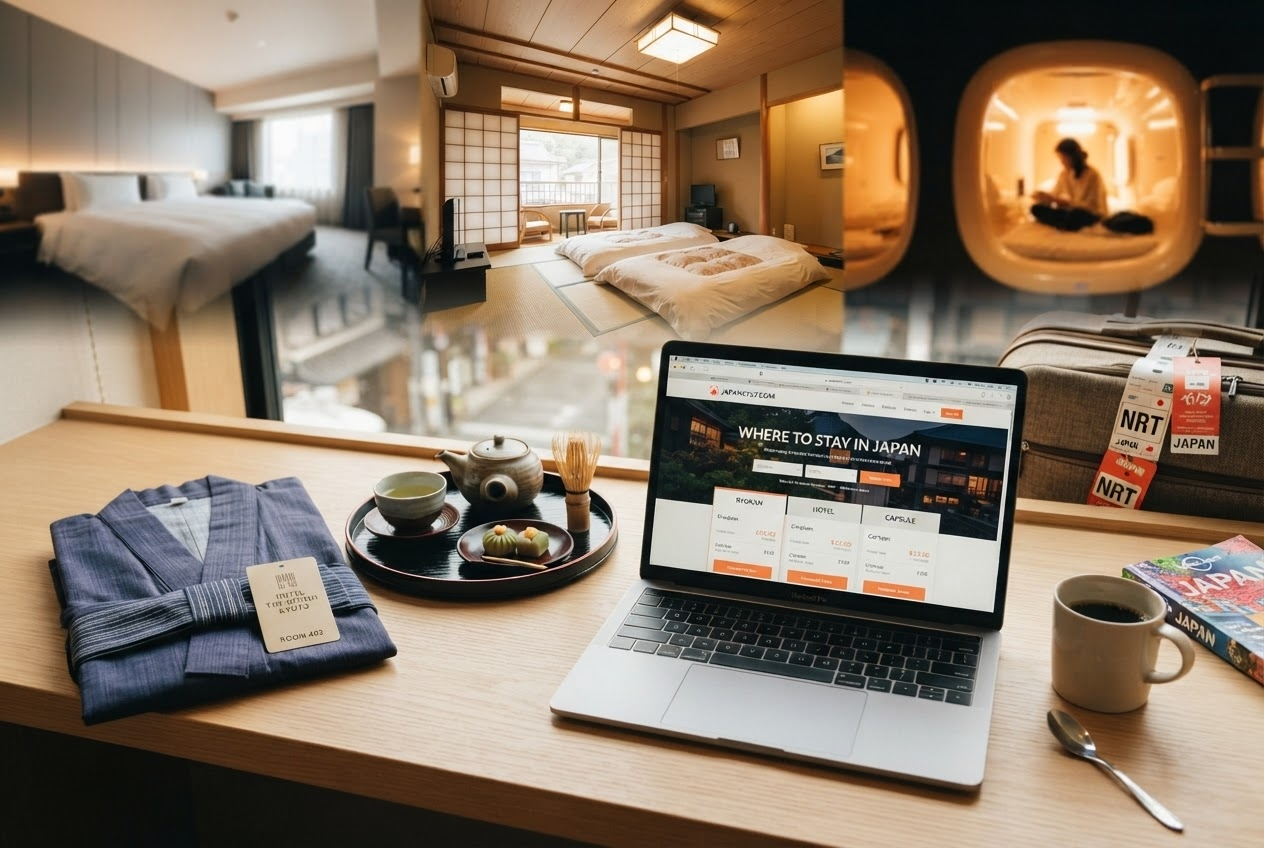
Japanese accommodation is unusually stratified. There is no gentle slope from budget to luxury — instead there are six distinct kinds of place, each with its own logic, and the price differences between them are less informative than the differences in what they are for.
Get the mix right and you will sleep better and spend less than someone booking four nights of the same international chain.
At a glance
- Business hotel
- 7,000–13,000 JPY. Small, spotless, central. The workhorse.
- Ryokan
- 20,000–60,000 JPY per person with dinner and breakfast. An experience, not a bed.
- Hostel
- 3,000–5,000 JPY a dorm bed. Japanese hostels are exceptionally good.
- Minpaku / apartment
- 10,000–20,000 JPY. Kitchen and washing machine. Good for families.
- Capsule
- 3,500–6,000 JPY. Better than it sounds. Usually single-sex floors.
- Book ahead
- 2–3 months for spring and autumn. Everything else can wait.
Business hotels — the right default
Toyoko Inn, APA, Route Inn, Dormy Inn, Super Hotel, Richmond. These are Japan’s great unsung travel infrastructure: small, immaculately clean, always within a few minutes of a station, and roughly half the price of an international chain in the same district.
A single room is about 12 square metres, with a compact unit bathroom, a desk, blackout curtains, a kettle, and everything within reach of the bed. It is engineered rather than decorated, and after a day of walking that is exactly right.
Dormy Inn deserves a specific recommendation. Most branches have a large communal bath on the top floor, free late-night ramen, and a coin laundry. For a walking trip, a hot bath at the end of the day is worth more than an extra two square metres.
Ryokan — spend money here, once
A ryokan is a traditional inn, and it is not a room — it is an evening. You arrive in the afternoon, change into a yukata, bathe in the onsen, and eat a multi-course kaiseki dinner served in your room or a dining room at a set time. Breakfast is Japanese and substantial. You leave by ten.
The price is quoted per person including both meals, which makes it look shocking next to a hotel room rate. It is not comparing like with like: dinner alone would cost 8,000–15,000 JPY.
One or two nights in a fortnight is the right amount. More and the fixed schedule starts to constrain your days; fewer and you have missed one of the genuinely distinctive things Japan offers.
Where: Hakone, Kinosaki, Kusatsu, Nyuto, Kurokawa, Yufuin, Gero — onsen towns, not cities.
→ Staying in a ryokan: what actually happens, hour by hour
Hostels — better than you expect
Japanese hostels are among the best in the world: clean, quiet, well designed, and used by Japanese travellers as well as foreign ones. Dorm beds are typically capsule-style with a curtain, a light, a socket and a shelf, rather than an open bunk.
Many have excellent common areas and cafés, and a growing number are conversions of interesting old buildings. Private rooms in hostels often undercut business hotels.
The trade-off is the same as anywhere — noise, shared bathrooms — but the floor is quieter than you are used to. Japanese hostel etiquette is strict about it.
Minpaku and apartments
Licensed short-term rentals. The 2018 minpaku law requires registration, and legal listings display a licence number — booking an unlicensed one is a genuine risk of arriving to a cancelled reservation.
Worth it for: families, groups, stays over four nights, anyone who wants a kitchen and a washing machine. A two-bedroom apartment for a family beats two hotel rooms on both price and sanity.
The catches: most are unstaffed, so luggage forwarding cannot be delivered and early check-in is impossible; many have strict quiet rules because they sit in ordinary residential blocks; and a 90-day annual operating cap means some listings vanish seasonally.
Capsule hotels
Not the novelty they are presented as. A capsule is a moulded sleeping pod with a mattress, light, socket and screen, in a room of thirty or forty of them, with lockers and a shared bath.
They are cheap, extremely clean, and the standard answer to missing the last train. Most are single-sex or have separate women’s floors — check before turning up. Newer “luxury capsule” chains blur the line with hostels and are genuinely comfortable.
Not suitable if you have a large suitcase, or if you need to get into your bag at 3am.
Temple lodging — shukubo
Staying in a working temple. Koyasan in Wakayama is the place to do it: fifty-odd temples take guests, serve shojin ryori Buddhist vegetarian cuisine, and invite you to the morning service at six.
It is not luxurious — thin walls, futons, shared bathrooms, early nights — and it is one of the more memorable nights available in Japan.
→ Wakayama: Koyasan and the Kumano Kodo
What things cost
| Type | Per night | Includes |
|---|---|---|
| Hostel dorm | 3,000–5,000 JPY | Bed, shared bath |
| Capsule | 3,500–6,000 JPY | Pod, shared bath, lockers |
| Business hotel single | 7,000–13,000 JPY | Room, unit bath, sometimes breakfast |
| Business hotel twin | 11,000–18,000 JPY | As above |
| Minpaku apartment | 10,000–20,000 JPY | Kitchen, washing machine |
| Mid-range ryokan | 20,000–35,000 JPY pp | Room, onsen, dinner, breakfast |
| High-end ryokan | 40,000–80,000 JPY pp | As above, private bath, kaiseki |
| International 4–5 star | 30,000–80,000 JPY | Room only |
How to book
- Business hotels: the chain’s own site, then Booking.com or Agoda.
- Ryokan: Japanese sites — Jalan, Rakuten Travel — have far more inventory than international ones, and machine translation handles them. Many good ryokan simply are not listed abroad.
- Hostels: Hostelworld and Booking.com both work well.
- Minpaku: Airbnb, checking for a licence number in the listing.
Book two to three months ahead for spring and autumn, and further for late November in Kyoto. Outside those windows, two to three weeks is plenty.
Choosing a location
More important than the property. In Japanese cities, the station is the unit of geography — you want to be within a five-minute walk of one on a line that goes where you are going.
- Tokyo: anywhere on or just inside the Yamanote loop. Ueno, Asakusa and Ikebukuro are cheaper; Shinjuku and Shibuya are convenient and loud; Ginza and Nihonbashi are quiet in the evening.
- Kyoto: near Kyoto Station for transport, or Karasuma/Shijo for atmosphere and walking. Gion is beautiful and expensive.
- Osaka: Namba for food and nightlife, Umeda for transport.
What is included
Nearly always: yukata or pyjamas, toothbrush, razor, shampoo, conditioner, body wash, towels, hairdryer, kettle, slippers. You do not need to pack toiletries.
Often: a coin laundry on an upper floor, a communal bath, free late-night noodles at Dormy Inn.
Rarely in business hotels: a room large enough to open two suitcases at once.
Questions people actually ask
Are Japanese hotel rooms really that small?
Business hotel singles are about 12 square metres and it is less of a problem than it sounds, because everything is designed for the space. If you need room to spread out, book a twin for one person — many chains price it barely higher.
Can I stay in a ryokan with tattoos?
Private-bath ryokan, always. Communal baths vary — many now allow tattoos or provide cover stickers, but some still refuse. Ask when booking rather than on arrival.
Do hotels have twin beds or doubles?
Both, but Japanese “double” rooms are often quite small and “semi-double” means a bed narrower than a standard double. Read the bed size in centimetres rather than the room name.
Is Airbnb legal in Japan?
Licensed short-term rentals are legal and display a registration number. Unlicensed listings exist and are periodically removed, sometimes cancelling bookings at short notice. Check for the number.
Can I leave luggage before check-in?
At any staffed hotel, yes, free, and after check-out too. Unstaffed apartments cannot, which is a real argument for hotels on travel days.
Are there family rooms?
Business hotels rarely sleep more than three. For families, look at minpaku apartments, Japanese-style rooms with futons laid out on tatami, or hotels that advertise 和室 (washitsu).
Keep planning
Japan with Children: What Works, and What to Skip
Japan is one of the easiest countries in the world to travel with children, with two exceptions: hotel rooms are sized for…
Where to Stay in Kyoto: The Five Areas, and the New Lodging Tax
Kyoto is a city you see before nine in the morning, which makes where you sleep matter more than it does in…
Where to Stay in Tokyo: Which Area, and What a Night Costs
In Tokyo you are not choosing a neighbourhood so much as a station. Six areas that work for a first trip, what…