Halal, Allergies and Dietary Needs in Japan
Japan's allergen labelling law is stricter than most countries and its restaurant culture is far less prepared. What is legally disclosed, what is not, and how to eat halal, gluten-free or allergen-safe with confidence.
 Signpost Japan
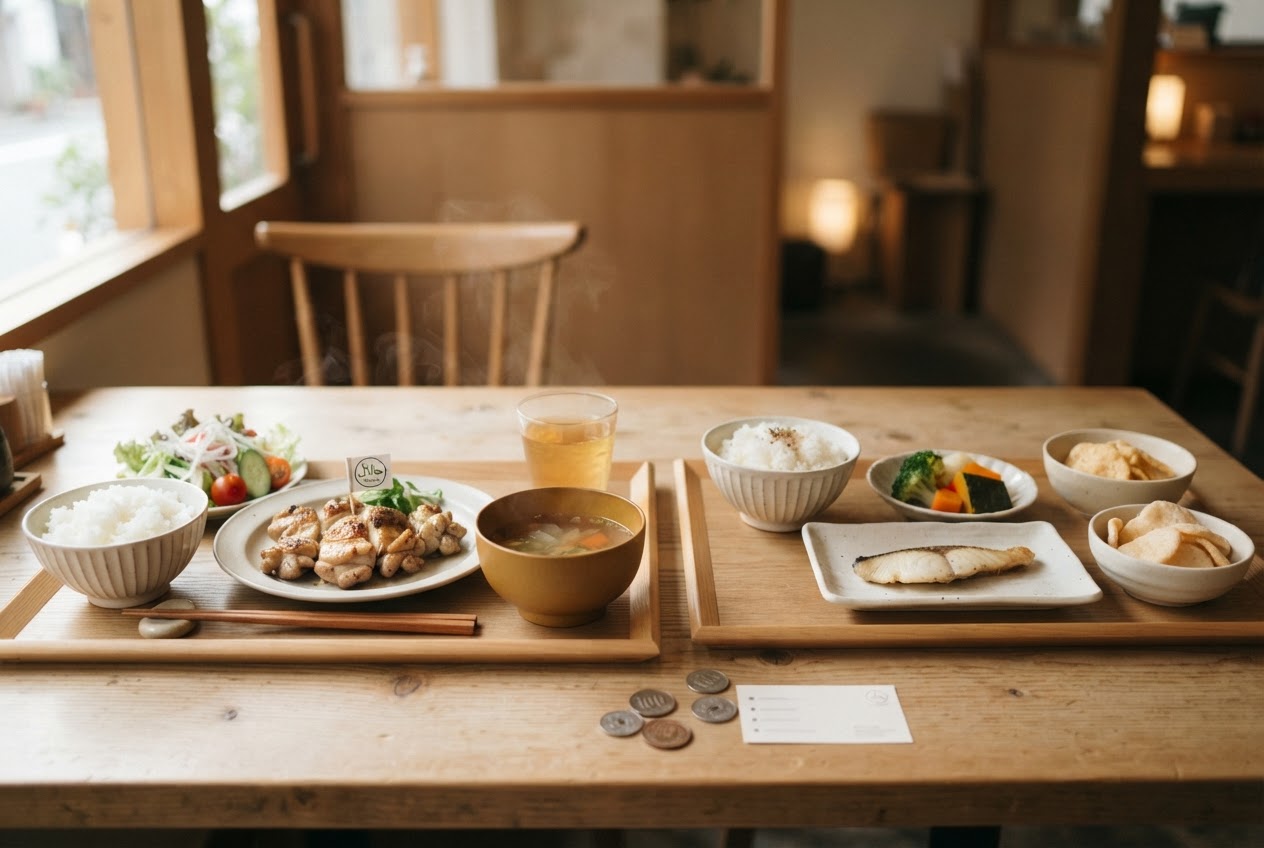
Japan handles dietary requirements in two very different ways depending on whether the food came out of a factory or a kitchen.
Packaged food is well regulated. Eight allergens must be declared by law and a further twenty are recommended, with clear labelling.
Restaurant food is not. There is no legal requirement to disclose allergens on a menu, staff are often unsure, and cross-contamination is not a concept most small kitchens work with.
That gap is the whole problem, and it is manageable if you know where it is.
At a glance
- Legally labelled
- Shrimp, crab, walnut, wheat, buckwheat, egg, milk, peanut — on packaged food
- Not required
- Any disclosure in restaurants
- Halal
- Growing fast. Certified restaurants in all major cities; prayer rooms in airports and malls.
- Gluten-free
- Hard. Soy sauce contains wheat.
- Essential
- A printed Japanese card, and a translation app for labels
- Emergency
- 119 for an ambulance. Carry your adrenaline auto-injector.
Allergies
What the law covers
Japan requires the declaration of eight specified allergens on packaged food: shrimp, crab, walnut, wheat, buckwheat, egg, milk and peanut. A further twenty ingredients — including soy, sesame, cashew, mackerel, salmon, beef, pork, chicken, squid, gelatine and others — are recommended and usually declared in practice.
Buckwheat (soba) is on the mandatory list because soba allergy is relatively common and severe in Japan, and it is taken seriously.
What it does not cover
Restaurants. There is no obligation to disclose, few kitchens track cross-contamination, and a fryer used for prawn tempura will also fry vegetables.
Chain restaurants are the exception: most large chains publish full allergen charts, often as a QR code on the menu or a laminated sheet at the counter. Ask for the arerugii hyou (allergen chart).
The card
Carry a printed Japanese card. Wording that works:
食物アレルギーがあります。〇〇を食べると命に関わります。少量でも危険です。 Shokumotsu arerugii ga arimasu. ○○ o taberu to inochi ni kakawarimasu. Shouryou demo kiken desu. I have a food allergy. Eating ○○ is life-threatening for me. Even a small amount is dangerous.
Naming the consequence matters. “I cannot eat X” is heard as a preference; “this is life-threatening” is heard correctly.
Allergies
Common allergens in Japanese food
| Allergen | Where it hides |
|---|---|
| Wheat | Soy sauce, miso, most sauces, tempura batter, ramen |
| Egg | Tamagoyaki, mayonnaise, batter, many desserts, some noodles |
| Milk | Bread, sauces, curry roux, desserts |
| Shellfish | Dashi variants, snacks, sauces, fried food shared oil |
| Buckwheat | Soba, and shared boiling water in noodle shops |
| Peanut/nuts | Less common in Japanese cooking than in Chinese or Thai |
| Sesame | Very common — dressings, goma-dofu, breads, sauces |
Sesame deserves particular attention: it is not on the mandatory list and it is used constantly.
Halal
Japan’s halal infrastructure has expanded substantially over the last decade, driven by visitors from Indonesia and Malaysia.
Certified restaurants exist in Tokyo, Osaka, Kyoto, Nagoya, Fukuoka and Sapporo — Japanese cuisine as well as Turkish, Indonesian, Indian and Middle Eastern. Certification bodies include the Japan Halal Association and the Japan Muslim Association; look for their marks rather than a self-declared sign.
Muslim-friendly is a separate and weaker claim, generally meaning no pork and no alcohol in the food but not certified. Many restaurants use it in good faith; ask what it means for that specific kitchen.
Prayer rooms are now common: Narita, Haneda, Kansai, Chubu and Fukuoka airports all have them, as do many large department stores, shopping centres and some train stations. The Japan Halal directory and several apps map them.
Mosques — Tokyo Camii in Yoyogi-Uehara is the largest in Japan and worth visiting regardless of faith; Kobe Mosque, built in 1935, survived both the 1945 bombing and the 1995 earthquake.
The specific difficulties:
- Mirin and cooking sake are in a great deal of Japanese cooking, including dishes with no other alcohol.
- Pork gelatine and pork extract appear in sweets, ramen broths and snacks.
- Shared fryers and grills.
- Dashi is fish-based, which is generally acceptable, but confirm.
Self-catering, halal supermarkets (there are several in Tokyo and Osaka), and seafood-based Japanese meals are the practical fallbacks.
Gluten-free
This is the hardest requirement in Japan, and it is worth being blunt about it.
Soy sauce contains wheat. Standard Japanese shoyu is brewed from soybeans and wheat in roughly equal parts, which means soy sauce is in nearly everything savoury and nearly all of it contains gluten.
What helps:
- Tamari — a wheat-free soy sauce, available in supermarkets and health shops. Carry a small bottle.
- Rice, sashimi, grilled fish and meat without sauce, plain onigiri, most rice-based dishes.
- 100% buckwheat soba (juwari soba) — most soba is cut with wheat flour, but pure buckwheat exists and is labelled 十割.
- Dedicated gluten-free restaurants in Tokyo and Kyoto, findable through celiac travel resources.
The awareness level is low. Guruten furii is understood by few; explaining “wheat allergy” (小麦アレルギー, komugi arerugii) is far more effective, because wheat is a legally recognised allergen and staff take it seriously.
Other requirements
Kosher — very limited. Chabad houses in Tokyo and Kyoto provide meals and are the practical route.
Nut-free — comparatively easy. Nuts are much less used in Japanese cooking than in other Asian cuisines.
Lactose intolerance — easy. Traditional Japanese cooking uses almost no dairy.
Diabetes and low-carb — challenging, as rice and noodles are the base of nearly every meal. Grilled fish, meat, tofu and vegetable dishes at izakaya work well.
Telling accommodation in advance
The single most important practical step for anyone with a serious requirement.
Ryokan prepare kaiseki in advance and cannot adapt on the night. Tell them at the point of booking, in writing, with specifics. Most will accommodate; some will decline, which is the honest response.
Hotels with buffets usually label allergens on the dishes and can advise.
Tours and cooking classes need the same notice.
Questions people actually ask
Is packaged food labelling reliable?
Yes. The eight mandatory allergens must be declared and the additional twenty almost always are. Use a translation app’s camera on the ingredients panel.
Will restaurants take my allergy seriously?
They will try. The limitation is knowledge and kitchen practice rather than willingness — small kitchens genuinely may not know whether a sauce contains wheat.
Is halal food easy to find?
In the major cities, yes, with certified restaurants and prayer rooms. In rural Japan, plan around self-catering and seafood.
Can I bring my own food?
Yes, with the exception of meat products, which are prohibited at the border. Packaged snacks and specialist products for dietary needs are fine.
What if I need an ambulance?
Dial 119. Operators can connect to English support, though there may be a short delay. Carry a card in Japanese stating your condition and medication.
Should I get travel insurance?
Yes. Japanese healthcare is excellent and expensive for non-residents, and an allergic reaction can mean an ambulance and an overnight stay.
Keep planning
Drinking in Japan: Sake, Shochu, Highballs and Where to Try Them
How to read a sake label, why everyone is drinking whisky and soda, and the difference between a standing bar and a…
Sushi, Ramen, Udon, Soba: What to Eat Where
Six things worth eating properly at least once, what separates a good version from a bad one, and roughly what each should…
Izakaya Etiquette: How a Japanese Night Out Actually Works
The small dish you did not order, the rule about pouring your own drink, and why everyone orders a beer first. An…