How to Order in a Japanese Restaurant Without Japanese
Ticket machines, plastic food, counters with no menu at all, and the six phrases that cover every restaurant in the country. Eating well in Japan is a mechanics problem, not a language problem.
 Signpost Japan
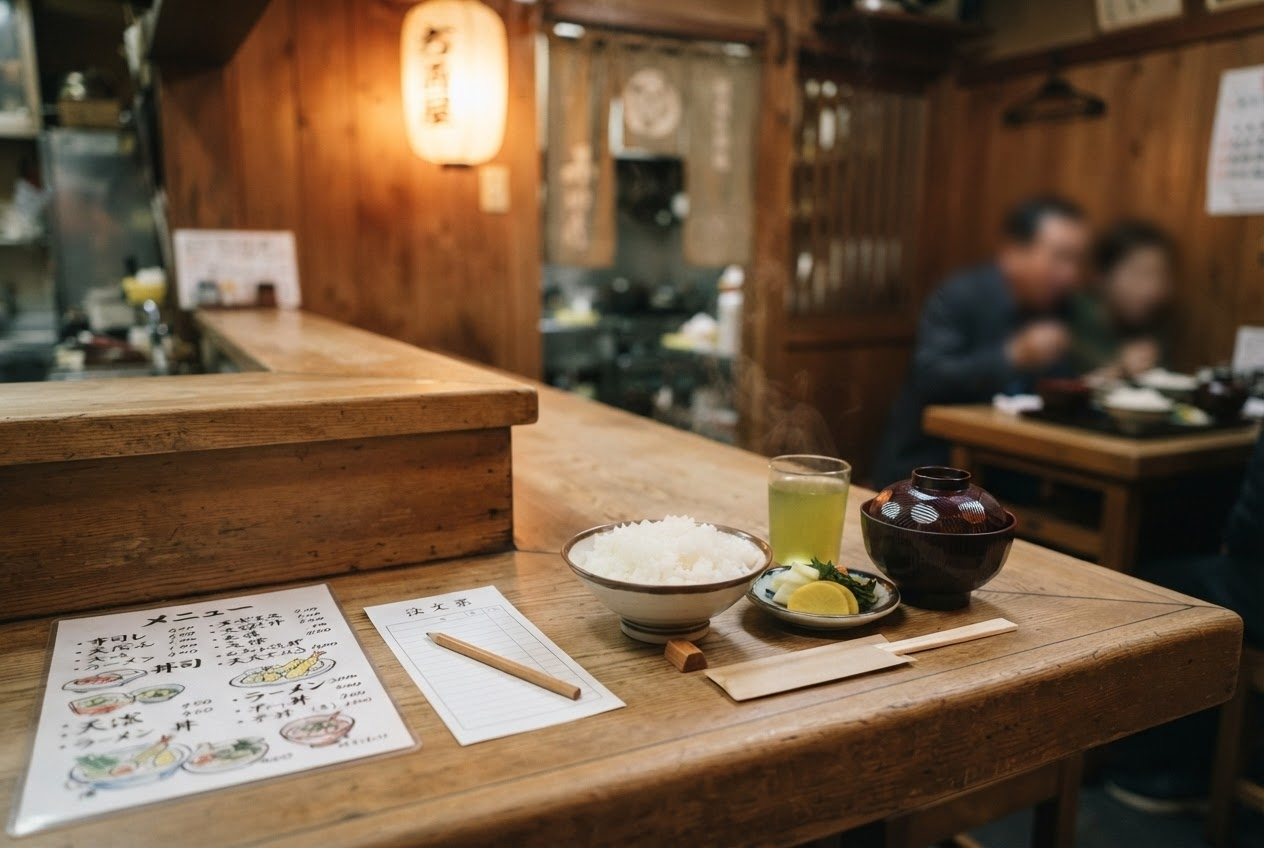
The food in Japan is not the hard part. The hard part is the doorway: a small restaurant with a curtain over the entrance, no English sign, no visible menu, and six seats. Almost everyone walks past those places for their first three days and eats at chains instead.
You do not need Japanese to eat in them. You need to know how the systems work, and there are only about five of them.
At a glance
- The universal phrase
- Sumimasen — excuse me, sorry, thank you. It opens every interaction.
- Ticket machines
- Press a picture, take the ticket, hand it over. No talking at all.
- Plastic food
- The window display is the menu. Take a photograph and point.
- Tipping
- Never, anywhere
- Paying
- At the till on the way out, not at the table
- Splitting the bill
- Often not done in small places. Pay together and settle later.
The five kinds of restaurant, and how each works
1. The ticket machine shop
Common for ramen, gyudon, curry and soba. A vending machine stands just inside the door.
Look for an English button
Newer machines have one, top corner. If not, the top-left button is almost always the shop’s main dish.
Put the money in first
Most machines will not let you press anything until you have paid. Notes and coins; newer ones take IC cards.
Press the picture
Add a topping button if you want one. The machine prints a ticket.
Take your change and sit down
Put the ticket on the counter in front of you. Staff will collect it.
Eat, and leave
You have already paid. Say gochisousama deshita on the way out.
This is the easiest system in the world for a foreign visitor: no conversation is required at any point.
2. The plastic food window
Restaurants with a display case of extremely realistic plastic models outside — sampuru, an industry that has existed since the 1930s.
The models are the menu, with prices. If you cannot read anything inside, photograph the model you want and show it to the staff. This is completely normal and nobody will find it odd.
3. The photo menu
Most family restaurants, izakaya and casual places. Point at the picture. Many now have tablets with an English setting — ask for it: Eigo no menyuu wa arimasu ka?
4. The counter with no menu
The intimidating one: eight seats, a chef, and a wall of handwritten paper strips. These are often the best restaurants in Japan.
Two approaches that work:
- Omakase — say it, and the chef chooses. It means “I leave it to you”. Ask the price range first if that matters: Ikura gurai desu ka?
- Point at what someone else has. Entirely acceptable, and often welcomed.
5. Reservation-only
High-end sushi, kaiseki and anything with a Michelin star. Many will not take foreign bookings directly; your hotel concierge can call, and some require an introduction. Book weeks or months ahead.
The six phrases
Everything you need in a restaurant
Sumimasen does an enormous amount of work. Say it to get attention, to apologise, and to thank someone. If you learn one word, learn this one.
What happens when you walk in
“Irasshaimase!” — shouted by everyone. It means welcome. No response is required. People spend their first week in Japan trying to answer this; you just walk in.
Then: “Nanmei-sama desu ka?” — how many people? Hold up fingers.
You may be asked counter or table (kauntaa or teeburu), and in some places smoking or non-smoking, though indoor smoking has been heavily restricted since 2020.
Things that are different
Water and tea are free and automatic. A glass of iced water or a cup of tea arrives without being ordered and is refilled without charge. You do not tip for it.
The wet towel. Oshibori, hot or cold, for your hands. Not your face — though older Japanese men do exactly that, and nobody minds.
Call the staff. Japanese restaurants do not have a waiter hovering. Say sumimasen clearly across the room, or press the buzzer on the table. Waiting quietly to be noticed can take a very long time.
Pay at the till. Take the slip from your table to the register by the door. Payment at the table is rare.
The money tray. Put cash in the small tray rather than in the cashier’s hand.
Otoshi. At izakaya, a small dish you did not order may arrive with your first drink, and 300–500 JPY will be on the bill. It is a cover charge, not a scam.
Chopstick rules that matter
Most chopstick etiquette is over-explained. Two things genuinely matter, because both resemble funeral rites:
- Do not stand chopsticks upright in rice.
- Do not pass food chopstick to chopstick.
Everything else — rubbing disposable chopsticks together, resting them on the bowl — is minor. Nobody expects perfect technique from a visitor.
Slurping, and other permissions
Slurping noodles is fine, and for hot ramen and soba it genuinely helps by cooling the noodle as it goes in. You do not have to.
Lifting your bowl to your mouth is correct for rice and soup. Soup is drunk from the bowl; the spoon is for the solids.
Eating quickly is polite at a counter. A ramen shop with a queue expects you to take fifteen minutes, not fifty.
Not finishing is mildly awkward but not a crisis. Say gochisousama anyway.
Finding good places
- Queues are reliable. Japanese people queue for food that is worth queueing for, and they do not queue long for anything else.
- Tabelog is the domestic review site. Its scoring is harsh — anything above 3.5 is genuinely good, above 3.8 is exceptional.
- Department store restaurant floors — usually the top two floors — are consistently good and always have picture menus.
- Station buildings have entire restaurant levels, and standards are high.
- Avoid the street with the touts. Japan mostly does not have touts; where it does, ignore them.
Questions people actually ask
Will restaurants refuse foreign customers?
Very rarely, and it is usually about capacity or a lack of any shared language rather than hostility. A handful of high-end places take bookings only through introductions. If a place is genuinely full, you will be told politely.
Can I use a card?
In chains, hotels and city restaurants, usually. In small independents, often not. Ask before sitting: Kaado wa tsukaemasu ka?
Is it rude to eat alone?
No — Japan is the best country in the world for eating alone. Counters, single seats and solo booths are standard, and nobody will look at you.
How do I ask for something without an ingredient?
Say the ingredient and nuki de — “without”. Niku nuki de is without meat. For allergies, carry a written card; verbal requests are unreliable.
Should I book restaurants in advance?
Only high-end places. Everywhere else, walk in and expect to queue at the good ones. Popular ramen shops at 12:30pm will have a line.
What do I do if I do not like something?
Eat what you can and leave the rest quietly. Sending food back is essentially unheard of and would cause real distress.
Keep planning
Drinking in Japan: Sake, Shochu, Highballs and Where to Try Them
How to read a sake label, why everyone is drinking whisky and soda, and the difference between a standing bar and a…
Sushi, Ramen, Udon, Soba: What to Eat Where
Six things worth eating properly at least once, what separates a good version from a bad one, and roughly what each should…
Izakaya Etiquette: How a Japanese Night Out Actually Works
The small dish you did not order, the rule about pouring your own drink, and why everyone orders a beer first. An…